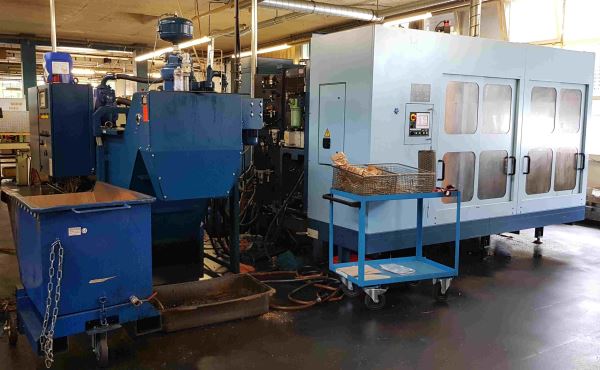
Smart Buyer’s Guide: How to Choose the Right Pre-Owned, Used, Secondhand, Surplus CNC Equipment Before Purchasing Matsuura H-Plus 300 PCII CNC Horizontal Machining Center made in Japan
Here’s a Smart Buyer’s Guide for evaluating a pre-owned / used / surplus Matsuura H-Plus 300 PCII (or H.Plus-300 / horizontal machining center) (or closely related variant). Because this is a high-capability horizontal / palletized machining center with automation features (pallet changers, tool magazines, etc.), your inspection and decision process must be quite rigorous. Below is a structured framework: reference specs, what to inspect, functional tests, risk factors, negotiation safeguards, and red flags.
1. Reference Specs & Baseline Expectations
Before you go onsite, know what “healthy / spec” looks like for an H-Plus 300 so you can detect deviations. From Matsuura’s published data:
| Parameter / Feature | Typical / Published Value | Notes / Source |
|---|---|---|
| Work envelope / maximum work size | Ø 530 × H 760 mm (≈ Ø20.86 × 29.9 in) | Standard “maximum work size” spec |
| Loading / pallet capacity | 250 kg (≈ 551 lb) | That is the maximum workpiece + fixture load per pallet |
| Travel (X / Y / Z) | X = 500 mm, Y = 560 mm, Z = 500 mm (i.e. ~19.68 / 22.04 / 19.68 in) | These are the primary axis strokes for the standard model |
| Spindle & Speed | Standard: 15,000 rpm (BT40), optional 20,000 rpm version | The high-speed spindle is an important option to check |
| Rapid traverse / feed rates | Rapid traverse ~ 60,000 mm/min in X/Y/Z (~ 60 m/min) | Good rapid performance is a key capability |
| Tool Magazine / ATC | Standard drum magazine: 60 tools; optional matrix / expanded storage up to 320+ tools | The tool system is a major subsystem |
| Pallet / Automation System | The “PC” versions incorporate pallet change / automation systems (PC5, PC15, etc.) | The automation system (pallet changer, table motion) is critical to validate |
| Thermal compensation / maintenance features | Thermal Meister (axis / spindle thermal displacement compensation) is standard in newer models | A built-in compensation system is a key value differentiator |
| Machine mass / space & utilities | The machine is heavy (e.g. ~8,300 kg for the PC2 variant) Power input ~ 42 kVA (in some spec sheets) | You must ensure your facility can support the mass, footprint, and utilities |
These benchmarks are your reference. A used candidate ideally should be close to these specs (within reasonable wear margins). Large deviations, missing options, or broken features should be scrutinized.
2. Pre-Inspection / Information to Collect Before Onsite Visit
Before you walk into the factory or warehouse, gather as much documentation and background as possible. This helps eliminate bad candidates early and focus your inspection.
Ask the seller for:
- Model, variant, serial number, build year, and configuration options.
– Confirm whether it’s the “PCII” (pallet changer II) or some automation version.
– List of factory options installed (e.g. 20,000 rpm spindle, pallet changer type, tool magazine size). - Operating / runtime data
– Total hours (spindle hours, cutting hours, idle hours).
– Duty cycles (heavy cuts vs finishing). - Maintenance / repair history
– Records of spindle rebuilds, linear guide replacement, gear or drive repairs, pallet changer overhauls.
– Preventive maintenance logs (lubrication, calibrations, alignment). - Modifications / non-OEM retrofits
– Any aftermarket changes (e.g. different control, additional sensors, non-original cables or boards). - Documentation
– Mechanical / electrical / hydraulic / pneumatic schematics, wiring diagrams, parts lists / BOMs.
– Control manuals, software / firmware documentation, parameter backups. - Tooling & spare parts included
– Tool holders, backup spindle parts, spare belts, encoders, control modules, pallets, fixtures. - Photos / video
– Video of machine in operation: pallet change, tool change, spindle running, axis motion.
– Photos of interior cabinets, wiring, underside, mechanical assemblies. - Facility / installation constraints
– Floor capacity, crane / rigging history, utility requirements (power, air, cooling).
– Whether the machine has been moved before, whether it’s still leveled. - Reason for sale / condition
– Why the machine is being sold (upgrade, underutilization, breakdown).
– Whether the machine was functional just before shutdown.
If you see missing or inadequate documentation, unknown modifications, or the seller unable to provide calibration records, treat that as a red flag (discount or avoid).
3. Mechanical & Structural Inspection Checklist
Once on site, you or your inspection team needs to systematically inspect the mechanical, motion, and infrastructure subsystems. Because the H-Plus 300 is a palletized, horizontal center with automation, there are many subsystems to validate.
Here’s a guide:
A. Base, Frame, Structure & Enclosure
- Visually inspect the base, columns, bed, frame castings for cracks, weld repairs, distortions, or damage.
- Check whether the machine sits level; its base and foundation should be stable and without obvious sag, twist, or subsidence.
- Inspect guarding, doors, covers, chip enclosures for missing parts, damage, or modifications.
- Check that rails, slide covers, wipers, scrapers, and chip guards on axes are intact and in good condition.
B. Linear Axes / Guideways / Ball Screws / Bearings
- Visually examine linear guideways and rails (X, Y, Z) for scoring, corrosion, pitting, wear marks.
- Jog axes (X, Y, Z) at slow speeds over full travel; feel for smoothness, binding, irregular friction, stick-slip zones.
- Reverse small moves and use dial indicators to detect backlash on each axis.
- Using a precision straightedge or test bar, check straightness / linearity over select travel lengths.
- Inspect ball screws and nuts for noise, backlash, binding, free play.
- Check couplings between motors and screws for looseness, misalignment, wear.
- Inspect lubrication / oil delivery systems: lines, filters, pumps, reservoir cleanliness, oil condition.
- Verify that way covers and wipers are present and correctly functioning.
C. Spindle & Drive Assembly
- Run the spindle (without load) over its permitted rpm range; listen for bearing noise, vibration, irregularity.
- Mount a precision indicator or test bar and measure radial and axial runout at multiple radii.
- Inspect the spindle interface (taper, bore, tool clamping surfaces) for wear, scratches, damage.
- If any coolant-through-spindle (CTS) or similar features were installed, verify their condition.
- Check that the spindle drive motor, coupling, belts (if any), or transmission are in good shape and aligned.
D. Pallet / Automation / Table / Pallet Changer System
- Exercise the pallet changer (both load/unload and indexing) multiple times. Check for hesitation, misalignment, noise, or vibration.
- Inspect pallet indexing mechanism, locking mechanism, alignment pins or centering features.
- Check table / pallet surfaces for wear, flatness, dings, distortion.
- Inspect the pallet carrier, pallet rails, racks, rollers, guides for wear or play.
- Evaluate any wiring, sensors, or actuation systems associated with pallet changer / automation.
E. Tool Magazine / ATC
- Cycle the tool magazine / ATC through all tools multiple times; verify speed, correct indexing, and no misfeeds.
- Inspect magazine rails, arm/linkage joints, sensors, tool grip mechanisms, etc.
- Under some conditions, test tool load/unload under nominal conditions (if safe).
- Check tool holders, collets, and retention devices for wear, play, or damage.
F. Auxiliary Systems (Coolant, Air, Pneumatic, Hydraulics)
- Inspect coolant tank, pumps, plumbing, filters, and flow. Check for leaks, corrosion, or blockage.
- Inspect compressed air lines, regulators, filters, leakage.
- If hydraulics are used (clamping, actuation), inspect pumps, lines, valves, seals, pressure gauges.
- Check chip conveyor, exhaust / coolant splash systems, and ensure that chip removal paths are clear and functional.
G. Electrical / Control / Cabinet / Wiring
- Open control and drive cabinets; inspect for dust, coolant ingress, corrosion, overheating marks or discoloration.
- Check wiring harnesses, terminal blocks, connectors, shielding, proper labeling, strain relief.
- Inspect servo drives, amplifier modules, power supplies, cooling fans, heat sinks.
- Check that all modules are correctly seated; look for loose boards or signs of repair.
- Examine sensor wiring (encoders, limit switches, probes) for integrity, shielding, and routing.
H. Environmental & Setup Considerations
- Evaluate the environment: floor vibration from nearby heavy machines, temperature stability, drafts, or thermal gradients.
- Check whether the machine has been moved; whether alignment / leveling has already been disturbed.
- Ensure the foundation / anchor points are robust and appropriate for a heavy machining center with pallet systems.
Document all observations, take photographs, and mark any anomalies.
4. Functional & Performance Testing / Validation
No inspection is complete without live tests under power and production-like cycles. Use a test part, gauges, and full cycles to flush out hidden issues.
A. Axis / Motion Tests
- Jog X, Y, Z through full travel at slow / medium / max safe speeds, observing smoothness, no jumps, or stutters.
- Reverse approach to positions to detect hysteresis or backlash errors.
- Cycle axes repeatedly (long motion back & forth) to check for drift, stick zones, or inconsistencies.
B. Spindle / Cutting Tests
- Run spindle at different rpms; listen for bearing noise or vibration, monitor temperature drift.
- Perform light test cuts (milling / facing) on a known block; measure for surface finish, dimensional consistency, chatter.
- Measure the test specimen with precision gauge / calipers and compare with the programmed dimensions to check accuracy.
C. Pallet / Automation / Table Tests
- Run full pallet change cycles with load (if safe); check timing, indexing accuracy, repeat execution.
- Test return to previous pallet position and verify positional repeatability.
- Under machining conditions, perform operations across multiple pallets to check for alignment consistency.
D. Tool Change / ATC Tests
- Cycle tool changes repeatedly, observe indexing errors or time deviations.
- Test tool change under partial load (if possible) and resume operations, measure any offset shifts or position errors.
E. Error / Recovery / Interrupt Tests
- Interrupt machining mid-cycle and resume; check whether the system correctly resumes from the proper position.
- Trigger limit switches or alarms (if safe) and check error handling, fallback behavior, safe state.
- Power off and power back on; check whether homing, referencing, parameters, and memory states are correctly restored.
F. Long-Run / Thermal Drift Test
- Run the machine under load for an extended period (e.g. 30–60 minutes + cycles).
- Re-measure critical features (test block, tool offsets) to detect drift.
- Monitor axis offsets, thermometer / temperature drift, spindle drift, etc.
G. Full Part / Production Simulation Test
- If possible, run a “representative part” program that exercises multi-axis, tooling changes, pallet changes, heavy / light passes.
- Measure finished parts for critical tolerances (diameter, flatness, location, finishing) and compare to design.
- Repeat cycles to identify trends, drift, wear magnification, or failure over multiple runs.
Capture all deviations, offsets, and anomalies in a measurement log for later review.
5. Spare Parts, Control / Software & Support Viability
Even a machine that passes mechanical and functional tests may become worthless if you can’t maintain it or replace failed modules. So you must assess future supportability.
- Ensure you receive all documentation: mechanical / electrical / wiring diagrams, parts lists / BOMs, service / maintenance manuals, control / software manuals, parameter backups.
- Confirm that the CNC / control software (firmware, parameter files, licenses) can be transferred to you.
- Inspect control boards, servo amplifiers, module types: are they modern / supported or obsolete?
- Determine whether key modules / electronics are still made or have aftermarket alternatives.
- Check whether Matsuura (or associated service centers) in your region still support the H-Plus 300 series.
- Investigate the availability of critical spares: spindle bearings, linear guides, ball screws, encoders, couplings, pallet changer parts.
- Check whether calibration / alignment / metrology tooling (test blocks, calibration masters) are available or included.
- Evaluate opportunities (or constraints) for retrofits or upgrades (e.g. replacing old servo drives or control boards).
- Check whether existing consumables or tooling (pallets, fixtures, tool holders, ATC tooling) are standard or custom and whether replacements are available.
A single failed, unreplaceable module (e.g. control board or drive) can render the machine useless in the future.
6. Risk / Cost Budgeting & Decision Logic
When comparing used candidates, evaluate not just the asking price but the total lifecycle cost, hidden risks, and alternative options.
| Risk / Cost Factor | What to Estimate / Ask | Impact on Decision |
|---|---|---|
| Refurbishment / repair cost | Cost to repair spindle, realign, replace worn guideways, fix pallet changer, replace control modules | If those costs reach 20–30 % or more of total budget, risk is high |
| Parts / module obsolescence | Are key electronics or modules discontinued or rare? | If a major module fails later and can’t be replaced, the machine may become dead |
| Calibration / alignment & commissioning cost | Post-transport you’ll need to re-level, calibrate, test, run-in, verify geometry | These “hidden” startup costs are often underestimated |
| Transport / rigging / installation | Crating, shock control, crane, leveling, anchoring, services connection | Underestimating this can blow your budget |
| Downtime / integration / programming | Time needed to debug automation, pallet logic, operator training | Always provide buffer time & cost |
| Drift margin & wear headroom | Even if machine passes now, wear may reduce long-term performance margin | Favor machines with cushion in tolerance before failure |
| Alternative / newer / refurbished options | Total cost (purchase + refurb + downtime) vs acquiring a newer / refurbished machine with warranty | Sometimes higher upfront spending reduces long-term risk and improves ROI |
As a rough rule of thumb, many used machine buyers allocate 20–30 % (or more in high-precision / automation-rich machines) of the purchase price for refurbishment, spare parts, alignment, and contingency.
7. Contract Protections & Acceptance Clauses
Because of the high complexity and risk, your purchase contract should include strong protections.
- Acceptance / Performance Clause: Final payment only after the machine passes your agreed set of mechanical, functional, and dimensional tests in your facility.
- Hold-back / Escrow: Retain a portion of the contract sum until successful commissioning.
- Limited Warranty / Guarantee: Seek warranty (e.g. 30–90 days) on key subsystems (spindle, axes, pallet system, control electronics).
- Spare / Tooling Package Clause: Insist the seller include critical spare modules (drive cards, encoders, pallet parts, tool holders) or discount accordingly.
- Documentation & License Transfer Clause: Ensure full transfer of manuals, schematics, software parameter backups, control licenses.
- Latent Defect / Repair Clause: Define remedies if defects appear after installation (repair, replacement, partial refund).
- Transport / Damage Liability: Clarify which party bears damage risk during shipping, disassembly, reassembly, alignment errors.
These contractual protections help shift some of the risk back to the seller.
8. Red Flags & Deal-Breaker Conditions
Here are conditions you should strongly avoid (or demand heavy discount / repair) when assessing a candidate:
- Spindle runout, vibration, bearing noise significantly beyond tolerance
- Axis binding, stick-slip behavior, large or unusual backlash
- Pallet changer misalignment, hesitation, misindexing, repeatability errors
- Tool magazine / ATC misfeeds, slow indexing, worn magazine components
- Missing or severely damaged wiring, cabinets with corrosion, water ingress or burnt boards
- Control modules / electronics missing or custom-unserviceable
- Absence of documentation, parameter backups, calibration records
- Large drift / inability to hold repeatability in functional tests
- The seller refuses full power-on tests or disables access to internal systems
- Critical subsystems are known to be obsolete without replacement paths
- The selling price is too close to refurbished / newer machines, leaving little margin for surprises