Smart Buyer’s Guide: How to Choose the Right Pre-Owned, Used, Secondhand, Surplus CNC Equipment Before Purchasing Traub TNA 480 CNC Lathe made in Germany
Below is a “smart buyer’s checklist and decision-framework” you can use when considering a pre-owned / secondhand / surplus CNC machine — tailored in particular toward a machine like the Traub TNA 480 (or machines of similar vintage, precision, and complexity). Use it as both a diagnostic checklist and negotiation tool. If you like, I can also turn this into a printable inspection sheet you can take on site.
Why a specialized checklist is needed for a machine like Traub TNA 480
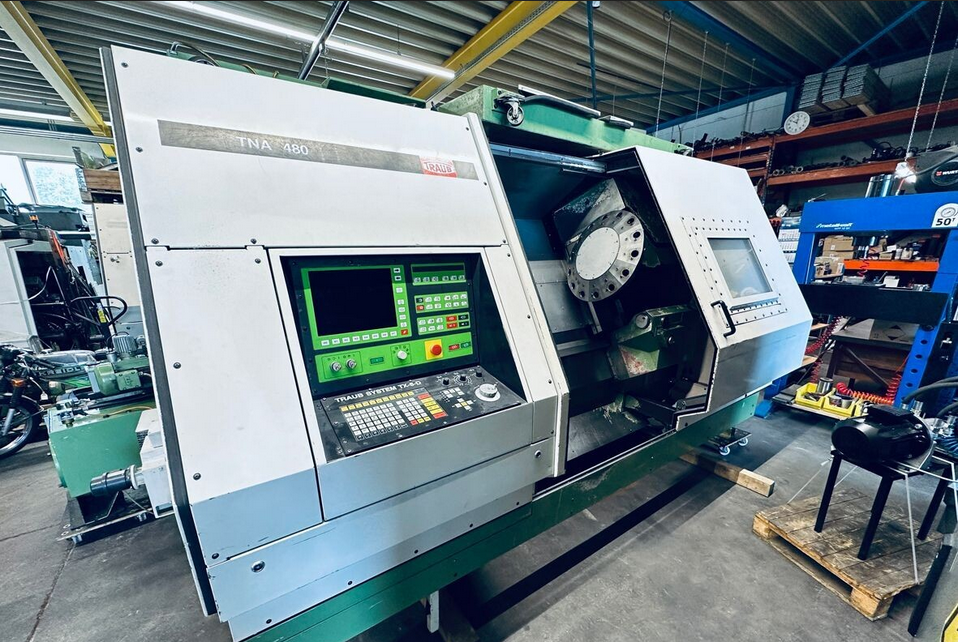
Before diving into the checklist, here are some particulars about the Traub TNA 480 that illustrate what to focus on:
- The model is a CNC universal lathe / turn-mill center (not a simple bench lathe) with relatively high mechanical complexity (spindles, turrets, possibly milling, C-axis, etc.).
- Typical specs (depending on variant) include: ~ spindle bore ~ 80 mm max swing diameter over bed ~360–400 mm, turning length ~1,000 mm (in some configurations) , power levels in the 20–30 kW range, multiple tool positions, etc.
- Because these machines are not “commodity,” replacement parts, control electronics, and service support may be more limited than for mainstream brands.
Thus, small defects or wear can become expensive (spindle repair, ball screws, control replacement). You must apply more scrutiny than for simpler machines.
Smart Buyer’s Checklist for Used CNC Machines (especially complex ones)
Below is a structured checklist with explanations and “red-flags” to watch out for. You may use it during remote evaluation (videos/photos) and in person.
| Area | What to Check / Questions to Ask | Why It Matters / What to Watch For | Acceptable vs. Red Flag |
|---|---|---|---|
| 1. Matching your application | • Are the machine’s range of motions, travel, swing, spindle bore, turret capacity, and tooling compatible with the parts you will make? • Does the control system and software support your CAD/CAM and programming environment? • What material(s) you intend to machine — will spindle power, rigidity, and feed rates suffice? | If the machine is undersized or lacks the necessary axes/attachments (Y-axis, milling, C-axis), you might never reach full utility. Retrofitting can be extremely costly. | Machine meets or slightly exceeds your requirements vs. machine is marginal or requires major rebuild / retrofit. |
| 2. Machine documentation, history & provenance | • Request full maintenance/service logs, repair records, overhaul history. • Request original and up-to-date electrical, hydraulic, pneumatic, lubrication, and control schematics. • Ask for the machine’s “crash history” (any collisions, overloads, misfeeds). • Ask for information about original controls / upgrades (e.g. whether control has been modernized) | A well-documented machine implies careful use and maintenance. Unknown history is a major risk. Crash or overload history may have induced hidden misalignments or damage. | Full documentation, clear history, no hidden surprises vs. missing logs, ambiguous history, possible collisions or undocumented repairs |
| 3. Visual / external inspection | • Look for rust, corrosion, pitting, especially on bed ways, guideways, covers, turret slides, column surfaces. • Inspect for cracks, welds, repairs on major castings or mounting surfaces. • Check for extraneous modifications or missing covers (loose panels, missing guards). • Check for oil leaks, coolant leaks, hydraulic/pneumatic leaks. | External condition often mirrors internal care. Deep rust on ways is very expensive to restore. Missing parts or covers suggest neglect. | Minor surface wear, good paint, intact covers vs. heavy rust, missing parts, patched welds, leaking systems |
| 4. Spindle / Bearing / Rotation behavior | • Run the spindle at multiple speeds, including top speed, with no load — listen for abnormal noises (rumble, whine, knocking). • After running, feel for heat or uneven heating in the spindle housing. • Check for runout on the spindle (e.g. via dial indicator at taper). • Check whether spindle bearings have been replaced (recent rebuild is positive). • If it’s a multi-step or gear reduction spindle, test gear shifts. | The spindle is one of the costliest single failures. Bearing wear or damage often leads to replacement costs in the order of many thousands. | Quiet, smooth, within spec runout, acceptable temperature vs. noise, roughness, attack or heavy wear or vibration |
| 5. Guideways, slides, gibs, ball screws & backlash | • Move axes manually (if possible) and under powered motion — check for “stiction,” binding, or roughness. • Measure backlash on each axis at multiple positions (X, Z, possibly Y). • Look for wear or scoring on the way surfaces, specifically where slides travel repeatedly. • Check condition and lubrication of way covers, wipers, and seals. • Check ball screw condition — backlash, wear pattern, whether preloaded, any signs of pitting or corrosion. | Accuracy, surface finish, and repeatability depend on the geometric integrity of these components. Worn screws or guideways are expensive to replace or regrind. | Backlash within manufacturer spec, smooth motion, minimal wear vs. excessive backlash, binding, visible scoring, worn nuts |
| 6. Turret, tool changer / magazine, cutter system | • Index the turret through all positions; verify smooth indexing, no slop, no jamming. • Check tool clamp mechanism for wear or slippage. • Test the tool change cycle (with actual tools in turret) and measure positioning accuracy. • If there is a tool magazine, test rotation, indexing, and alignment. | If the turret or tool changer is worn, your cycle times and accuracy suffer. Replacing or refurbishing these is costly. | Smooth, accurate, minimal end play vs. misalignment, hesitation, binding, slop |
| 7. Control electronics, software, and interface | • Power on the control and verify operation of all buttons, screens, switches, alarms. • Verify program upload/download (USB, network, serial). • Run sample or test program (if possible) to exercise all axes. • Check for software upgrades or version history; and compatibility with your CAM/NC environment. • Ask whether spare parts for the control (I/O boards, drives, connectors) are still available. | Even mechanically perfect machines are worthless without functional controls. Electronic failures are common in older machines. Compatibility and maintainability of control is crucial. | Fully functional with interface and connectivity vs. dead control, broken panels, obsolete or unsupported hardware |
| 8. Auxiliary systems & support subsystems | • Coolant system (pumps, filters, piping) — test for pressure and flow, check for clogging, leaks. • Lubrication / centralized grease / oiling systems — are all lines intact? any leaks or failed valves? • Hydraulic / pneumatic systems (if used) — test pressure, check valves, cylinders. • Chip conveyor, guards, coolant/chip tray, exhaust / fume extraction systems. • Check electrical panel, cabling, breakers, wiring, grounding. | Often overlooked, these subsystems are essential for reliable operation; rebuilding them can be surprisingly expensive. | Working, maintained, no major repairs needed vs. broken pumps, rusted lines, leaking seals, missing parts |
| 9. Structural alignment, geometry & test cuts | • Conduct a geometry check: e.g. measure straightness, squareness, alignment between spindle and bed, etc. • Do a test part (if possible) to check dimensional accuracy, repeatability, surface finish. • Check for thermal drift: run for an extended period and see whether dimensions shift. • Check machine in multiple positions to verify consistent performance across travel. | The “true” health of the machine is determined by how well it can still hold tolerances in real part production. | Test part within tolerance, stable numbers vs. parts out of spec, drift, distortion |
| 10. Power, foundation, layout & logistics | • Verify the machine’s power requirements (voltage, phases, current) and whether your facility can supply them. • Check whether a special foundation, anchoring, or leveling must be done. • Confirm dimensional clearance, overhead crane or rigging needs, floor loading capacity. • Evaluate transport, rigging, disassembly/assembly cost. • Evaluate lead time to get the machine fully installed and operational. | These “logistics” aspects sometimes cost as much or more than the machine itself. | Feasible within your facility with modest cost vs. impossibly high rigging or infrastructure upgrades |
| 11. Spare parts, consumables & support | • Ask which parts have been recently replaced (bearings, seals, ball screws, AGVs, sensors). • Ask whether spare parts are still available for this model / control / brand. • Ask whether any “hard to get” parts (e.g. gearbox, spindle housing, control boards) are still manufactured or available on secondary market. • Evaluate costs and lead times for critical parts. | You need to know you can keep it running; a machine is worthless if you cannot fix it. | Parts available, known price/lead times vs. rare/obsolete, overpriced or unavailable spares |
| 12. Price, total cost, negotiation buffer | • Based on condition and defects, calculate “repair / refurbish cost” and deduct from asking price. • Ask whether seller will cover part of refurbishment or provide warranty. • Consider contingencies (control failure, spindle rebuild, alignment correction, parts). • Compare with new or more recent machines to assess risk premium. | Many sellers undervalue the cost to bring a used machine to “good as new.” Having buffer in your offer is critical. | Margin to absorb repairs and still meet your price target vs. zero margin (i.e. full risk on buyer) |
| 13. Inspection by a third party / expert | • If possible, bring a machinist, service technician, or metrology expert to accompany you. • Do thermal imaging, vibration analysis, electrical analysis, etc. • If remote, ask for high-resolution videos of machine running, tool changes, axes movement, etc. | Expert inspection often catches issues you’d miss. Many buyers pay for this and save thousands in risk. | Expert’s “clean bill of health” or identified minor issues vs. refused or superficial inspection |
| 14. Contract, warranty, acceptance criteria | • Define acceptance tests (e.g. make a test part, geometric tolerances) before you accept delivery. • Where possible, negotiate a short “trial / burn-in” period with return rights. • Require seller to provide spare parts, manuals, control backups, and training if possible. • Get all changes, promises, and defects in writing. | Clear contract reduces post-sale disputes. | Fair acceptance criteria, return rights, documented promises vs. vague “as is” sale |
How to Use This Checklist Specifically for Traub TNA 480
When applying the above to a machine like the TNA 480:
- Tailor your expectations
Given the TNA 480’s typical spec (e.g. 80 mm spindle bore, ~360 mm turning capacity, TX-8D control, etc.) you should set your “go / no-go thresholds” based on those known values (e.g. acceptable backlash < X µm, runout ≤ Y µm). Also consider whether you’ll need to upgrade the control or integrate it with your current systems. - Demand sample production
Ask the seller to run a representative part that mirrors what you intend to do (geometry, material, difficulty). Compare the results (dimensional accuracy, finish, cycle time) to your required spec. If they refuse, treat that as a red flag. - Check for known weak points in this model / era
- Older TX-8D controllers may have parts obsolescence.
- Bearings or spindles may have run long hours under strain.
- Turrets or indexing mechanisms of this generation might have wear or play.
- Check whether any upgrades (electronics, servo drives) were done.
- Compare with alternate machines
Use this inspection result to compare other candidate machines (e.g. from Mazak, Okuma, DMG Mori, etc.). Sometimes a slightly younger or more mainstream machine gives you better parts support, albeit at a higher purchase price.
Red Flags and Deal-Breakers (Specific Warnings)
Here are things you should refuse or walk away from unless the seller is willing to accept major deductions or repairs:
- Spindle with obvious vibration, noise, or heating issues (unless they offer rebuilding as part of sale).
- Severe wear or scoring on guideways or bed surfaces.
- Control system is nonfunctional, unrepairable, or completely obsolete (no spares).
- Missing or badly damaged turret / tool changer / indexing drive.
- Missing or unusable documentation, wiring, or schematics.
- The machine cannot be demonstrated under load or refuses to run a sample program.
- Foundations, rigging, or transport costs that effectively double the cost or put it out of budget.
Suggested Process / Roadmap for Buying a Used Machine
- Define your requirements (geometry, materials, tolerances, production volume)
- Shortlist candidates (including TNA 480 machines)
- Request documentation & photos / videos before committing to travel
- Do remote vetting (ask for running video, tool changes, measured data)
- Schedule on-site inspection using the above checklist (ideally with expert)
- Negotiate price with known defects
- Contract with acceptance criteria / trial period
- Plan transport, reinstallation, alignment, acceptance testing
- Commissioning / burn-in / fine tuning
- Run test parts, monitor for drift, and validate to spec