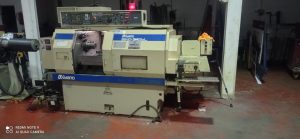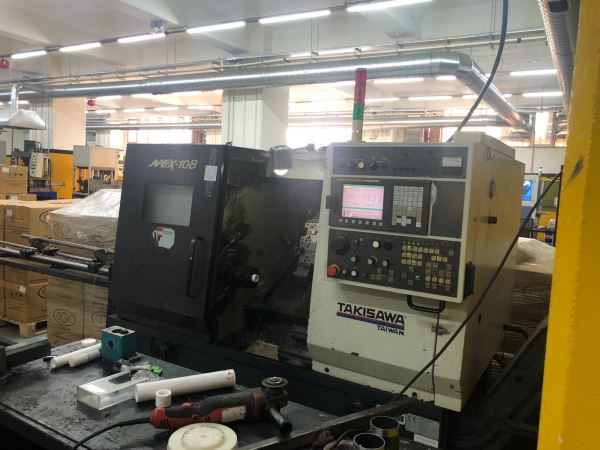
Smart Buyer’s Guide: How to Choose the Right Pre-Owned, Used, Secondhand, Surplus CNC Equipment Before Purchasing TAKISAWA NEX-108 CNC Lathe made in Japan
Here’s a Smart Buyer’s Guide / Checklist for evaluating a used / secondhand / surplus Takisawa NEX-108 CNC lathe. Because this is a fairly capable mid-size CNC turning center (often used for general turning, possibly with milling / Y / C axis options), your inspection has to cover mechanical integrity, control, spindle health, tooling systems, and beyond.
Below is a structured approach: reference specs, detailed inspection checklist, critical risk areas, acceptance criteria, valuation & negotiation tactics, and post-installation validation.
1. Reference / Nominal Specs & Capabilities
Before inspecting, know what the NEX-108 is supposed to deliver (or at least typical ranges) so you can spot deviations. Some typical specs from manufacturer / listings:
| Parameter | Typical / Published Value | Notes / Sources |
|---|---|---|
| Max turning diameter (over bed) | ~ 320 mm | Takisawa’s spec: “Max turning diameter: 320 mm” |
| Max turning length / travel (Z-axis) | ~ 481 mm | Takisawa spec: “Max turning length (mm), 481” |
| Bar capacity (bar work) | ~ 52 mm | Takisawa spec: “Bar capacity (mm), 52” |
| Spindle maximum speed | ~ 4,000 rpm | Typical spindle rpm: 4,000 rpm is commonly listed. |
| Turret / tool stations | 10 or 12 stations (typical) | Many used machines show T10 / T12 turrets. |
| Drive motor power | ~ 7.5 / 11.0 kW (depending on configuration) | One listing: “Spindle Motor 7.5 / 11.0 kW” |
| Swing over bed (max diameter over bed) | ~ 400 mm | Some listings: Ø above bed 400 mm |
| Travel of X-axis | ~ 180 mm | Listings show X-axis travel ~ 180 mm |
| Travel of Z-axis | ~ 530 mm | Listings show Z-axis ~ 530 mm |
Also note: there are variants with Y-axis or C-axis (multi-axis option) built in.
Use these as baseline targets; a used machine may deviate due to wear or modifications, but deviations must be explainable and acceptable for your application.
2. Pre-Purchase / Site Inspection Checklist
Below is a thorough on-site inspection list. Use it as a checklist with pass / borderline / fail markings. Bring your precision instruments, e.g. dial indicators, test bars, measuring tools, vibration meter, and a trusted machinist if possible.
| Subsystem / Area | What to Inspect / Test | Acceptable Condition / Red Flags |
|---|---|---|
| Documentation & History | Ask for original manuals, spare parts lists, electrical / wiring diagrams, maintenance logs, serial numbers, retrofit history | A complete history is a big plus. No documentation increases risk. |
| Frame, Bed, Base & Structure | Inspect for cracks, repairs, deformations, welds; level of bed surface; check for warping or bending; verify foundation mounting integrity | No visible structural damage. Bent or warped structures are serious defects. |
| Guideways / Ways / Slides | Move carriage / cross slide across full travel slowly; feel for binding, tight spots, stick-slip, uneven friction; inspect for scoring, wear lines | Smooth motion, no “hard spots” or jumps. Deep wear streaks / gouges are red flags. |
| Ball Screws / Lead Screws / Drive Train | Measure backlash on each screw, check endplay, test for smoothness, check couplings, inspect for wear or misalignment | Backlash within tolerance; smooth input–output motion. Excessive play or grind is bad. |
| Axis Motors / Drives / Encoders / Feedback Loops | Jog all axes (X, Z, and any additional axes) at varying speeds; check for servo alarms, resonance, overshoot, oscillation; test movement under load if possible | Axes move smoothly, no error alarms, respond well. Any axis misbehaves is a red flag. |
| Spindle & Bearings | Run spindle (no load) at multiple speeds; listen for noise, vibration; test run-out with test bar / dial indicator; test under light load (if feasible) | Quiet, smooth, low vibration. Run-out within your tolerance. Bearing groan, heat, or high vibration are serious issues. |
| Turret & Tool Holding System | Cycle the turret through all stations; check indexing accuracy, locking firmness, repeatability, slop, cam or indexing mechanism condition | Turret must index precisely, lock solidly, and repeatably. Any hesitation, looseness, mis-indexing is a deal-breaker. |
| Tooling Spindles / Live Tooling (if installed) | Test driven tools / milling spindles: rotation, torque, noise; inspect drive lines, wiring, coupling, spindles for wear | All live-tool components should operate cleanly. Worn or erratic behavior is a risk. |
| Optional Axes (Y, C, etc.) | If the machine has Y-axis, C-axis or other built-in axes, test their full motion: backlash, smoothness, vibration, repeatability | Additional axes must operate cleanly and within acceptable accuracy. |
| Workholding / Chuck / Jaws / Tailstock | Check chuck run-out, jaw repeatability, chuck mounting, jaw condition; inspect tailstock (if present) alignment and movement | Chuck run-out must be minimal; jaws must grip consistently. Tailstock alignment must be good. |
| Cooling / Lubrication / Chip Removal | Inspect coolant pump, lines, nozzles, sump, filters; lubrication system to slides and screws; chip conveyor or removal arrangement; cleanliness | Must function reliably. Leaks, blockages, or non-functional cooling/lube are red flags. |
| Electrical / Control Cabinet & Wiring | Open cabinets, inspect wiring, connectors, terminal blocks, signs of overheating, corrosion, dust, routers, spare card slots | Wiring should be neat, original, with no burn marks or frayed wires. |
| Control / CNC / Software | Boot control, check that all axes are recognized, upload / download programs, jog, tool table functions, diagnostics, error logs | Control must be fully functional. Missing or faulty control modules are serious issues. |
| Operational / Machining Test | Run a sample part (representative of your work) in typical turning operations; measure finish, dimensional error, stability | Should produce parts within your tolerance. Poor finish, chatter, or deviation is unacceptable. |
| Thermal / Long-Run Stability | Run the machine for 1+ hour of continuous operation, measure drift in axes, temperature rise, dimensional drift | If geometry or accuracy drifts over time, that’s a red flag. |
| Spare Parts / Accessories | Ask what tooling, collets, chucks, backup spindles, sensors, extra parts are included | A good package of spares and tooling adds value and reduces risk. |
| Acceptance / Trial Clause | Negotiate a test / acceptance period post-delivery (e.g. you get to run your own parts) | Very useful. If seller refuses, assume risk. |
Additionally, you may want to use a vibration analyzer during spindle test, and measure spindle bearing temperature during operation.
3. Critical Risk Areas & Common Failure Modes
Some parts of the NEX-108 (or any CNC lathe) are more susceptible to failure or hidden degradation. These deserve special attention:
- Spindle Bearings / Spindle Wear — This is often the most expensive repair. Bearing play, noise, or vibration often signal deeper damage.
- Turret Indexing & Locking Wear — Repeated use leads to cam, pin, or locking mechanism wear, causing mis-indexing or looseness.
- Ball Screw / Nut Wear / Backlash — Over many hours, screws / nuts wear, increasing backlash or uneven motion.
- Drive Motor / Amplifier or Encoder Faults — Servo drive or feedback component failure may cause erratic motion or no motion.
- Control / CNC Module Obsolescence or Failure — The CNC control system must be healthy (including I/O modules, power supplies, memory). Obsolete or broken modules may be costly to replace.
- Wiring Harness / Connector Fatigue / Electromechanical Aging — Insulation breakdown, connector corrosion or broken wires often hide problems.
- Cooling / Lubrication Neglect — If coolant or lubrication systems are deficient or clogged, wear accelerates on ways, screws, spindles.
- Thermal Drift / Alignment Loss — A machine may be accurate at cold start but drift under heat, especially if bearings or alignment are compromised.
- Missed Maintenance / Hidden Damage — Crash history, repair welds, improper reassembly, alignment abuse may be covered by cosmetic repair but hide deeper issues.
- Accessory / Tooling Wear or Missing Items — Worn chucks, jaws, collets, attachments degrade capability; missing tooling means extra cost.
If any of these show serious defect, negotiate accordingly or reconsider the purchase.
4. Acceptance Criteria & Thresholds
Before you inspect, define your “go / no-go” tolerances & thresholds based on your parts:
- Maximum allowable spindle run-out (e.g. ≤ X µm)
- Axis backlash / play limits (X, Z, any optional axes)
- Turret indexing error tolerance
- Tool change repeatability tolerance
- Part turning accuracy tolerance for test parts
- No persistent alarms or faults in control
- Spindle noise, vibration, temperature rise within acceptable limits
- Cooling / lubrication must function under full speed
- Additional axes (if present) must meet motion and backlash thresholds
- No structural defects or hidden damage
- Good wiring and control modules
- Complete or adequate tooling / spare parts inclusion
If a machine exceeds any of your critical thresholds, you should renegotiate, demand repair, or walk away.
5. Valuation & Pricing Approach
When forming an offer and assessing price:
- Research comparable used NEX-108 machines (year, condition, hours) to benchmark pricing.
- Deduct estimated cost of known repairs (spindle overhaul, turret repair, control module replacement, calibration, wiring).
- Add value for included tooling, spares, attachments.
- Include shipping, installation, alignment, commissioning costs.
- Include a “risk discount” margin in case hidden defects appear after purchase.
- If control or electronics are obsolete or parts are hard to find regionally, that reduces value.
- Use your inspection findings to adjust your offer (e.g. “because turret indexing is worn, I will deduct $X in repair cost”).
- Demand clarity on as-is vs refurbished condition.
6. Negotiation & Risk Mitigation Strategies
- Live demonstration & sample machining: Bring your own sample or representative workpiece to test before purchase.
- Cold inspection: With power off, inspect panels, wiring, internal cabinets, structural components for wear or damage.
- Photo documentation: Document every issue found and share with seller to justify price adjustments.
- Acceptance window / trial period: Negotiate a period after delivery where you can test performance—if unacceptable, you may return or renegotiate.
- Include spare parts / modules: Insist that the seller include control modules, wiring harnesses, spare motors, chucks, collets.
- Transport / installation risk clause: Make sure seller assumes risk for damage until you accept the machine.
- Baseline alignment & measurement report: Request that the seller provide baseline measurements (e.g. spindle run-out, axis zero) to compare on your installation.
- Walk-away clause: If any of your critical acceptance criteria are not met, be ready to pull out.
7. After Purchase: Installation, Commissioning & Validation
Once the NEX-108 is delivered and installed:
- Precision leveling, alignment & referencing
Use granite base, dial indicators, laser alignment, to verify axes are orthogonal, level, and co-linear. - Baseline measurement & calibration
Measure spindle run-out, backlash, axis straightness, positioning deviation, etc. Record for future drift comparison. - Test machining, “golden part”
Run your most demanding part(s); verify dimensional accuracy, surface finish, repeatability across multiple runs. - Thermal stability / continuous operation test
Run the machine for extended duration, monitor drift, temperature, alignment changes. - Compensation routines
If control supports backlash compensation, thermal compensation, or kinematic corrections, configure and verify them. - Lubrication / cooling verification
Verify all lubrication and cooling circuits are working under normal load, and check for leaks or performance issues. - Spare parts stocking & maintenance plan
Stock critical spares (spindle bearings, screws, couplings, control modules, wiring harness sections). Define preventive maintenance intervals. - Performance monitoring over time
Periodically check your benchmark parts to detect degradation or drift before it becomes a production problem.
8. Summary & Advice
- The Takisawa NEX-108 is a capable mid-range CNC lathe, often with options for Y / C axes. Knowing its baseline specs (320 mm diameter, 481 mm length, 52 mm bar capacity) helps in assessing machine claims.
- A used NEX-108’s value lies heavily in the health of its spindle, turret, drive systems, control electronics, and structural alignment.
- Use a systematic inspection checklist covering mechanical, electrical, motion, control, and tooling systems.
- Be particularly vigilant about spindle wear, turret indexing, backlash, control module health, wiring, and reasons for past repairs.
- Define your acceptance criteria in advance, and enforce them in negotiation.
- Insist on demos, sample part tests, inclusion of spares, and risk-sharing in transport.
- After installation, validate carefully, set baselines, monitor drift, and establish preventive maintenance.