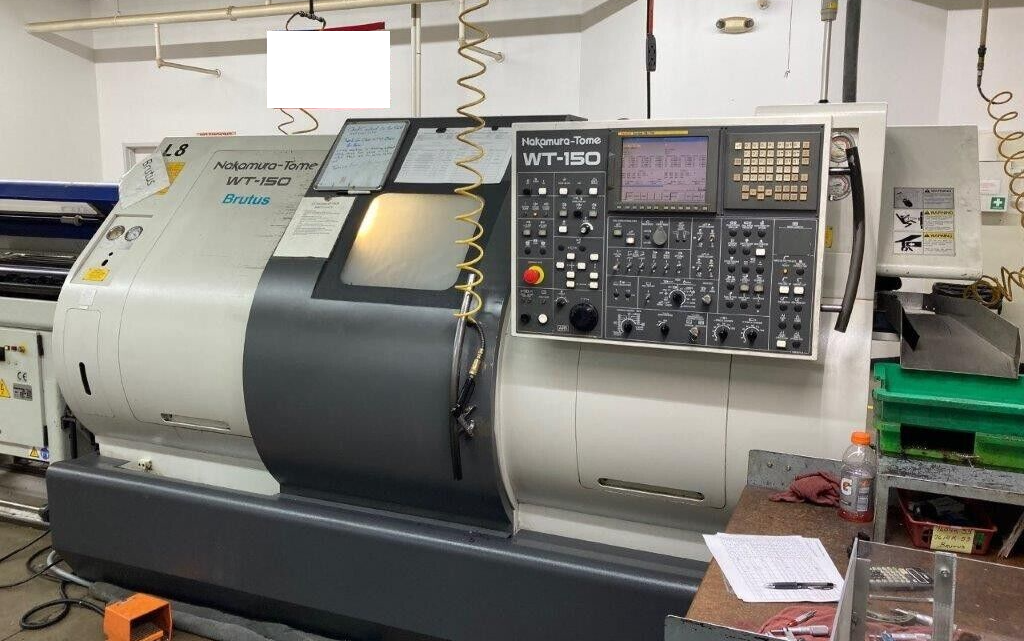
Smart Buyer’s Guide: How to Choose the Right Pre-Owned, Used, Secondhand, Surplus CNC Equipment Before Purchasing NAKAMURA TOME WT-150MY CNC Turning Center made in Japan
Here’s a Smart Buyer’s Guide (checklist + risk zones + negotiation strategy + post-installation tips) for evaluating a pre-owned / used / surplus Nakamura Tome WT-150MY (or variant “WT-150 / MMY / MY” etc.) CNC turning center / multitasker. Because these are high-capability, multi-axis machines (with twin turrets, live tooling, sub-spindles, Y / C axes), you must inspect all mechanical, electrical, and control subsystems carefully.
Below is my recommended structured approach.
1. Know the Machine: Baseline Specs & Features
Before going onsite, assemble the nominal / ideal specs of a healthy WT-150MY (or equivalent variant) so you can benchmark what you find.
From used listings and seller descriptions:
- The WT-150MY / WT-150MMY is a multi-axis, twin turret, twin spindle / sub-spindle capable turning center.
- Typical spindle speeds: ~ 5,000 rpm on main spindles.
- Bar / spindle bore: ~ 51 mm (~2″) bar capacity / spindle bore.
- Travel / stroke ranges: X ~ 6.2″ (≈ 157–160 mm), Z ~ 18.3″ (≈ 465 mm) in many WT-150MMY units.
- Turrets: twin turrets (upper + lower), often 12 stations each, with live tooling, Y-axis on upper turret, full C-axis control on spindles.
- Control: Fanuc 18i-TB or equivalent CNC controls are common in used units.
- Other features: parts catcher, chip conveyor, bar feeder interface.
- Distance between spindles / inter-spindle distance: varies depending on variant.
Use these specs as your “target ranges.” If a candidate machine claims wildly different numbers, get justification (replacement spindles, custom modifications, etc.).
Also, understand which variant / option set you are dealing with: WT-150MY, MMY, or others differ in Y-axis, turret tool count, live tooling, control upgrades, etc.
2. Inspection & Evaluation Checklist
Here’s a detailed on-site (or remote + partially on-site) checklist. Bring precision measuring instruments, a trusted technical expert, and an inspection sheet. Mark every item OK / borderline / fail.
| Subsystem / Area | What to Inspect / Test | Acceptable Condition / Red Flags |
|---|---|---|
| Documentation & History | Request operator manuals, parts catalogs, wiring / hydraulic / pneumatic schematics, maintenance log / service records, retrofit history | Complete documentation is a strong plus. Missing or inconsistent history is a risk |
| Frame, Base, Structure | Visually inspect for cracks, weld repairs, distortions in base or columns; check alignment of major surfaces; ensure no structural damage | Structural damage or warpage is a serious red flag |
| Guideways / Linear Slides / Ways | Move turrets, cross slides, Y-axis, Z-axis slowly; feel for binding, uneven friction, “hard spots”; visually inspect for wear, gouging, scoring | Smooth movement across full travel. Deep wear or scoring is problematic |
| Ball Screws / Drive Train / Couplings | Check backlash, endplay, smoothness, check coupling alignment and condition | Acceptable (within your tolerance) backlash; no binding or clunking |
| Axis Motors, Drives & Encoders | Jog each axis (X, Y, Z, turret, sub-spindle, C-axes) through full traverse, test responsiveness, check for servo alarms, vibration, oscillation | All axes must respond cleanly. Any mis-behavior or drive fault is a concern |
| Main Spindle & Sub-spindle | Run spindle no-load at multiple speeds; listen for noise or bearing whine; measure run-out (test bar); possibly test under light load | Quiet, minimal run-out. Excessive noise, vibration, or heat is a red flag |
| Turrets (Upper & Lower) | Index turrets through all stations, check repeatability, locking clamping firmness, slop, hesitation | Turrets must index cleanly, no slop, good locking. Mis-index, bounce or hesitation is unacceptable |
| Live Tooling / Milling Spindles | Test all driven / milling axes: check rotation speed, torque, vibration, wiring, gearbox wear | Should run smooth. Any wobble, noise, or erratic behavior is a major issue |
| Y-Axis Movement (if present) | Move Y-axis both directions; measure backlash, repeatability, check binding, serviceability | Y-axis must move smoothly and return accurately |
| Workholding / Chucks / Jaws / Tailstock | Inspect chuck for run-out, jaw condition, clamping consistency; check tailstock alignment, quill backlash | Chuck run-out minimal; jaws in good condition; tailstock alignment acceptable |
| Cooling / Lubrication / Chip Handling | Inspect coolant pump, lines, nozzles, filters; check lubrication system to slides, screws; inspect chip conveyor, piping, cleanliness | These systems must work reliably. Leaks or blockages are red flags |
| Electrical Cabinets / Wiring | Open cabinets, check wiring, connectors, terminal blocks, signs of overheating, splices, dust, corrosion | Wiring must be orderly, with no burn marks, broken insulation, or sloppy repairs |
| Control / CNC / Software | Power up the control, test axis homing, tool tables, I/O, tool change routines, diagnostics, error history | Control must be fully functional. Missing or corrupted modules are a red flag |
| Operational / Machining Test | Run a representative sample workpiece / trial part, through turning + milling paths, tool changes, multi-axis moves | The machine must deliver parts within your tolerance, show stable behavior |
| Thermal / Long-Run Test | Run the machine continuously for 1+ hours, measure drift of axes and geometry changes, temperature rise of bearings and motors | Minimal drift and stable operation are expected; any noticeable drift or shifting is a warning |
| Spare Parts / Tooling / Accessories | Ask what tooling, chucks, collets, spare modules, accessories, probes, attachments are included | A strong accessories and spares package increases value |
| Acceptance / Trial Period | Negotiate a post-delivery acceptance period (to test the machine under your conditions) | Valuable to reduce risk; refusal may suggest hidden issues |
You may also wish to carry a vibration meter, thermography gun, or measurement equipment to capture baseline readings.
3. Key Risk Zones & Failure Modes for Nakamura WT-150MY
Because this is a high-end multi-axis turning center, certain components are more vulnerable. Be especially cautious when inspecting these:
- Spindle / bearing wear — one of the most expensive repairs; subtle bearing noise or looseness should be cause for concern
- Turret indexing / locking mechanisms wear — wear in cam surfaces, lock pins, indexing drives can degrade tool repeatability
- Live tooling / milling spindle defects — gearing, drive motors, wiring fatigue frequently fail
- Control / CNC module failure or obsolescence — missing or failed control/electronics (I/O, memory, boards) can be expensive to replace
- Drive / servo faults / encoder errors — one bad axis or servo drive can cripple the machine
- Wiring fatigue / insulation breakdown / connector corrosion — hidden wiring issues often cause intermittent problems
- Thermal drift / misalignment over time — especially for machines that operated in variable temperature environments
- Lubrication neglect — failure of lubrication systems accelerates wear on slides, screws, guides
- Hidden crash damage or structural modifications — repaired damage may not be fully disclosed
If one or more of these zones show serious defects, the cost to remedy may outweigh the purchasing savings.
4. Acceptance Criteria & Thresholds (Your “Go / No-Go” Metrics)
Set objective thresholds before inspection. Some sample criteria:
- Spindle run-out: ≤ a few µm (depending on your parts)
- Axis backlash / play: ≤ your tolerance (X, Y, Z, turret axes)
- Turret indexing error: within acceptable limit
- Tool change repeatability: within tolerance
- Multi-axis machining test: must deliver parts to your dimensional and surface spec
- Control / CNC must operate without persistent faults
- Live tooling axes must spin cleanly and respond well
- Temperature rise and vibration within safe bounds
- Cooling / lubrication systems functioning under load
- No major structural defects or hidden damage
- Adequate tooling / spare parts included
- Wiring / electrical integrity maintained
Any significant violation of these should either trigger price renegotiation or rejection.
5. Valuation & Pricing Strategy
When considering the asking price:
- Benchmark against comparable used WT-150MY / WT-150MMY machines from listings (checking year, condition, hours).
- Deduct the estimated cost of repairs / refurbishments (spindles, turrets, control electronics, alignment)
- Add value for included tooling, bar feeders, accessories, spare modules
- Factor in shipping, installation, alignment, calibration costs
- Include a risk premium / contingency for hidden defects
- Evaluate control / electronics obsolescence: if modules are rare or expensive locally, that reduces value
- Use inspection defects as negotiation points (e.g. “because turret lock is sloppy, deduct $X”)
Your offer should leave you room for inevitable adjustments.
6. Negotiation & Risk Mitigation Strategies
- Run full demo & test cuts: Bring representative parts to test the machine.
- Inspect cold & open internals: With machine powered off, inspect wiring, cabinets, structural joins.
- Document every defect: Use your checklist, record photos, and use them in negotiation.
- Negotiate an acceptance / trial period: A post-install test period allows you to discover defects under actual production conditions.
- Require spare modules / boards: If possible, have the seller include extra electronics, wiring, or drive modules.
- Assign transport risk properly: Determine who is responsible for damage during moving or reassembly.
- Request baseline alignment / measurement data: So you have “before” data to compare after installation.
- Walk-away clause: If critical criteria aren’t met, you must be ready to walk away.
7. Post-Installation Commissioning & Validation
Once the machine arrives and is installed:
- Precision leveling & alignment
Use granite plates, laser alignment, dial indicators, to align axes, check orthogonality, and correct setup. - Baseline measurements & calibration
Record spindle run-out, backlash, axis straightness, alignment, etc. - Test / “golden part” run
Run your most demanding complex part sequence (turning + milling + live tooling) and verify outputs. - Thermal / continuous operation test
Let the machine run for extended hours and observe drift, geometry shifts, temperature behavior. - Load compensation & calibration
Configure backlash compensation, thermal maps (if supported), tool offsets, and calibration routines. - Lubrication / coolant system validation
Ensure all lubrication and coolant circuits operate under load with proper flow, no leaks. - Preventive maintenance schedule
Define and perform periodic checks: turrets, spindles, wiring, sensors, alignment checks. - Diagnostic & vibration logging
Monitor vibration, axis load, motor current, etc., to detect early wear. - Spare parts stocking
Keep critical spares: spindle bearings, drive modules, tool holders, wiring harness sections, sensors. - Performance tracking
Periodically re-run test parts and compare to your baseline to detect drift or degradation.
8. Summary & Final Recommendations
- The Nakamura Tome WT-150MY / variant is a complex, high-capability multi-axis turning center. Its strengths include twin turrets, live tooling, Y-axis, and multitasking ability.
- Because of its complexity, you must inspect mechanical, electrical, and control systems with rigour: spindle, turrets, drives, axes, wiring, and control modules.
- Use reference specs (spindle speed, travel, bar capacity, turret configuration) as benchmarks to spot exaggerations or significant deviation.
- Define your acceptance thresholds in advance and stick to them during inspection and negotiation.
- Insist on demo runs, acceptance period, spares inclusion, and clear responsibility for transport risk.
- After purchase, do careful alignment, baseline measurement, long-run validation, and set up preventive maintenance from day one.