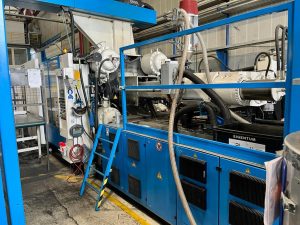
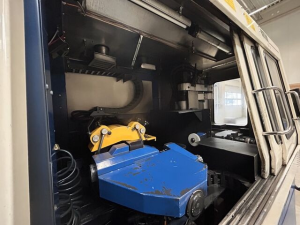
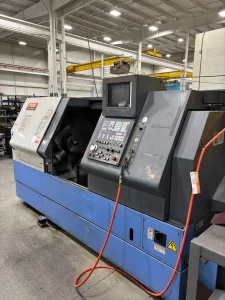
Smart Buyer’s Guide: How to Choose the Right Pre-Owned, Used, Secondhand, Surplus CNC Equipment Before Purchasing Okuma MacTurn 550 CNC MultiTasking Turn-Mill Center made in Japan
Below is a Smart Buyer’s Guide (detailed checklist + risk areas + negotiation & post-installation steps) tailored for evaluating a pre-owned / used / surplus Okuma MacTurn 550 (multi-tasking turn-mill center / lathe + milling + sub-spindle etc.). Because this is a high-spec, multi-axis machine, the inspection must be rigorous.
I’ll organize it as follows:
- Key reference specs & functional expectations
- Inspection & evaluation checklist
- Critical risk zones & failure modes
- Acceptance criteria & thresholds
- Valuation / pricing strategy
- Negotiation & risk mitigation tactics
- Post-installation commissioning / validation
- Summary and recommended approach
1. Reference Specs & Functional Expectations
Before inspecting, you should know what a “healthy” MacTurn 550 should deliver. This helps you spot deviations, hidden degradation, or overstated claims.
From various used-machine listings and Okuma spec references:
- The MacTurn 550 is a heavy multi-tasking turning / milling center (turn-mill hybrid) using Okuma’s OSP controls.
- Some representative specs (from listings / dealer sources):
• Max swing over saddle: ~ 720 mm (≈ 28.34″)
• Max machining diameter: ~ 720 mm
• Distance between spindles (i.e. working length): up to around 2,000 mm (≈ 2 meters) in some versions.
• X-axis (cross) travel: ~ 25.98″ (~ 660 mm) for primary turret / spindle
• Y-axis travel: ~ 9.84″ (~ 250 mm)
• Spindle speeds: main spindle ~ 3,000 – 3,500 rpm in many used machines
• Secondary spindle speeds / sub-spindle: some versions list ~ 3,800 rpm or similar for sub-spindle.
• Power: motor ratings in used listings include 30 kW for main spindle, 22 kW for sub-spindle in some versions.
• Turret / tool capacity, live tooling, milling, B-axis or universal heads: many machines include live tooling, a milling spindle (e.g. 10,000 rpm) for side machining, universal heads with B-axis, etc.
• Control: OSP-series (e.g. OSP-P200L, OSP-E100L) in used listings.
Thus, when assessing a candidate, measure and test against these benchmarks (accounting for configuration variants).
Also note: because this is a multi-tasking machine (turning + milling + sub-spindle + turrets etc.), its complexity is much higher than a simple turning center, so your inspection must cover all subsystems.
2. Inspection & Evaluation Checklist
Take a systematic approach. Bring along precise measurement tools, a trusted technician, and an inspection sheet. Go through each subsystem and test thoroughly.
| Subsystem / Area | What to Inspect / Test | What is Acceptable / Red Flags |
|---|---|---|
| Documentation & Machine History | Request original manuals, maintenance logs, wiring diagrams, rebuild history, retrofits, software / control upgrades | Complete documentation is valuable; lack of history is a risk |
| Frame, Bed, Column & Structural Integrity | Look for cracks, repairs, welds, distortions, alignment of major surfaces, torsion or bending signs | Any visible structural repairs or misalignment are serious concerns |
| Guideways / Linear Rails / Ways | Move axes through full travel; check for smoothness, binding, zones of high friction, variations in resistance; use dial indicators to spot wear | Smooth, consistent motion with minimal zones of increased resistance |
| Ball Screws / Drive Train / Couplings | Check backlash, end play, smoothness, coupling alignment, noise, end bearings | Acceptable backlash (within your tolerance), no binding, smooth motion |
| Axis Motors / Servos / Encoder Feedback | Jog all axes (X, Y, Z, turret, B-axis, C-axes) at various speeds; watch for servo alarms, overshoot, oscillation, error flags | Axes should move fluidly, settle stable, no repeated alarms |
| Main Spindle / Sub-spindle | Run spindles at no-load and loaded; measure run-out (test bar), listen for noise or vibration; check temperature behavior and bearing condition | Minimal noise or vibration; run-out within acceptable tolerance |
| Turrets & Indexing Mechanisms | For upper / lower turrets, check indexing accuracy, backlash, locking firmness, cam surfaces, drive motors, repeatability | Turrets must index cleanly and lock solidly. Slop, hesitation, bounce, mis-indexing are red flags |
| Tool Holders / Live Tooling / Milling Axes | Inspect tooling spindles, drive motors, gearboxes, wiring to driven tools, condition of tool seating surfaces, alignment | All tool drives should operate smoothly. Worn tapers, misalignment, or failed motors are serious drawbacks |
| Y-Axis Function | Test Y-axis travel, backlash, smoothness, repeatability | The Y-axis must move cleanly and return precisely |
| Workholding / Chucks / Jaws / Sub-spindle Coupling | Check chuck jaws, clamping repeatability, alignment, run-out, sub-spindle coupling alignment | Workholding must be secure and repeatable under load, minimal run-out |
| Rotary / C-Axes / B-Axis / Universal Head | If machine has B-axis or universal head, test rotation, indexing, backlash, motor behavior, positioning accuracy | These axes must operate without slack, binding, or irregular motion |
| CNC / Control / Software | Power up control, load programs, test all axes, tool table, macros, diagnostics, error memory; check control version, licenses, function modes | Control must be fully functional. Missing or fault-ridden control is major liability |
| Electrical Cabinet / Wiring | Inspect wiring for heat damage, corrosion, cleanliness, routing, connectors, spare modules, fan cooling | Burn marks, sloppy wiring or patchwork wiring is warning sign |
| Cooling / Lubrication / Hydraulic / Pneumatic Systems | Check coolant pumps, flow, pipes, filters, fluid condition; lubrication lines, oil supply to guides, hydraulics (if any) | These systems must work reliably. Failed lubrication or coolant leads to accelerated wear |
| Chip Removal / Conveyor / Guards / Safety | Inspect chip conveyors, guards, doors, safety interlocks, chip flow paths | These should be intact and functioning; missing safety items are red flags |
| Operational / Machining Tests | Run sample parts (turning + milling) across full axes, with representative material. Observe tool paths, finishing quality, dimensional accuracy | Machine should produce parts within your tolerance under full operation |
| Thermal / Drift / Long-Run Stability | Run machine continuously over some hours and monitor drift in axes or part geometry | Significant drift over time is unfavorable |
| Spare Parts / Tooling / Accessories | Ask for included tooling, spares, motors, controls boards, backup parts, probes, etc. | A good spare parts package reduces your future risk |
| Acceptance / Trial Clause / Return Option | Negotiate a short acceptance period after delivery (e.g. you may test with your workload) | Always good to have; seller refusing suggests hidden risk |
Make sure each item is marked “OK / borderline / fail” in your inspection sheet.
3. Critical Risk Zones & Failure Modes Specific to a MacTurn 550
Because this is a very high-capability multi-tasking machine, certain systems are high-risk. These deserve extra attention and may be deal-breakers if compromised.
- Main / Sub-spindle bearing wear: Dual spindles are heavily loaded. Bearing degradation may show as noise, vibration, elevated temperature, or poor run-out.
- Turret indexing / locking wear: Turret cams, locking pins, indexing drives often wear. Mis-indexing or loose locking ruins tool accuracy.
- Live tooling / milling spindle issues: Drivetrain, wiring, gearboxes in live-tool modules are susceptible to wear or failure.
- Control / CNC obsolescence or missing modules: The OSP control must be intact and licensed. Missing boards or obsolete control may require expensive replacement.
- Drive / servo motor or amplifier faults: One faulty servo or axis may limit functionality.
- Y-axis & B/C-axis wear / backlash: Extra axes increase complexity; any looseness here degrades 5-axis performance.
- Thermal drift / structural loosening with heavy cuts: In extended runs, thermal expansion or loosened fasteners may degrade accuracy.
- Wiring fatigue / connector failure: In a complex machine, wiring harnesses are extensive. Breaks or poor splices are frequent weak points.
- Lubrication failure: Especially for guides, linear rails, ball screws, the lack of proper lubrication leads to accelerated wear.
- Inadequate maintenance / hidden damage: Previous users may have neglected systems or hidden defects (e.g. crashed axes, repair welds, parts replaced improperly).
If any one of these critical zones shows serious defect, the cost to repair may exceed your tolerance.
4. Acceptance Criteria & Performance Thresholds
Before onsite, define your thresholds—i.e., what deviations are acceptable and what must be rejected. Some suggestions:
- Main/sub-spindle run-out: ≤ a few micrometers (depending on your part specs)
- Axis backlash / play: ≤ a set maximum (depending on part tolerance)
- Turret indexing error: ≤ your tolerance (e.g. ≤ 0.02 mm or better)
- Tool change / live tooling accuracy: within your spec
- Multi-axis machining test: must meet your part tolerances
- Control fully functional, no persistent errors
- All axes move smoothly, no binding zones
- Spindle bearing noise / vibration within limits
- Temperature rise in drives / spindles within safe margin
- Lubrication / coolant systems functional
- Safety interlocks, guards intact
- Spare parts / tooling included
- Documentation complete or largely complete
If any of these fail beyond your threshold, you should demand repair, discount, or walk away.
5. Valuation & Pricing Strategy
When forming an offer:
- Start from a baseline of what similar MacTurn 550 machines (in good condition) are going for. Use listings for reference.
- Subtract estimated costs of needed repairs, parts, control board replacements, calibration, wiring, etc.
- Factor in transport, installation, teardown, alignment, commissioning cost.
- Value the included tooling, attachments, spares, probes, chucks.
- Also include “risk discount” for unknown defects, control obsolescence, hidden damage.
- Try to reserve margin for surprise repair during installation.
- Use your inspection data as negotiation leverage (list all defects and their estimated repair cost).
6. Negotiation & Risk Mitigation
- Live demonstration: Insist on full operation including multi-axis machining, machining a representative part.
- Cold inspection: Inspect internally (electrical cabinets, wiring, under covers) with power off.
- Document defects: Use your checklist to note every issue; include photos.
- Conditional acceptance period: Try to negotiate a post-install test period to confirm performance in your environment.
- Require spare modules / boards: If possible, have the seller include extra control cards, wiring harnesses, or drive modules.
- Share transport / installation risk: Who gets liability if damage occurs during disassembly / reassembly?
- Baseline alignment report: Ask the seller to provide base alignment or measurement data you can validate.
- Walk-away clause: If any critical acceptance criterion fails, be ready to rescind.
7. Post-Installation Commissioning & Validation
After the machine is installed in your facility:
- Precision leveling & alignment
Use granite plates, dial gauges, lasers to check axis squareness, geometric alignment, column alignment, spindle centers. - Load / calibration / compensation
Set up error compensation, thermal maps, backlash compensation, tool offsets, calibration of B/C axes. - Baseline test parts / “golden part”
Run your most demanding parts and verify dimensional accuracy, surface finish, tool path fidelity. - Multi-axis verification
Validate combined turning + milling sequences; test rotational axes. - Thermal stability check
Run continuous intervals and check for drift. - Document baseline metrics
Record run-out, backlash, axis deviation, tool offsets, etc. - Preventive maintenance schedule
Establish routines for lubrication, check turret indexing, sensor health, wiring, spindle monitoring. - Spare parts stock
Ensure you have critical spares: control modules, servo drive modules, tool holders, spindle bearings, wiring harness sections. - Performance tracking / drift monitoring
Periodically produce test parts and compare to baseline to detect deterioration or shifting.
8. Summary & Recommended Approach
- The Okuma MacTurn 550 is a complex, multi-axis turn-mill center with many subsystems; buying used demands rigorous vetting.
- Know the baseline specs (spindle diameters, travel, turret/tooling, axes, control) to benchmark candidates.
- Use a structured inspection checklist covering mechanical, electrical, control, tooling, drives, spindle, turrets, axes, safety, and machining performance.
- Pay special attention to high-risk zones: spindles, turrets, live tooling, control obsolescence, wiring, lubrication.
- Define your acceptance criteria clearly ahead of visits, and be ready to walk away from machines that fail.
- Negotiate with defect-based discount, insist on demos, acceptance periods, and spare parts, where possible.
- After installation, calibrate carefully, run baseline machining, monitor drift, and maintain a strong spares and preventive maintenance regime.