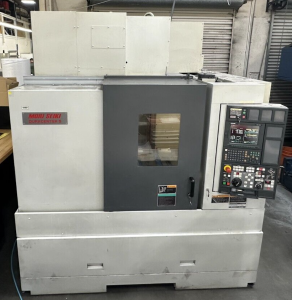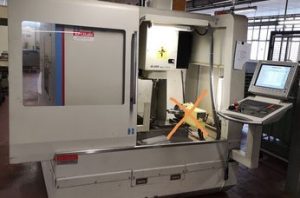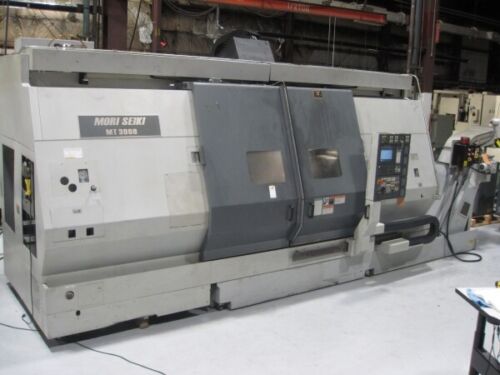
Smart Buyer’s Guide: How to Choose the Right Pre-Owned, Used, Secondhand, Surplus CNC Equipment Before Purchasing MORI SEIKI MT-3000S CNC Multi-Tasking Turn-Mill Machine made in Japan
Here is a Smart Buyer’s Guide for evaluating a pre-owned / used / surplus Mori Seiki MT-3000S (or similar variant) multi-tasking / turn-mill / multi-axis turning center / lathe. Because the MT-3000S is a complex, capable machine (with live tooling, Y-axis, subspindle, etc.), the evaluation must be rigorous across mechanical, control, tooling, and integration domains.
I also gather known reference specs to use as benchmarks. Use this as your inspection and negotiation playbook.
0. Reference Specs & Baseline Capabilities of MT-3000S
Before inspection, you must know what the machine should be capable of (in “as new / spec” condition). This sets your expectations and helps flag deviations.
From used listings and spec sheets:
- The MT-3000S often comes with the following features: subspindle, Y-axis, live tooling, B / C axes, Capto tool system, high pressure coolant, etc.
- Key capacities and specs (typical used machine listing)
| Spec / Feature | Typical Value (for used “MT-3000S /1500” listings) | Notes / Variation |
|---|---|---|
| Swing over bed | ~ 31.4″ (≈ 800 mm) | This is the maximum turning diameter capability |
| Turning diameter / workpiece | ~ 22″ (≈ 558 mm) | Inside the swing envelope |
| Center distance / turning length | ~ 60.0″ (≈ 1,524 mm) | This is the maximum length you can mount between centers |
| Bar capacity / spindle bore | ~ 3.5″ bar (≈ 89 mm) | Many listings list 3.5″ bar capacity |
| X / Z travels | X ≈ 25″ (≈ 635 mm) ; Z ≈ 62.8″ (≈ 1,595 mm) | The working strokes of the axes |
| Y-axis travel | ± 4.3″ (≈ ± 109 mm) | Permits off-center milling / drilling operations |
| B-axis tilt / C-axis indexing | B tilt: –120° to +105°; C indexing to 0.001° resolution | For angular tool orientation and 4th/5th axis motion |
| Spindle speed / motors | Main spindle: 3,000 rpm; live tooling spindle: 8,000 rpm; subspindle: 4,000 rpm | Check which option is installed |
| Tooling / turret / ATC | Example: 121-station Capto C6 tool changer in one listing | The number of tools / magazine matters for flexibility |
| Control / CNC | MORI / MSG-501 (some with Fanuc compatibility) | The control version and upgradeability are critical |
| Machine weight / dimensions | Example: weight ~ 39,600 lb ≈ 18,000 kg; dimensions ~ 252″ × 120.9″ × 129.7″ | You need to ensure your facility can receive, handle and install it |
These values are useful reference points. When you inspect a candidate, compare what it can actually do versus these specs. Deviations are acceptable if within tolerances, but large gaps or inability to approach benchmarks are red flags.
1. Pre-Inspection: What to Ask / Documentation to Acquire Before Visiting
Before you commit travel or inspection time, get as much background as possible. Many machines are disqualified before you arrive if certain red flags appear.
Ask the seller for:
- Machine model / variant / option list
- Confirm exactly whether it is “MT-3000S”, “MT-3000S/1500”, or another subvariant.
- List of options: whether Y-axis, subspindle, B/C axes, live tooling, high-pressure coolant, tool changer capacity, control version.
- Usage / runtime / load history
- Spindle hours (main, sub, live tooling)
- Typical cycle types (heavy cuts, light finishing)
- Idle time vs active use, peaks, throughput, any overuse or abuse conditions
- Maintenance, repairs, rebuilds
- Records of major repairs (spindle rebuilds, axis overhauls, turret/trunnion repairs)
- Preventive maintenance logs (lubrication, alignment, calibration, spindle checks)
- Any collisions, crashes, past rework or structural repair
- Modifications / non-OEM changes / upgrades
- Those might include non-standard control retrofit, custom wiring, non-factory parts.
- Upgrades of axes, drives, additional sensors, external tooling attachments.
- Full documentation
- Mechanical, electrical, hydraulic, pneumatic, wiring diagrams, parts lists / BOMs
- Control manuals, software, parameter backups, firmware versions
- Tooling / magazine specs, tool lists, calibration records
- Included tooling / spares / accessories
- Chucks, collets, live tools, tooling holders, spare parts (motors, encoders, cables)
- Calibration fixtures, alignment tools, sensors
- Photos / video / remote demo
- Videos of the machine in motion, tool changes, live tool spindle running, Y-axis motion
- Close-ups of control cabinet, axes, interior, wiring
- Environment / facility compatibility info
- Utility requirements: power, coolant, air, floor loading, foundation
- Whether the machine has been relocated before, any transport damage
- Reason for sale / machine downtime
- If it was replaced, underused, or damaged
If the seller cannot supply calibration or alignment records, or hides control / parameter backups, consider discount or disqualify the candidate.
2. Mechanical & Structural Inspection Checklist (On-Site)
Once you are on site, a thorough physical inspection is essential. Because this machine is complex, you should divide inspection into subsystems.
A. Base, Structure, and Frame Integrity
- Check the base and frame casting for cracks, past weld repairs, distortions or fatigue.
- Use straightedges or level instruments to check for twist, roll, or sag in the foundation or bed surfaces.
- Inspect machine guarding, covers, safety shields—ensure none are removed, damaged or open to contamination.
B. Guideways, Slideways, Ball Screws, Linear Motion
- Visually inspect guideways and slide surfaces for wear, scoring, pits, corrosion or damage.
- Jog axes (X, Z, Y if present) slowly through full travel; feel for stiction, binding, or variations in smoothness.
- Perform small reverse motion tests and check backlash via dial indicator (e.g. move ± small increment and see lag).
- Use a test bar or alignment gauge to measure straightness over selected travel.
- Check lubrication systems: lines, oil pumps, filters, cleanliness of oil, presence of coolant contamination.
- Check wipers, scrapers, covers on axes—if missing or damaged, debris ingress is a hazard.
C. Spindles & Live Tooling
- Spin the main spindle (no load) across its rpm range. Listen for bearing noise, vibration, heating.
- Mount a test bar or precision indicator to check radial and axial runout at multiple radii.
- Do the same for the live tooling spindle (if present): test at various speeds, check runout, stability, noise.
- Inspect spindle interfaces (tapers, collet interfaces, coupling surfaces) for wear or damage.
- Check subspindle (if present): spin it, measure runout, test match / transfer to ensure coaxial alignment when using both spindles.
D. Tool Turret / Tool Changer / Tool Magazine
- Cycle the turret / tool changer through all stations multiple times; measure indexing accuracy, speed, misfeeds, and repeatability.
- Watch for any hesitation, misalignment or collision potential.
- Inspect tool magazine rails, mechanical arms, pistons, sensors, couplings for wear, play, or looseness.
- Test tool loading / unloading under load if possible.
- Check the condition of the tool holders (Capto or other) and whether spares are standard or custom.
E. Y-axis, B / C Axes, Multiaxis Features
- Move the Y-axis (if present) across its travel. Check for backlash, binding, smoothness, and alignment.
- Test B-axis (tilt) and C-axis (rotation): check indexing, tilt limits, positioning accuracy, feedback loops.
- Use dial indicators or angle gauges to verify orthogonality, axis alignment.
- Combine complex moves (e.g. rotate + Y + linear) to see if motion synchronization is good.
F. Hydraulics, Pneumatic, Coolant & Lubrication Systems
- Inspect hydraulic lines, valves, pumps, reservoirs, seals for leaks, corrosion, or damage.
- Check coolant plumbing: pumps, pipes, filters, cooling water, pressure, flow, cleanliness.
- Inspect air / pneumatic lines (if used for clamping, ejection) for leaks, pressure stability, regulators and filters.
- Check high-pressure coolant path (if installed) for integrity, nozzles, lines, leakage.
G. Electrical Cabinet(s), Wiring & Components
- Open control cabinets; inspect for dust, coolant ingress, rust, corrosion, burn marks, stained PCBs.
- Inspect wiring harnesses, connectors, shielding, labeling, strain relief, missing covers.
- Check drive amplifiers, servo modules, power supplies, fans, cooling of electronics.
- Ensure all modules are properly seated, there are no loose boards, no overheated areas.
- Verify sensor wiring (thermocouples, encoders, scale feedback) is solid with proper shielding and no breaks.
H. Environmental / Setup Conditions
- Check floor vibration / stability; whether there are nearby heavy machines whose vibration might affect precision.
- Assess the temperature / thermal control in the machine’s environment: draft, temperature gradients, fluctuation.
- If machine was recently transported, check whether alignment, leveling, and calibration have been redone.
3. Functional / Performance & Test Cycle Validation
Mechanical checks alone are insufficient. You must see how the machine actually performs under load and over cycle repetition. Use test parts and measurement tools.
A. Axis / Motion / Jog Tests
- Move axes (X, Z, Y) through full stroke at various speeds; observe smoothness, no jump, no stutter, consistent velocity.
- Reverse motion and check how well the machine recovers position (backlash, hysteresis).
- Run longer travel moves to detect drift or cumulative error.
B. Spindle & Tooling Tests
- Run spindle at full rpm and check for vibration, noise, heating.
- Test cutting under light load: e.g. simple turning test to validate stability.
- Use test gauges to measure turned diameter, concentricity, surface finish.
- Engage live tooling, perform milling / drilling operations, monitor performance, cutting forces, vibration.
C. Combined / Multi-Axis Operation Tests
- Run a part or test program that exercises turning + milling + Y-axis + B/C axis moves.
- Run multiple repeated cycles (e.g. 10–20) and monitor drift, dimension variation, wear or heat effects.
- Measure final part tolerances (diameters, lengths, surfaces, positional tolerances) and compare to acceptable tolerances.
D. Subspindle / Part Transfer (if applicable)
- If the machine has a subspindle or twin-spindle operation, test part pass-off, alignment, coaxiality, exchange behavior.
- Check whether the transfer mechanism introduces offset, repeatability error or misalignment.
E. Error / Recovery / Fault Tests
- Pause mid-cycle, resume, and check whether the machine correctly returns to operation positions.
- Induce limit or soft alarm (e.g. open door, emergency stop) and check whether proper fault handling and safe state occurs.
- Power off & on: confirm that homing, referencing, memory retention, and repeatability restore properly.
F. Thermal Drift / Long-Cycle Test
- Run the machine continuously under load (e.g. 1 hour or more) and re-measure a test dimension.
- Evaluate drift (thermal expansion, axis drift, offset changes).
- Important for long-run stability.
These functional tests will help reveal hidden mechanical or control issues.
4. Spare Parts, Control / Software, Support & Future Maintenance
Even if the used machine passes all mechanical and performance tests, its long-term viability depends heavily on parts, software, and service support.
- Ensure full documentation is included: mechanical prints, electrical / wiring diagrams, software manuals, parameter sheets, parts lists / BOMs.
- Confirm control software, firmware, parameter backups are deliverable and licensed for you.
- Check whether control and drive modules (servo amps, motors, boards) are current or obsolete; verify availability and lead times of spares.
- Verify availability of tooling spares: live tool parts, turret drive parts, coupling parts, sensors.
- Check whether Mori Seiki (or successor / service network) in your region still supports MT series, spare parts, software updates.
- Calibration / alignment / metrology tools: check whether alignment datum, calibration tooling, test bars are included or available.
- Evaluate whether upgrades / retrofits (e.g. newer control boards, feedback systems) are feasible.
- Investigate whether there is a known list of common wear parts / failure modes for the MT-3000S and how easily they are serviced.
5. Risk & Cost Budgeting, Decision Strategy
Buying a used multi-tasking lathe like the MT-3000S is a high-stakes decision. Use the following to budget for contingencies and judge whether the deal is worth the risk.
| Risk / Cost Item | Estimate / Question | Impact / Decision Factor |
|---|---|---|
| Refurbishment & repair cost | Cost to rebuild spindles, re-clearance axes, replace worn guides, turret refurb, control module repair | If repair costs reach ~20–30 % of your investment, the risk becomes high |
| Parts / module obsolescence | Are servo amplifiers, feedback modules, control boards still manufactured? | One critical failure in an obsolete module can render the machine unusable |
| Calibration, alignment, commissioning cost | After moving, you’ll need alignment, calibration, test parts, control tuning | These are hidden but often significant costs |
| Transport, rigging, installation | Heavy machine, disassembly, packaging, cranes, leveling, anchoring | Poor planning or underestimation here can blow budgets |
| Downtime / integration / programming | Time required to debug multi-axis toolpaths, operator training, fixture setup | Always include buffer time |
| Accuracy drift / wear margin | Even if it passes now, residual error margin may already be small | Avoid machines close to their wear/precision limit |
| Compare with newer / refurbished machines | Compare total “landed cost” (used + refurb) vs cost of alternative new/refurb machine with warranty | Sometimes paying more up front gives lower risk and better product |
Conservatively, many used machine buyers reserve 20–30 % (or more, for complex multi-axis machines) of the purchase price for refurbishment, calibration, spare parts, and unforeseen issues.
6. Contract & Negotiation Safeguards
Given the complexity and risks, your purchase agreement must include protections.
- Acceptance / Performance Test Clause: Final payment contingent upon the machine passing your agreed test plan (mechanical, dimensional, operational).
- Hold-back / Escrow: Withhold a portion (e.g. 10–20 %) until commissioning in your facility.
- Limited Warranty on Key Subsystems: e.g. spindles, turret drive, axes, control modules (30–90 days).
- Spare Parts / Tooling Package Inclusion: Request seller include critical spares (servos, sensors, couplings, live tool components) or discount accordingly.
- Transport / Damage Liability: Define responsibility for damage during shipment, unpacking, reassembly.
- Documentation / IP / Software Transfer: Full transfer of manuals, drawings, parameter backups, software license rights.
- Latency / Hidden Defect Clause: Remedy for faults discovered post-commissioning (repair credit, part replacement, refund).
These protections shift some risk back to the seller and give you legal recourse.
7. Red Flags & Deal-Breaker Indicators
During inspection or negotiation, if you discover any of the following, approach the deal with extreme caution—or walk away:
- Spindle noise, vibration, or significantly elevated runout that cannot be explained or easily corrected.
- Turret misindex, tool changer errors, frequent misfeeds, or erratic behavior.
- Axis binding, stick-slip, or large backlash that suggests worn guides or screws.
- Y-axis sloppy, misaligned, or inconsistent motion.
- Subspindle / transfer mechanism faulty or misaligned.
- Control cabinets showing signs of water damage, burnt boards, corrosion or component neglect.
- Missing or unusable documentation / schematics / manuals.
- Critical modules or boards missing or nonfunctional (especially obsolete electronics).
- Motion / performance test fails: inconsistent part tolerances, drift, repeatability issues.
- The seller refuses full testing, or disallows access to control or internal components.
- Consumables, tool holders, spindle bearings, or tooling options are missing or nonstandard and unsupportable.
- The price differential compared to a recently refurbished or newer equivalent is small—leaving insufficient margin for risk.