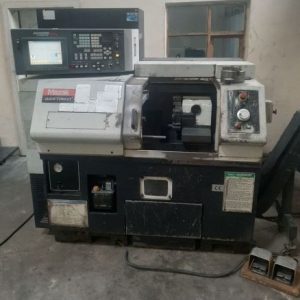
Smart Buyer’s Guide: How to Choose the Right Pre-Owned, Used, Secondhand, Surplus CNC Equipment Before Purchasing Mazak Quick Turn 6T CNC Lathe made in Japan
Below is a “Smart Buyer’s Guide” you can adapt when evaluating pre-owned / used / surplus CNC lathes, with focus on a machine like the Mazak Quick Turn 6T. The goal is to help you uncover hidden issues, compare offers rigorously, and reduce risk. Use this as a baseline and adapt based on your shop’s tolerances, tooling, and budget.
Why extreme diligence is needed for used CNC lathes (especially compact ones)
- Lathes see high mechanical stress, wear on spindle bearings, gearing, turrets, slides, etc.
- Small errors in spindle runout, backlash, or tool alignment can ruin parts rapidly.
- Repairs or component replacements (especially for older electronics, drive modules, spindle bearings) can be expensive or difficult to source.
- With a compact machine like the QT-6T, precision and rigidity margins are smaller, so any degradation can more easily push the machine out of acceptable tolerances.
Thus, treat used CNC lathe purchases as high-stakes investments — inspect meticulously, test thoroughly, and build in contingencies.
Benchmark / Nominal specifications of Mazak Quick Turn 6T (for reference)
Knowing the nominal / original specs helps you judge how far “off spec” a used machine might be. Below are typical published specs for the QT (Quick Turn) 6T model:
| Parameter | Typical / Published Value | Notes / Sources |
|---|---|---|
| Chuck size | 5″ (≈ 127 mm) | Machinetools listing: “Chuck Size 5″” |
| Maximum swing / turning diameter | ~11.81″ (~300 mm) | Machinetools listing says “Swing 11.81″” |
| Maximum turning diameter (cutting) | ~5.12″ (~130 mm) | Several used listings: “Maximum turning diameter 5.12″” |
| Maximum turning length / between centers | ~7.68″ (~195 mm) | Many listings: “Machining Length 7.68″” |
| Bar capacity (through spindle) | ~1.26″ (~32 mm) | Common spec: “Bar Capacity 1.26″” |
| Spindle speed | up to ~7,000 rpm | Frequently listed in used ads: “Spindle speed 7,000 rpm” |
| Spindle motor / power | ~7.5 hp (≈ 5.6 kW) | In some ads: “Spindle Motor: 7.5 hp” |
| X / Z travels | X ~3.19″, Z ~7.88″ (≈ 81 mm / 200 mm) | As per a listing: “X-Axis Travel 3.19″, Z-Axis Travel 7.88″” |
| Turret positions | 8 stations (common) | Many used listings mention 8-position turret |
| Control system | Typically Mazatrol (e.g. T-Plus, Mazatrol Fusion, etc.) | The model is often sold with standard Mazak Mazatrol CNC control. |
| Machine footprint / weight | Varies; in some listings, ~1,800 kg | For example, one listing: overall dims 1710×1345×1600 mm, weight ~1800 kg |
Use those as your “reference spec sheet.” When you inspect a candidate machine, compare what it actually delivers vs what it should deliver based on these.
Pre-Purchase Evaluation & Inspection Checklist
Here is a structured checklist and methodology. For serious purchases, bring along a CNC/lathe specialist, metrology tools, and sample parts to test.
| Subsystem / Area | What to Inspect, Measure, or Test | Why It Matters & Red Flags |
|---|---|---|
| Seller & Documentation | • Check seller’s reputation, prior sales history • Get complete maintenance / repair logs, parts replaced, service invoices • Request original factory documentation: schematics, manuals, part lists • Ask for serial number, manufacture year, history of modifications | Good documentation is a strong signal of care; lack thereof raises risk of hidden issues |
| Usage / Duty History | • Ask for “cutting hours” (not just power-on hours) • Ask what kind of parts were machined (material, roughing vs finishing) • Ask for records of breakdowns, downtime, major repairs • Ask about spindle load usage (how often in heavy cuts) | Heavy-use or abuse can accelerate wear. A machine that sat idle may be in better condition than one heavily used in tough jobs |
| Visual / External Condition | • Inspect for corrosion, rust, pitting on exposed surfaces • Examine enclosure, guards, way covers, chip guards • Check wiring & conduit routing, damage, exposed cables • Inspect for signs of impact, collisions, repairs (welds, patched areas) • Inspect the interior of the bed, chip pans, drainage • Look at condition of lubrication lines, hoses, fittings | External neglect often correlates with internal neglect. Damaged covers lead to contamination of critical surfaces |
| Spindle & Bearings | • Run spindle at low, mid, and near max speeds; listen for abnormal noise, hum, bearing knocking • Use a test bar or gage to measure spindle runout (radial and axial) • Let it run for an extended period (10–30 min) and check temperature rise • Check taper / nose for wear, burrs, or damage • Inspect spindle seals, lubrication supply, bearing housing | Spindle repair or replacement is very costly. High runout or noise is a red flag |
| Slideways, Leadscrews / Ballscrews, Motion System | • Move axes manually and with feed, feel for binding, stick-slip, roughness • Check backlash on each axis (X, Z) • Use a dial indicator to check straightness, linearity along axes • Inspect way surfaces for wear, scratches, scoring • Inspect leadscrew/ballscrew condition, nut play or backlash • Check lubrication (slides, ways) tubing, oil passages | Worn slides or screw assemblies degrade accuracy and may require reconditioning |
| Turret / Tool System | • Cycle turret (all tool stations) repeatedly; watch for hesitation, misalignment, slop • Test tool change under load • If equipped with live tooling, test tool spindle (run at speed) and check vibration/noise • Inspect tool holders, clamping mechanism, condition of pockets • If sub-spindle / gang tooling, test those functionalities too | Tool changer or turret failures can cripple production and are costly to repair |
| Control, Drives, Electronics | • Power up control, test interface, buttons, display, emergency stops • Test axis movement under manual and programmed commands • Inspect drive modules, servo amps, wiring, connectors, boards for signs of overheating, corrosion • Load sample programs or transfer programs to/from the machine • Check limit switches, home switches, signal wiring • Check for alarms, fault history in control | Control or drive failure often costs more than mechanical repairs |
| Coolant, Chip Removal & Lubrication Systems | • Inspect coolant tank, pumps, piping, seals for leaks • Test coolant flow, pressure, filtration • Inspect chip conveyors (if present) • Check lubrication (ways, slides, spindle) lines, pumps • Inspect for sludge, contamination in coolant or lubrication systems | Poor coolant or lubrication can accelerate tool / machine wear |
| Thermal Stability & Drift | • Let the machine run idle or under a light load for a period and monitor for drift • Move between reference points repeatedly and check repeatability • Check whether the machine has thermal compensation features (if applicable) • Monitor critical parts (spindle, headstock) for temperature rise | Thermal drift can degrade precision on small machines significantly |
| Test Cuts / Load Testing | • Run a representative part (similar to what you plan to make) with roughing and finishing cuts • Measure part dimensions, roundness, surface finish • Run for a sustained period (≥ 30 min) and observe stability, chatter, vibration • Cycle through sequences (tool changes, direction reversals) • Measure repeatability by repeating cuts and measuring deviation | This is often the best real-world validation of machine health |
| Installation / Infrastructure Considerations | • Verify that your shop has adequate power, voltage, current, and air supply • Check physical footprint, floor strength, height clearance, crane / rigging capacity • Ensure machine’s mounting base, leveling, anchorability are adequate • Plan for transport, disassembly, re-assembly, re-leveling, calibration | Even a perfect machine is worthless if it cannot be installed or aligned properly |
| Spare Parts, Upgrades & Support | • Ask what spare parts are still available for that model (bearings, drive modules, control boards) • Check whether the machine has been modified or retrofitted — ensure quality of modifications • Ask whether spare tooling, holders, collets, fixtures are included • Check whether the control / electronics are standard / supported | If parts are obsolete, your downtime and maintenance costs can be high |
| Warranty, Acceptance Terms, Contract Protections | • Try to negotiate a short acceptance / trial period after delivery • Make final payment contingent on satisfactory test performance • Document the as-delivered condition in writing • Request limited warranty (if possible) for critical components • Clarify risk for transport damage, reinstallation problems | Even used-equipment deals benefit from contractual protections |
| Price Benchmarking & Total Cost Assessment | • Compare the asking price to similar QT 6T machines in the market • Discount for condition, required repairs, refurbishment • Add transport, rigging, teardown, reassembly, calibration, spare parts costs • Leave a margin in your bid for unforeseen issues | Often the “bargain” becomes expensive after all hidden costs are included |
You may also build a weighted scoring sheet (e.g. give spindle health, tool system, control, alignment, parts risk each a weight) so you can compare multiple machines quantitatively.
Red Flags / Deal Breakers
If you see any of the following, proceed with extreme caution or reject the deal:
- Spindle runs with audible vibration, noise, or excessive temperature rise.
- Spindle runout or axial play beyond tolerances.
- Turret misalignment, hesitation, failure to index reliably.
- Excessive backlash or play in axes.
- Deep scratches, scoring, or damage on slides or beds.
- Signs of flooding, coolant intrusion into electronics, or corrosion in sensitive areas.
- Missing covers, damaged way covers, exposed lead screws or wiring.
- Control / drive electronics in visibly poor condition (burn marks, smells, damaged boards).
- Parts or modules (drive, control) that are obsolete or extremely hard to source.
- Seller refuses to allow full demonstration, test cuts, inspections, or on-site evaluation.
- Installation / transport obstacles that make the project impractical.
- Large undisclosed needed repairs (rebearing, regrinding, drive replacement) that eat up the “discount.”
Applying the Guide to a Hypothetical QT-6T Offer
Suppose someone offers you a Mazak Quick Turn 6T (circa 1998–2000), claiming “very low hours, fully functional, includes tooling, ready to ship.” Here’s how you’d apply the guide:
- Get the serial number, year, and full service history.
- Compare claimed usage against typical life expectancy for QT 6T.
- Visually inspect machine — condition of exterior, covers, wiring.
- Run spindle tests (various RPMs), measure runout, listen for noise.
- Move axes, test backlash, inspect slides for wear.
- Cycle turret and test tool change.
- Load up a sample part program, run under cutting load, measure output.
- Let machine run for a while, then test for drift, repeatability.
- Inspect control / electronics, drive modules, I/O, wiring.
- Check coolant / lubrication / chip removal systems.
- Evaluate rigging, transport, installation costs.
- Negotiate for acceptance period, holdback, documented condition.
If the machine passes with tolerances acceptable to your work, and total landed cost (purchase + transport + rework) is still favorable, then proceed — but always with reserve for surprises.
Summary & Best Practices for Used CNC Lathe Acquisition
- Don’t trust photos or seller claims alone — demand in-person or live-video inspections and full test cuts.
- Know the nominal specs (spindle, travels, speeds, turret) so exaggerations stand out.
- Measure and test everything (spindle, slides, backlash, tool system, electronics).
- Build in the cost of refurbishment, spare parts, transport, re-leveling, calibration.
- Negotiate with safeguards: inspection windows, holdback, limited warranties.
- Use or hire metrology / CNC experts to assist with inspection.
- Favor sellers who provide documentation, spare parts, and support.
- If critical defects arise, be prepared to walk away — there are always other machines.