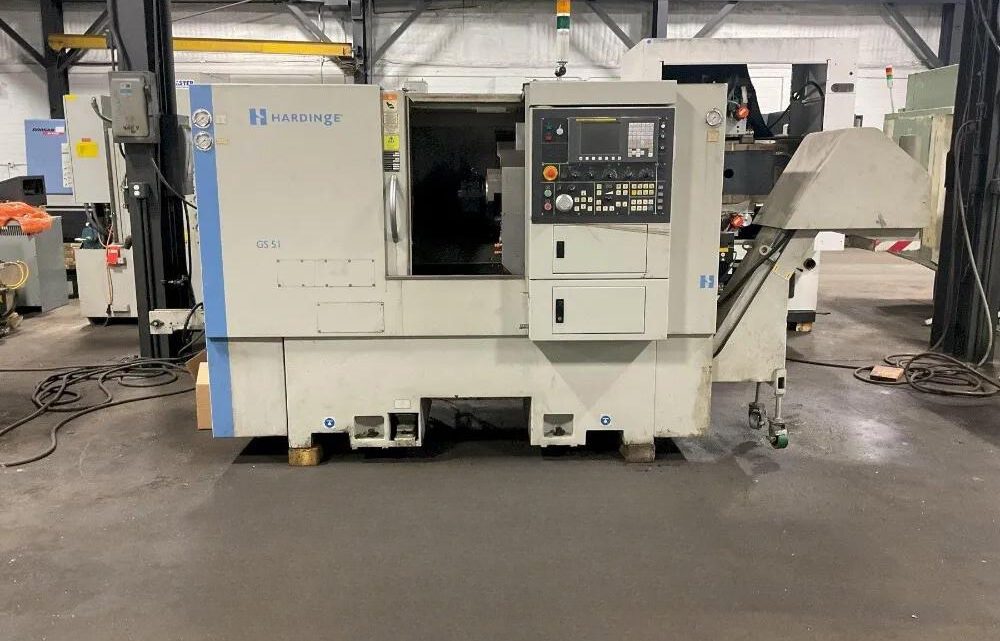
Smart Buyer’s Guide: How to Choose the Right Pre-Owned, Used, Secondhand, Surplus CNC Equipment Before Purchasing Hardinge GS-51MS CNC Lathe made in USA
Here’s a tailored “Smart Buyer’s Guide” for evaluating pre-owned / used / surplus CNC lathes, with a focus on a model like the Hardinge GS-51MS. Use this as a framework (and customize it to your shop, parts, tolerances, and budget).
Why extra care is needed with used CNC lathes
- Lathes are subject to heavy loads, vibrations, and wear—especially on ways, spindles, turrets, and drive trains.
- A minor error or hidden damage can affect accuracy, repeatability, and tool life.
- The cost to refurbish (regrind, replace bearings, rewiring, re-leveling, retrofit) can erode much of the “saving” of buying used.
- For the GS-51MS, which is a relatively high precision machine with live tooling, sub-spindle, and optional bar feed, the complexity multiplies the risk.
So approach a used lathe purchase with diligence and a checklist mindset.
Key specs & features of Hardinge GS-51 / GS-51MS (benchmarks)
Before inspection, know the nominal specs so you can spot exaggerations or mismatches. Below are typical specs and features for GS-51 / GS series machines (and known features of GS-51MS):
| Parameter | Typical / Factory Spec | Notes / Sources |
|---|---|---|
| Chuck size | 8″ (203 mm) | Many listings indicate this size. |
| Max bar capacity | 2″ (50.8 mm) | Common spec line. |
| Max turning diameter (over ways) | ~18″ | Some sources list swing over ways ~18″. |
| Max machining diameter | ~11.1″ (for certain config) | E.g. in an example GS-51 listing: 11.10″. |
| Max machining length | ~16″ | E.g. listing shows 16″ length capacity. |
| Spindle speed | 5,000 rpm (max) | One listing: 5,000 rpm. |
| Spindle motor / power | 25 HP (for some configurations) | One listing: 25 HP. |
| Control | Often Fanuc 0i-TD for MS variant | The GS-51MS listing includes “Fanuc 0i-TD” in the spec. |
| Features (for “MS” version) | Live tooling, sub-spindle, bar feed, parts catcher | The listing for GS-51MS includes these features. |
Use these as your “target spec” to evaluate how close a used machine still is to factory performance.
Pre-purchase inspection & evaluation checklist
Here’s a step-by-step guide to inspect and evaluate a used CNC lathe like the GS-51MS.
| System / Component | What to Check / Test | Why It Matters / Red Flag Indicators |
|---|---|---|
| Seller & documentation | • Verify seller credibility, references • Request full maintenance & repair history (parts replaced, service logs) • Ask for wiring diagrams, manuals, control software versions • Ask for serial number, original purchase date, modifications | Lack of documentation increases hidden risk. |
| Usage, duty history | • Ask for “cutting / active hours” (not just power-on hours) • Ask for typical duty: roughing vs finishing, high loads, materials cut • Ask for downtime, breakdown history | A machine used heavily for rough work is more worn than one used for light finishing. |
| Visual / external condition | • Check for rust, corrosion, paint peeling, scratched surfaces • Look for dents, misalignments, signs of past collisions or repairs • Inspect way covers, chip guards, splash guards • Inspect wiring, conduits, junction boxes, panels for neatness, damage | Poor external condition often correlates with internal neglect. |
| Spindle & bearings | • Run spindle at multiple speeds (low, mid, max) and listen for noise, hum, vibration • Use a test bar or dial indicator to check spindle runout or radial/axial play • Let spindle run for several minutes and check temperature rise • Check spindle taper condition (no damage, burrs) • Inspect lubrication (oil, grease) and seals | Spindle failure or bearing wear is costly and reduces precision. |
| Headstock, gears, drives | • If the lathe has gear ranges or stepped speeds, test gear shifting and listen for gear whine • Inspect gearboxes for noise, backlash • Move the spindle under slow feed and watch behavior • Check for oil leaks around headstock, seals | Gearbox problems are costly to repair. From forums: “spindle noise @ highest speed; housing temperature” are things to check. |
| Guideways, bed, carriage, cross slide, turret slideways | • Inspect bed ways for wear, scoring, scratches • Move carriage and cross slide manually; feel for binding, irregular resistance • Measure backlash in feed screws / ball screws • Use a test indicator to measure straightness and parallelism along bed • Check turret slideways and tool slideways • Inspect lubrication system and way oil passages | Wear here degrades accuracy and may require refurbishment. |
| Turret / tool system / live tooling | • Cycle the turret fully, check for misalignment, hesitation, noise • Test every station in the turret • If equipped with live tooling, run live tool spindle (at speed) and observe vibration, noise, runout • Check tool holders, clamping mechanisms, collets • Check sub-spindle (if present) for correct operation | Tool changer or live tooling issues can cripple productivity. |
| Control, drives & electronics | • Power up the CNC, check control interface, displays, buttons, emergency stops • Inspect drives, amplifiers, servo modules, cabling, connectors • Attempt axis motion in manual and program mode • Load / transfer part programs, check communications ports • Check signal I/O boards, limit / home switches, feedback wiring | Faulty control electronics or drives can be expensive to replace. |
| Coolant / lubrication / fluid systems | • Inspect coolant tank, fluid level, contamination, sludge • Run coolant pump and check flow, pressure, leaks • Inspect coolant piping, seals, hoses • Check oil lubrication systems (way oil, spindle oil) • Inspect chip conveyor (if present) • Check parts catcher, chip removal systems | Poor coolant / lubrication leads to tool wear, corrosion, and damage. |
| Thermal stability & drift | • Let the machine run idle (or under light load) for some time and watch for drift in axes • Move back to reference (home) and see repeatability • Check if the machine has thermal compensation features • Monitor temperature of critical components (spindle, headstock) | Thermal drift can degrade precision, especially well-worn older machines. |
| Test cuts / load test | • Run a real machining cycle (preferably one similar to your intended parts) • Do finishing cuts, roughing cuts, side cuts • Measure parts (roundness, dimensions, tolerances) • Run the machine under load for a sustained period (30+ minutes) • Listen for abnormal noise, vibration, tool deflection, chatter • Cycle-run repeated operations | This is one of the most telling tests. If it fails here, you’ll regret purchase. |
| Foundation, rigidity, installation factors | • Review how the machine is mounted, leveling, anchor bolts, base plates • Check floor flatness, capacity, vibration isolation • Check dimensions, weight, lifting points for disassembly / transport • Estimate costs and risks of transport, re-assembly, re-leveling | A perfect machine can become useless if your shop can’t house or install it properly. |
| Spare parts, support, upgrades | • Ask whether spare parts (bearings, drives, control boards, feedback devices) are still available for this model • Check whether any modifications or retrofits have been done (or can be done) • Ask for included tooling, fixtures, software, communication cables • Check whether control or drive modules are standard / supported | If parts are obsolete, downtime and repair costs skyrocket. |
| Warranty, acceptance, contract terms | • Try to get a limited warranty, or an acceptance test period after installation • Make condition of sale contingent on successful inspection / test • Agree on payment structure (holdback until final checks) • Document existing condition at handover | Even in used-equipment transactions, you want risk mitigation. |
| Price benchmarking & total cost accounting | • Compare the seller’s price vs comparable GS-51 / GS-51MS machines • Adjust for condition, needed rework, rebuild cost • Include transport, rigging, reinstallation, alignment, calibration costs • Include spare parts purchase upfront • Leave margin for unknown repairs | The “discount” must survive real-world hidden costs. |
Additionally, create a scoring matrix (e.g. weight each criterion: spindle, turret, control, wear, support) so you can compare multiple machines side by side objectively.
Red flags / deal killers
If you encounter any of these, consider walking away or heavily discounting:
- Spindle with loud noise, excessive play, or large runout.
- Turret that misaligns, binds, or fails to complete cycles properly.
- Excessive wear on bed ways, deep scratches, metal fatigue.
- Control / drive electronics in very bad shape, burnt components, wiring cobbled.
- Missing or damaged covers, debris inside base, signs of flooding or coolant infiltration.
- Parts / modules that are obsolete, no longer manufactured, or hard to source.
- Seller refusing any test cuts or inspection rights.
- Transport, setup, or installation constraints that make the machine impractical to relocate.
- Major repairs needed (rebore, regrind, gearbox overhaul) that exceed your budget.
From user forums:
“Toolchabge, lube, coolant leaks in enclosure, air leaks, control buttons worn? Spindle hours, way covers, spindle taper clean, tool holders marred?”
Also: “spindle noise @ highest speed … axis noise … does the machine home properly, hit soft limits, do a tool change”
Example: Evaluating a used Hardinge GS-51MS (hypothetical case)
Suppose someone offers you a 2014 Hardinge GS-51MS (as one listing shows). They claim “low hours, all live tooling, full bar feed, sub-spindle, Fanuc 0i-TD control, includes tooling, chip conveyor.” Your steps:
- Get the serial number, purchase invoice, service history, and modifications.
- Compare their spec claims vs nominal: do they really have full live tooling, sub-spindle, etc.
- Perform a visual inspection: look for corrosion, wear, wiring, covers, cleanliness.
- Run spindle tests: at idle and under moderate load; measure runout and noise.
- Cycle turret and live tooling; run the sub-spindle.
- Move carriage along bed, check for irregular movement or binding.
- Run a test part: turning + live tooling operations. Measure the output against tolerance.
- Monitor the machine over time (30 min+) for thermal drift.
- Inspect control, drives, wiring. Try program upload/download, check alarms.
- Assess foundation and transport issues. Do you have rigging capacity?
- Ask what parts they have on hand (bearings, tool holders, etc.).
- Negotiate based on identified repairs or refurbishments needed.
If the machine passes all (or most) of your tests with tolerances within acceptable limits, then you can proceed — but always leave room for unexpected costs.
Summary & best practices (for CNC lathe purchases)
- Don’t rely solely on photos or seller claims — insist on in-person or live-video inspection with full test cuts.
- Know the nominal specs (spindle, travel, turret, speeds) so exaggerations stand out.
- Measure and test everything: spindle, turret, bed, drives, control, tooling, etc.
- Be conservative in your valuation — always factor in refurbishment, spare parts, transport, setup, calibration costs.
- Use contractual protections: inspection windows, payment holdback, limited warranty.
- Bring or hire an experienced machine tool / metrology / CNC expert to help you inspect.
- Favor sellers who can provide full documentation, spare parts, and support.