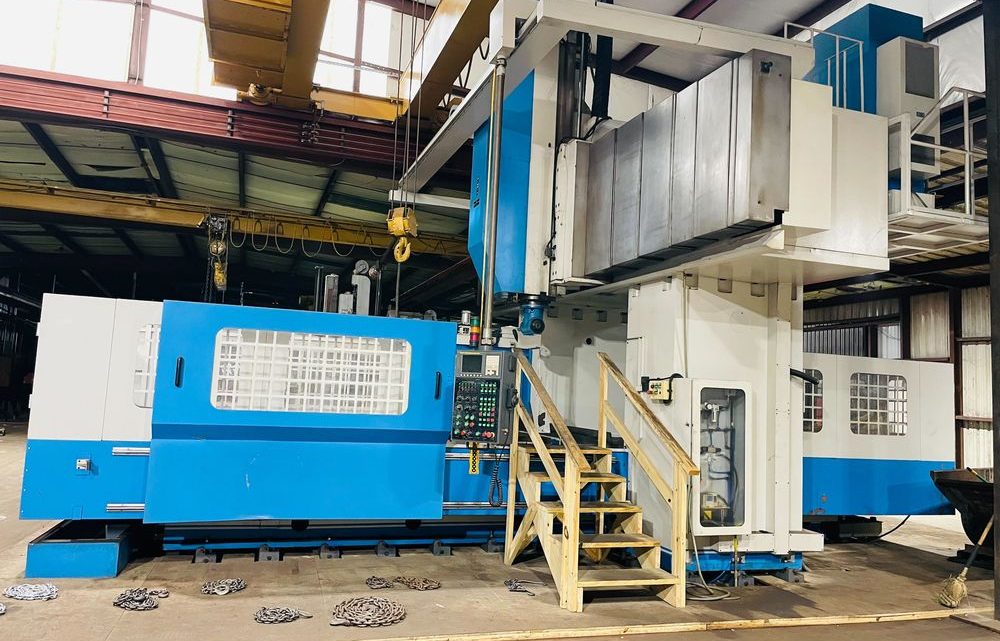
Smart Buyer’s Guide: How to Choose the Right Pre-Owned, Used, Secondhand, Surplus CNC Equipment Before Purchasing Knuth Portamill PBZ Heavy 2025 CNC Double Column Bridge Type Machining Center made in Germany
Here is a Smart Buyer’s Guide tailored for evaluating pre-owned / used / surplus CNC double-column / gantry / portal machines, specifically for something like a Knuth Portamill / PBZ Heavy / portal / gantry style machining center. Use this as a checklist and decision framework. (You should adapt based on the exact variant / size / travel / control.)
Why double-column / portal / gantry machines need special care
Portal / gantry / double-column CNC machines (sometimes called “bridge mills,” “portal mills,” “gantry machining centers”) are heavy, large, and complex. Issues that are less critical in smaller machines become major problems here. Some reasons extra caution is needed:
- The structural integrity of the frame / gantry / columns is central to accuracy; any twist, settlement, or misalignment is amplified over long spans.
- The travel distances and loads are large, so thermal expansion, stiffness, and deflection become critical.
- Reworking or repairing large components is costly (regrinding, straightening, major alignment).
- Transportation, installation, foundation, and leveling challenges are much more significant.
- Spare parts (linear guides, ball screws, massive motors, control modules) may be expensive or harder to source for older or niche models.
- Documentation, history, and support are key since one bad component (drive, encoder, rail) can compromise the whole machine.
So treat a used gantry / double-column purchase as acquiring a large, precision structure, not just a “mill with bigger spans.”
What you should know up front (benchmarking spec sheet)
Before you go inspect, gather as much as possible on the original / nominal specifications of the Knuth PBZ Heavy (or the variant under offer). Some example data and hints:
- Knuth’s product line includes PBZ Heavy gantry / portal CNC machines.
- One listing for a used Knuth PBZ2025 (vertical / gantry style) gives:
• Table size: 78″ × 196″
• Maximum table load: 80,000 lb (~36,287 kg)
• Spindle: 35 HP, 6,000 rpm, taper CT50 - The “PBZ Heavy” line (or “gantry-type / portal type”) is shown on Knuth / sales partner sites under “Gantry-type machining centers” with models like PBZ Heavy 2217, PBZ Heavy 3217, 3220, etc.
- One portal style model (Knuth Portalo C 3019) gives some example dimensioning: 3,000 × 1,500 mm table, up to 9,000 kg table load, spindle speeds up to 6,000 rpm, 24-station tool changer, etc.
From those and other sources, your benchmark spec sheet (for the specific machine under offer) should include:
- Travel in X, Y, Z (or U / V / W if used)
- Table / bed dimensions & usable surface
- Maximum workpiece / table load
- Spindle: power (HP or kW), rpm, taper / interface, torque curve
- Tool changer (type, number of tools, max tool length / weight)
- Guide / rail types (linear guides, box ways)
- Ball screws / drive specs (pitch, diameter, preload, feedback)
- Positioning accuracy & repeatability specs
- Rapid traverse speeds, feed rates
- Control type / brand / version, drive modules, feedback (linear scales / encoders)
- Machine footprint, weight, mounting / base / leveling requirements
- Utilities: power, cooling, hydraulics, coolant, chip removal, (air, vacuum, etc.)
- Any optional axes / functions (e.g. machining head, rotary table, tilting head)
Having this spec sheet allows you to compare “as-is” performance claims with what the machine should do.
Inspection & evaluation checklist for gantry / double-column machines
When you visit the machine (or lead a video / remote inspection), here is a systematic checklist. Bring experts (metrology, mechanical, CNC) and measuring tools (laser, levels, dial indicators, test bars, straightedges).
| System / Area | What to Inspect / Test | Why It Matters & Red Flags |
|---|---|---|
| Seller & Documentation | • Check seller reputation, references, previous sales • Request full maintenance / repair history, replacement parts invoices • Ask for configuration records, upgrades, modifications, rebuilds • Ask for original manuals, electrical schematics, parts lists • Get serial numbers, manufacturing dates, control / drive module history | A well-documented machine gives more confidence; missing or inconsistent documentation is a warning |
| Structural Integrity & Frame / Gantry / Columns | • Visually inspect for cracks, welds, repairs, distortions, fatigue marks • Check columns’ verticality, straightness, alignment • Measure flatness, twist, parallelism across the gantry / crossbeam • Look at mounting surfaces, interface surfaces for wear • Inspect beam deflection, sag, or bending indicators • Look for corrosion, rust, or pitting on exposed castings or surfaces | The structural skeleton is fundamental — any misalignment here is extremely costly to repair or rework |
| Guideways / Rails / Linear Motion | • Inspect linear guides / rails for wear, pitting, galling, scoring • Move axes manually (if safe) to feel for binding, friction, roughness • Check preload condition of guides if applicable • Inspect ways, guide brackets, wipers, covers, scrapers • Inspect support / alignment of rails on beams • Inspect linear scale strips or encoders, check for damage, cleanliness | Worn guides degrade accuracy; misaligned rails cause binding and rapid wear |
| Ball Screws / Drive Systems | • Inspect screws, nuts, support bearings, couplings for wear, damage • Check backlash, lash, backlash compensation • Check gear / belt / coupler systems (if applicable) • Evaluate drive motor / servo / gearboxes • Inspect feedback devices (linear scales, rotary encoders) • Measure whether axes move smoothly and consistently | Drive / feedback degradation erodes positional precision and repeatability |
| Spindle / Machining Head / Headstock | • Run spindle at low → mid → high rpm; listen for noise, hum, vibration • Use test bar / gauge to check runout, radial and axial play • Let machine run for a period and monitor temperature rise • Check spindle taper / interface for wear, damage • Inspect spindle bearings, lubrication, seals • If the head has swiveling / tilting axes, test those motions for rigidity and backlash | Spindle / head issues are among the costliest faults in a machining center |
| Tool Changer / Tool Magazine | • Cycle all tool stations, check reliability, hesitation, misalignment • Inspect grippers, arms, mechanisms, pockets • Test full tool change cycles under power • Check for any collisions, collisions history, damage • Inspect tool holders, length offsets, weight limits • If there’s a tool pre-setting or touch system, test it | Tool changer failure or misalignment can ruin productivity or damage parts |
| Control, Electrical & Drive Electronics | • Power on the control, check interface, buttons, indicators, alarms • Inspect control cabinet: drive modules, power supplies, wiring, cooling, fans • Check servo / drive modules for signs of overheating, corrosion, damage • Load and run sample programs; test axis commands • Inspect I/O boards, limit switches, signal wiring, grounding • Check feedback loop integrity, error counts, alarms history • Verify software / firmware version, backup present | Faulty or marginal electronics are a major failure risk post-purchase |
| Coolant / Chip Removal / Filtration Systems | • Inspect coolant tank, pumps, piping, seals, hoses • Run coolant system, check pressure, flow, leaks • Inspect filtration / settling systems, filters, screens • Inspect chip conveyors, removal systems • Check flushing / coolant jets, lines, nozzles • Inspect lubrication / central lubrication systems for axes, guides, screws | Poor coolant or chip control leads to contamination, accelerated wear, failure |
| Thermal Stability, Drift & Compensation | • Let the machine run idle or lightly for substantial time, monitor drift • Cycle between reference points, measure repeatability • Test movement back and forth over long distances and check geometric consistency • Check whether the machine has thermal compensation features • Monitor temperature of spindle, columns, beams during extended running | On large machines, heat expansion / drift can significantly degrade accuracy |
| Test Cuts / Load Testing Under Real Conditions | • Run a representative part job (heavy machining, finishing, multiple axes) • Measure output: flatness, dimensions, tolerances, surface finish • Cycle through tool changes, direction reversals, retracts • Run for sustained periods (hours) and observe stability, vibration, chatter • Check repeatability by re-machining same reference points • Check edge conditions and boundary travel behavior | Real-world performance is the ultimate test — if it doesn’t deliver, it’s worthless |
| Foundation, Installation & Infrastructure Checks | • Determine machine weight, lifting / crane points, how it was mounted • Inspect base, leveling pads, anchor holes, leveling shims • Check whether buyer’s floor is strong enough, flatness / vibration elements • Assess required utilities: power, cooling water, chilled water, air supply, hydraulic systems • Plan for disassembly, transport, reassembly, alignment, re-leveling • Check shop height clearance, door sizes, overhead crane access • Evaluate if relocation will require realigning or adjusting beams / supports | Even a perfect machine is useless if it cannot be installed or aligned properly |
| Spare Parts, Support, Upgrades & Obsolescence Risk | • Ask what spare parts are still available (guide rails, screws, drives, control boards) • Check whether any parts are custom / proprietary • Ask about past upgrades or retrofits and their quality • Check whether the control / software is still supported • Ask if any spare tooling, fixtures, staff training materials are included | If parts are obsolete or unavailable, downtime risk skyrockets |
| Contract Terms, Warranty & Acceptance | • Request a short acceptance / trial period after installation • Make final payment contingent on passing tests / geometry checks • Document the as-delivered condition in writing, with photos • Request any limited warranty for critical systems • Clarify responsibility / liability during transport, setup, damage • Set inspection rights and possible rejection criteria | These contractual protections reduce your risk of hidden defects |
| Price Benchmarking & Total Cost / ROI Calculation | • Compare the asking price to similar PBZ / portal machines in the market • Adjust for condition, needed refurbishment, missing subsystems • Add in transport, rigging, reassembly, alignment, calibration, downtime costs • Estimate spare parts, maintenance backlog cost • Leave margin for unknown “surprises” • Evaluate ROI vs building new or selecting alternate machine | The “discount” over new can be eaten by hidden costs if you’re not careful |
You may also build a scoring / weighting sheet (e.g. structure = 20 %, drives = 15 %, control = 15 %, spindle = 15 %, test cuts = 15 %, parts risk = 10 %, installation risk = 10 %) to compare multiple candidate machines.
Red Flags / Deal Killers (for gantry / portal machines)
Watch for these warning signs — if they appear, be extremely cautious or walk away:
- Cracks, welds, repairs, deformations in the gantry, columns, crossbeam or base.
- Excessive structural settling or misalignment (measured drift, twist).
- Rail / guideway damage or severe wear (galling, pitting, missing wipers).
- Drive system or screw damage / play / backlash beyond acceptable limits.
- Spindle / head vibration, noise, high runout, overheating.
- Tool changer failing to index or misaligning, repeated tool failures.
- Control / drive electronics in poor condition (burn marks, corrosion, failing modules).
- Missing or obsolete spare parts for critical components.
- Seller refusal to allow full test runs / live machining / independent measurement.
- Unmanageable installation / transport constraints (foundation, crane, shop layout).
- Under-dimensioned utilities (power, cooling, air) or lack of infrastructure.
- Large hidden refurbishment needs (rewelding, straightening, major regrind) that eat into any price advantage.
Example: Applying the Guide to a Candidate Knuth PBZ Heavy
Suppose someone offers you a Knuth PBZ Heavy 2025 variant (or similar portal mill) made in Germany, claiming good condition, low hours, includes all tooling and control. Here’s a sample application:
- Get documentation: serial number, manufacturing year, service logs, modifications.
- Request nominal specs from Knuth or original paperwork (travel, spindle, load).
- Visually inspect the machine: look for cracks, misalignment, repairs, surface condition of columns and beams.
- Check rail / guide condition: look for wear, smoothness, inspect covers / wipers.
- Move axes manually (if safe) and test with drives: look for binding, roughness, backlash.
- Run the spindle at multiple speeds; measure runout, listen, check for heat drift.
- Cycle toolchanger, index tools, test mechanism.
- Load a test machining cycle (heavy + light cuts), measure output parts.
- Run for sustained time to monitor drift, temperature changes, repeatability.
- Inspect control cabinet, drives, wiring, I/O, feedback devices.
- Check coolant, chip removal, lubrication systems.
- Assess how to move / reassemble / realign the machine, floor strength, crane access, foundation work.
- Check spares availability, compatibility of electronics, upgrades potential.
- Negotiate contract and acceptance terms: holdback, trial period, documented condition.
- Compute total landed cost (purchase + transport + rebuild + downtime) and compare with alternatives.
If after all those tests, the machine still performs within tolerances you need, and the total cost remains acceptable, then it’s a candidate — but never proceed without factoring in risk margins.