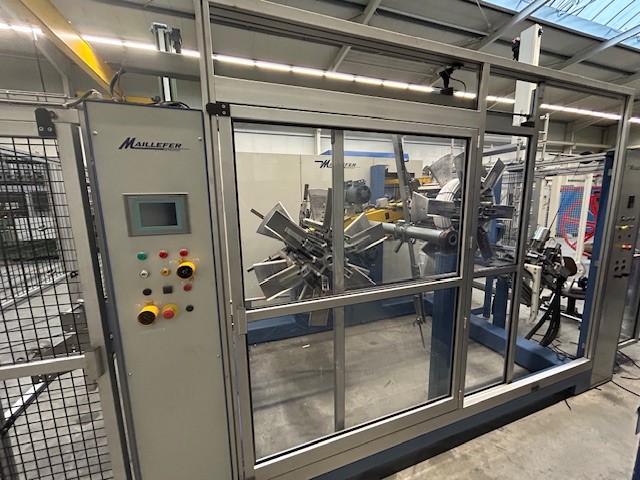
Smart Buyer’s Guide: How to Choose the Right Pre-Owned, Used, Secondhand, Surplus CNC Equipment Before Purchasing MAILLEFER MWB 1300P-CP Fully Automatic Double Coiler made in Switzerland
Here’s a Smart Buyer’s Guide (checklist, risk areas, negotiation approach, validation tips) specifically for evaluating a pre-owned / used / surplus Maillefer MWB 1300P-CP Fully Automatic Double Coiler (Switzerland origin). Because coilers are somewhat different from machine tools, some parts of the checklist differ (mechanical winders, binding heads, drives, control, alignment, etc.). Use this to avoid surprises and get a coiler that reliably integrates into your line.
1. Understand the Machine & Its Role
Before inspecting, clarify exactly what the MWB 1300P-CP must do in your application. Key parameters and features to benchmark:
- The MWB “1300” suggests a maximum coil diameter around 1300 mm (as seen in similar TCA 1300 / MWB 1300 series)
- It is a double coiler / dual-coiler (i.e. two coiling ends) to allow continuous operation (while one coil is being wound/unwound, the other coils)
- The binding (strapping) or “binder head” is a heavily stressed component; in fact, Maillefer has a Binder Head Exchange Program for its MWB / 1300 / TCA coilers, because each coil may need up to ~ 6 binding cycles.
- The coiler must match your tube / pipe / extrusion line in terms of line speed, diameter range, material stiffness / flexibility, torque / tensioning, traversing / traverse motion (layering), drive control, and part handling.
- Also consider: coil unloading / ejection mechanism, operator access, safety, and control / PLC / automation maturity.
So you should go into inspection with your required parameters (max OD, line speed, tube material, etc.) in hand, and measure candidate machines against those.
2. Pre-Purchase Inspection / Evaluation Checklist
Below is a detailed on-site inspection checklist tailored for automatic / dual coilers like the MWB 1300P-CP. Bring along mechanical and electrical test equipment, and ideally someone familiar with coiling / extrusion systems.
| Subsystem / Area | What to Inspect / Test | Acceptable Condition / Warning Signs |
|---|---|---|
| Documentation & History | Request all manuals, parts diagrams, electrical / control schematics, maintenance logs, operating hours, any rebuild or retrofit records | Ideally full documentation. Absence of documentation is a risk. |
| Frame, Base, Structural Integrity | Visual inspection of the frame, welds, structural members, mounting surfaces for distortion, cracks, repairs | No structural cracks or poor weld repairs. Misalignment or deformation is a red flag. |
| Coiling Ends / Shafts / Spindles | Inspect the rotating shafts / mandrels for wear, runout, straightness, bearing condition, coupling alignment | Straight, minimal runout, smooth rotation. Bent shafts, misaligned couplings, or noisy bearings are bad signs |
| Drive Motors / Gearboxes / Couplings | Test drive motors (on/off, ramp, torque), inspect gearboxes (backlash, noise), couplings for misalignment | Motors should run cleanly, gearboxes should have low backlash and no grinding noise. Couplings must be cleanly aligned. |
| Binder / Strapping Head | Because the binder head is heavily used (each coil often requires ~ 6 binding cycles), inspect binder cams, trolleys, strap feed, belts, actuators, sensors, mechanical wear, alignment | Binder head must be precise, with minimal slop. Excessive wear or misalignment indicates future trouble |
| Traversing / Lay Motion System (Traverse Guide, Carriage, Bearings, Rails, Drive Screws or Belts) | Move the traverse carriage across its full path; check for smoothness, backlash, binding zones, lubrication, rail wear, belt / screw condition | Should move smoothly, no “hard spots” or binding. Uneven wear or jerky motion is a concern |
| Synchronization & Control Logic | Coilers generally must synchronize coiling speed, traverse, binding, coil swap-over. Test the control logic / PLC, transitions between coilers, safety interlocks | All transitions should be seamless, no crashes or unexpected lags. Test failover or handover between the two coiling ends |
| Sensors, Encoders, Feedback Systems | Check any position sensors, speed encoders, tension feedback loops, safety sensors, limit switches, optical sensors | Sensors should reliably report values. Missing or malfunctioning sensors reduce control integrity |
| Safety & Covers / Guards | Ensure guarding, safety interlocks, emergency stops, covers over moving parts, proper signage, operator protection features | Safety features must be intact and functional |
| Power / Electrical Cabinet / Wiring | Inspect the electrical cabinet: wiring, control boards, terminal blocks, wiring neatness, signs of overheating, dust, moisture, corrosion | Wiring should be clean and professionally routed. Burn marks, sloppy wiring, or splices are red flags |
| Cooling / Lubrication / Hydraulic / Pneumatic Systems | Check lubrication systems for bearings, traverse guides, any hydraulic / pneumatic actuators (if present), verify hoses, pumps, filters, cleanliness | These must function reliably; failed lubrication or hydraulic systems can accelerate wear |
| Coil Transfer / Ejection / Unloading Mechanism | Inspect coil unloading, trolley / pallet / table mechanisms, sensors for coil presence, movement, motion smoothness | Unloading must be reliable and repeatable; any jam or misfeed issues are detrimental |
| Line Match / Integration Interfaces | Check mechanical / control interfacing to your extrusion line: motor speeds, communication (PLC/fieldbus), alignment of tube path, guidance, dancer system, pullers, etc. | Mismatch in speed, control signals, mechanical alignment can make integration very difficult |
| Operational / Run Test | If possible, run the coiler with a sample tube or cable at line speed: perform a coil build, test coil swap (dual coiling handover), test binding operation, ejection | The coiler must operate smoothly, swap over without hiccups, bind reliably, and eject coil properly |
| Thermal & Long-Run Behavior | Let the coiler run for extended time, monitor temperatures of motors / bearings / gearboxes, check for drift or mechanical loosening | Overheating, drift, or loosening over runtime is concerning |
| Spare Parts / Binder Head Exchange / Consumables | Ask what spare parts come (bearings, belts, coupling elements, sensor modules, binder head spare), and what manufacturer support exists (e.g. Maillefer’s binder head exchange program) | Having a spare binder head or access to reconditioning is valuable |
| Acceptance / Trial Clause / Return Option | Attempt to secure a test / acceptance period after delivery, to verify performance in your environment | Always favorable. If seller refuses, you assume more risk |
This list is specialized for coilers; you can adapt it into a portable checklist.
3. Key Risk Zones & Failure Modes Specific to Coilers / Dual Coilers
Because coilers are part of continuous process lines (extrusion, tube, cable) and subject to high speed, cyclic operation, and mechanical stress, there are some special risk zones to watch out for:
- Binder Head Wear / Misalignment
The binder or strapping head is perhaps the component most subject to wear. Maillefer acknowledges that binder heads wear and thus offers a binder head exchange program for MWB / 1300 / TCA coilers, so this is a known weak link. - Traverse / Layering Carriage Wear
The traverse system (which lays the tube properly across the coil width) can accumulate wear on rails, carriage guides, bearings or belts. Imperfect traverse leads to bad coil lay, gaps, overlaps, or instability. - Drive Motor / Gearbox / Torque Issues Under Load
At high line speeds and with stiff tubing, the coiler must deliver torque and control. Underestimating coupling alignment, gearbox backlash, or motor cooling can lead to failure. - Mis-synchronization / Handover Between Coiling Ends
In dual coilers, the handover between one coil being wound and switching to the second coiler must be flawless. Any lag, mismatch or control gap will cause tension spikes or coil defects. - Sensor / Feedback Failure
Position sensors, encoders, tension feedback loops, and safety sensors are critical. If any of these fail, the coiling control logic may misbehave, leading to coil buildup or damage. - Structural Distortion due to Load / Vibration
High-speed operation, vibration, and cyclic torque stresses can over time loosen mounts, warp structural members, or cause alignment drift. - Electrical / Wiring / Control Aging
PLCs, control boards, wiring looms, connectors, sensor cables may degrade, leading to intermittent failures. - Coil Ejection / Transfer Mechanical Failures
Coil ejection systems (trolleys, pallets, doors, actuators) often see mechanical abuse. Misalignment, sensor failures, or mechanical damage in those systems can stop operation. - Lubrication / Bearing Failures
If bearings, rails, or mechanical parts aren’t properly lubricated, wear will accelerate. Such failures may show subtle signs first, e.g. increased friction or noise.
Because of these, you must inspect with extra care in the binder / traverse / drive / control subsystems.
4. Define Acceptance Criteria & Performance Thresholds (Your “Go / No-Go” Metrics)
Before visiting, define your required tolerances / acceptance ranges, based on your tube / line parameters. Some example acceptance thresholds:
- Maximum allowable shaft run-out on coiling mandrels (e.g. ≤ few hundred micrometers, depending on tube flexibility)
- Acceptable backlash / play in traverse carriage (e.g. within your coil lay tolerance)
- Coiling speed capability (must match or exceed your line speed with margin)
- Binder head accuracy / repeatability (tight strap placement)
- Seamless handover between coiling ends (no sag or tension spike)
- Sensor / encoder feedback functioning across full travel
- No critical alarms or control errors during operation
- Motors, bearings, gearboxes running within acceptable temperatures and with minimal vibration
- Coil ejection / unloading must function reliably
- Control / PLC must integrate with your line logic (communications, commands)
- Structural integrity, no excessive loosening or mechanical drift
Use this list to accept or reject a candidate (or as negotiation basis).
5. Valuation & Pricing Factors
When evaluating asking price and making offers, factor in:
- The condition: if major components (binder head, traverse, drives) need replacement, discount accordingly
- The cost of spares, belt, bearing, coupling, sensor replacements
- The cost and risk of control / PLC repair or upgrade
- The cost of installation, alignment, integration into your line
- The value of included spare parts or backup modules (e.g. spare binder head, etc.)
- The risks due to missing documentation or obscured defects
- The uptime cost during commissioning or debugging
- The availability and cost of spare parts in your region
- Market comparables: what similar MWB 1300 coilers have sold for (if available)
- The “risk premium” you must discount for unknowns
6. Negotiation & Risk Mitigation Strategies
- Run full live tests: Bring a sample tube or mock run to test coiling, handover, binding, ejection
- Cold inspection: Inspect electrical panels, wiring, sensors, belts when machine is off
- Use your checklist to document every defect and deduct cost accordingly
- Negotiate a trial / acceptance period post-install (e.g. run in your line for X hours)
- Require spare or reconditioned binder head as part of package (Maillefer offers such service)
- Share transport / installation risk (who is responsible for damage during handling)
- Require as-delivered alignment / baseline readings so you have something to verify
- Walk-away threshold if a critical acceptance criterion fails
7. Post-Installation & Commissioning / Validation Steps
Once the coiler is delivered and integrated into your line, do the following:
- Alignment & mechanical calibration
Ensure the coiler is aligned in axis with extrusion line, mandrel concentricity, rotation axes. - Baseline measurements & mapping
Measure mandrel run-out, traverse linearity, sensor calibration, motor torque curves, binder head positional accuracy. - Run test coils
Start with shorter / test runs, monitor coil shape, tension stability, binding, ejection. - Simulate handover cycles
Force repeated coiling swaps to test handover logic, synchronism, and control transitions. - Thermal / long-run stability
Run extended coiling runs to observe drift, temperature increases, mechanical looseness. - Log performance & drift
Document behavior and deviations over time to detect wear onset. - Preventive maintenance plan
Set periodic checks on binder head wear, traverse rail lubrication, motor bearings, gearboxes, sensor calibration. - Maintain spare parts stock
Especially for binder components, belts, couplings, sensors, bearings, cables. - Regular recalibration & inspection
After some operational hours, re-verify alignment and accuracy.
8. Summary & Final Tips
- A Maillefer MWB 1300P-CP Fully Automatic Double Coiler is a precision, high-stress component in continuous production lines, especially in tube / extrusion / cable industries.
- The binder head is a known wear hotspot; Maillefer even offers an exchange program for MWB 1300 / binder heads.
- Your inspection must cover mechanical (coiling shafts, traverse, drives), electrical/control, sensor/feedback, binding, ejection systems, and the logic that synchronizes the two coiler halves.
- Define your acceptance thresholds (run-out, backlash, synchronization, binding accuracy) in advance, and use them to reject unacceptable machines or drive negotiation.
- After purchase, do precise alignment, baseline mapping, test coil runs, and set up preventive maintenance and performance monitoring.