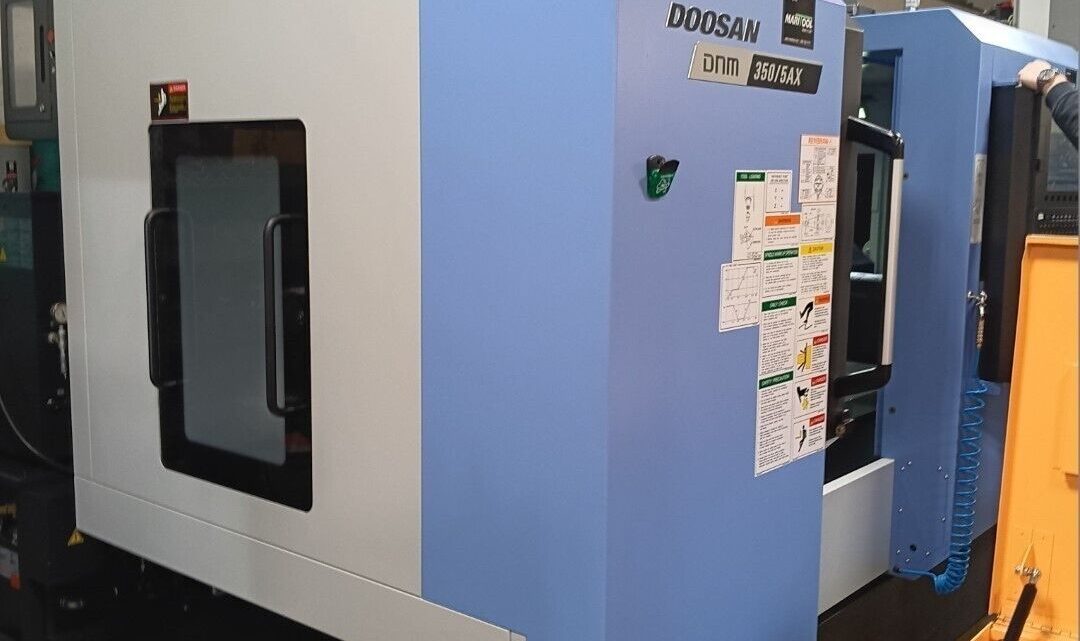
Smart Buyer’s Guide: How to Choose the Right Pre-Owned, Used, Secondhand, Surplus CNC Equipment Before Purchasing Doosan DNM 350 5X CNC Vertical Machining Center (4+1) Axis made in South Korea
Here’s a Smart Buyer’s Guide (inspection checklist, risk areas, negotiation levers, post-installation validation steps) tailored for evaluating a pre-owned / used / surplus 5-axis vertical machining center, specifically something like a Doosan / DN Solutions “DNM 350 / 5AX (4+1 / full 5-axis)” (South Korea origin).
First, I’ll outline what you should expect from a “good” DNM 350/5AX (or equivalent) spec, so you know what to aim for, then the detailed inspection and risk mitigation strategy.
1. Baseline / Nominal Specs & What “As New” Should Be
Before inspecting any used candidate, arm yourself with the factory or catalog specs so you can detect deviations. For the DNM 350/5AX (or similar 5-axis DNM series) here are representative specifications (from DN Solutions / Doosan / dealers) to guide you:
| Parameter | Typical / Quoted Value | Notes, Variants, Caveats |
|---|---|---|
| X travel | ~ 400 mm | “400 mm” X axis travel is common in specs for the 350/5AX model. |
| Y travel | ~ 655 mm | Many catalogs list Y = 655 mm for the 350/5AX. |
| Z travel | ~ 500 mm | Z travel typically ~ 500 mm. |
| Spindle speed | up to ~ 12,000 rpm | A high-speed spindle is common in these machines. |
| Spindle power | ~ 18.6 kW (or in that ballpark) | Many specs list ~ 18.6 kW spindle motor. |
| Tool magazine / stations | up to ~ 60 tools | Typical tool capacity for a 5-axis DNM 350 is ~ 60 tools. |
| Maximum table / workpiece load | ~ 250 kg | One spec sheet lists this. |
| Maximum part dimensions (rotary / table) | Ø ~ 400 mm / height ~ 335 mm | From the spec sheet of “Max. Workpiece Diameter / Height” in DNM 350/5AX data. |
| Rapid traverse / feed rates | ~ 36 m/min in X / Y, ~ 30 m/min in Z (as catalog spec) | In the DNM-350/5AX info table, rapid XY = 36 m/min, Z = 30 m/min. |
| Machine footprint, weight, envelope | ~ 3,209 × 3,150 × 3,109 mm (L×W×H), ~ 8,500 kg | From published machine dimensions for the 350/5AX. |
When assessing a used machine, you’ll want it to match or be reasonably close to these nominal values (or deviations explained via modifications or known upgrades).
Also note: the “5AX” sometimes refers to full simultaneous 5-axis capability (i.e. a tilting / rotating table or tilting head) or 3+2 indexing mode. Be clear whether the candidate machine supports full simultaneous 5-axis or only 3+2 or 4+1. The control, drives, interpolation, and stiffness demands differ.
With those reference benchmarks in hand, you can more objectively evaluate a used unit.
2. Pre-Purchase Inspection & Evaluation Checklist
This is a detailed on-site (or remote, partially) checklist of what to check, test, measure, and how to interpret results. It’s invaluable to bring along a trusted technician, metrology instruments, or conduct an independent inspection if possible.
| Subsystem / Area | What to Inspect / Test | Acceptable / Good Condition / Red Flags |
|---|---|---|
| Documentation & History | Ask for original manuals, electrical / pneumatic / hydraulic / wiring diagrams, maintenance logs, rebuild or modification records, control backup history | Prefer machines with full documentation. If the seller has none, that’s a risk. |
| Machine Frame, Column, Base | Inspect for cracks, welding repairs, distortions, misalignments, signs of structural fatigue, corrosion | No visible structural damage, no improper weld repairs. A crack in a column or base is serious. |
| Guideways / Linear Rails / Ways | Move axes across full travel slowly, inspect for binding, tight spots, uneven friction, backlash, wear streaks, lubrication condition | Consistent motion, smooth transition, no “hard spots” or binding zones. If you feel zones of resistance or varying friction, that’s a warning sign. |
| Ball Screws / Drive Systems / Couplings | Check backlash, free play, endplay, noise, smoothness. Inspect couplings for wear or misalignment | Minimal backlash (within tolerance), smooth motion, no clunks, no misalignment of coupling halves. |
| Axis Motors / Drives / Encoders | Power up axes, jog motions, accelerate, decelerate, check for servo alarms, encoder errors, axis overshoot, response uniformity | All axes operate smoothly, no axis dropping out, no persistent alarms, uniform acceleration/deceleration. Any erratic axis behavior is a red flag. |
| Spindle (Main Spindle) | Run the spindle (without load) at various RPMs, listen for unusual noise, measure run-out (e.g. with test bar or gauge), inspect bearings’ condition (temperature, vibrations) | Quiet, stable operation. Run-out within small limits (your part tolerance). Elevated noise, vibration, or excessive run-out suggest worn bearings or spindle damage. |
| Rotary Table / 5th Axis / Tilting Mechanism | If the machine has integrated B / C axes or tilting table, inspect those mechanisms: test rotation, locking, backlash, angular accuracy, mechanical play, motor performance, synchronization, gear wear | The rotary / trunnion axes must operate smoothly, lock solidly, with minimal play and within angular tolerance. Worn gears or backlash in rotary axes degrade 5-axis precision heavily. |
| Tool Change / Magazine / Tool Holding | Test tool magazine rotation, tool pick / drop, tool change speed, accuracy of tool alignment, tool clamp torque, tool interface condition (e.g. BT40, Big Plus), inspect taper surfaces | Tool changes should be smooth, accurate, repeatable. Worn tapers, chipped surfaces, or misalignment are red flags. |
| Work Table / Fixture Interface | Check flatness of table, condition of fixture mounting surfaces, alignment of rotary table (if integrated), clamping reliability, table leveling & rigidity | Table should be flat and robust. Deformed or worn table surfaces reduce workholding precision. If a rotary table is integrated, check its alignment relative to axes. |
| Control / CNC Hardware / Software | Boot up the control, load test programs, verify all axes are recognized, jog functions, look for diagnostics / error logs, check version, software licenses, availability of I/O, communications, maintenance modes | A working control is essential. If axes aren’t recognized or control crashes, that’s a major deal breaker. Also check whether the control version is current or whether older/unsupported versions will require upgrades. |
| Electrical Cabinets / Wiring | Open panels: inspect for dirt, dust, burnt components, wiring quality, cable trays, connectors, cleanliness, fan cooling, PCB condition. Check for signs of overheating, burnt traces, corrosion | Panels should be clean and well kept. Burnt wires, damaged connectors, patch wiring, or water ingress are red flags. |
| Cooling / Lubrication / Chip Removal Systems | Inspect coolant pumps, coolant lines, filters, skimmers, chip conveyors, filters, lubrication (way oil, ball screw oil systems), oil reservoirs, hoses, condition of coolant (cleanliness, contamination) | All systems should operate. Absence or failure of lubrication or coolant systems is a serious maintenance neglect indicator. |
| Thermal / Drift / Long-Time Stability | If possible, run test cuts or let the machine run for an hour or more and check drift or drift in axes positions, thermal expansion behavior | If the machine’s axes shift over time, or control deviations creep, then thermal stability or internal alignment may be compromised. |
| Test Cuts / Machining Trials | Provide a representative part / block or bring sample geometry. Run a multi-axis machining operation. Measure finished part tolerances (dimensional deviation, surface finish, angular accuracy) | The machine should be able to produce parts within your required tolerances. If it fails, that’s a deal-breaker. |
| Spare Parts / Accessories / Tooling Inventory | Ask what tooling, fixtures, probes, spare parts (spindle bearings, encoders, motors, recirculating ball screws, cables) are included. Also ask about parts availability locally. | A machine with a good spare stock and locally available parts is much less risky. |
| Acceptance / Trial Period / Conditional Clause | Try to negotiate a test / acceptance period after delivery, so you can validate in your environment | Always valuable. If the seller refuses, that raises risk. |
You can adapt this into a standardized inspection form or checklist sheet.
3. Key Risk Areas Specific to 5-Axis / Vertical Machining Centers
Because 5-axis machines are more complex than simple 3-axis VMCs, they carry additional risks and more “failure modes” to watch out for. Here are the biggest trouble zones:
- Rotary / Tilting Axis Wear & Backlash
The B / C / tilt / rotary mechanisms suffer heavier mechanical loads. Wear, backlash, gear teeth wear, or looseness in these axes will degrade accuracy severely in multi-axis operations. - Synchronization / Coupling Errors
In full 5-axis simultaneous interpolation, axes must coordinate precisely. If drives, encoders, or interpolation logic are off, you’ll get contour errors, surface anomalies, or positional defects. - Spindle Stability & Thermal Behavior
High RPM spindles, when combined with multi-axis motion, test the machine’s thermal stability and stiffness. Spindle growth, heating, or bearing defects can manifest worse under heavy multi-axis cuts. - Control / Software Obsolescence / Upgradability
5-axis control systems (interpolation, kinematics, collision avoidance) are more complex and rely on correct software and firmware. Obsolete controls or unsupported versions are riskier to maintain. - Tool Change & Tooling Stress
Frequent tool changes, heavy cutters or high cutting loads, and longer tool overhangs amplify tool-holding and magazine reliability requirements. - Calibration & Kinematic Compensation
5-axis machines require calibration of kinematic models, error maps, and compensation routines (e.g. axis misalignment, non-orthogonality). If the used machine’s calibration is lost or compromised, you may face significant rework. - Complex Maintenance & Higher Downtime Risk
More axes, more motors, more encoders, more wiring, more potential for failures — the complexity multiplies risk.
Therefore, for a 5-axis used machine, you must be more stringent in inspection and demand stronger guarantees.
4. Acceptance Criteria & Performance Thresholds
Before visiting, set your “go / no-go” metrics or thresholds, based on your required parts tolerances. Sample acceptance criteria might include:
- Main spindle run-out: ≤ X µm (e.g. ≤ 5 µm)
- Backlash / axis play: ≤ Y µm (as per part tolerance, maybe ± 2–10 µm)
- Rotary / tilting axis backlash: ≤ small angular threshold (e.g. < 0.01° or better)
- Tool change repeatability & tool alignment error: ≤ your part tolerance
- Ability to machine your most difficult part within tolerance in your materials
- All axes to track smoothly in a contour move (no axis dropouts or jerks)
- Control system fully operational, error logs clean, all axes recognized
- Tool magazine and tool feed reliably operating
- Lubrication / coolant systems functioning
- Documentation and spare parts reasonably available
These thresholds should be in writing and used explicitly during inspection negotiation.
5. Valuation & Pricing Strategy
When comparing the asking price and negotiating, consider:
- The “as-is” vs refurbished / “as-tested” condition: discount appropriately for interventions needed
- The cost to repair / re-calibrate / re-scrape / re-level / realign versus replacement
- The cost and time of spare parts, control upgrades or replacements, mapping of compensation tables
- The cost of transport, dismantling, rigging, reassembly, leveling, and commissioning
- The value (or lack) of included tooling, fixtures, probes, spares
- The age and usage history (hours, multi-axis usage) and how heavily the machine was stressed
- The market comparables in your region for similar 5-axis VMCs
- The risk premium (i.e. a discount for uncertainty or defects)
If you can find a similar machine that’s been recently refurbished / calibrated, that gives you a benchmark for how much refurb cost should be.
6. Negotiation & Risk Mitigation Tactics
- On-site / remote demo: insist on seeing axis motion in all axes (X, Y, Z, B, C or tilt) under test load, and contouring moves.
- “Cold” inspection: Inspect when machine is powered off to check wiring, covers, cleanliness.
- Test piece / trial run: Bring your toughest geometry / part to test in multi-axis mode.
- Conditional acceptance / return window: Negotiate a period post-install where you can reject or demand repair.
- Document every defect: Use your checklist to note every flaw, then deduct those repair costs.
- Spare parts / backup control / wiring / encoders included: If seller includes spares or backup modules, that reduces your risk.
- Factor in “hidden costs” like re-calibration, leveling shifts during transport, axis re-mapping.
- Walk-away criteria: If the machine fails a critical acceptance threshold (e.g. severe axis error, major spindle defect, control failure), be prepared to walk away.
7. After Purchase: Commissioning, Validation & Maintenance
Once the machine arrives and is installed:
- Precision leveling & alignment
Use granite surfaces, precision levels, dial gauges, laser trackers, and check orthogonality, squareness, and flatness. - Machine & axis calibration / compensation
Map error tables, establish compensation for kinematic axes (rotary / tilt), test and verify. - Baseline test parts
Run your most demanding 5-axis jobs; measure deviations, surface quality, contour accuracy. - Tool calibration / measurement
Inspect and re-calibrate tool offsets, tool lengths, tool macro compensation, tool holders. - Document baseline readings
Record run-out, backlash, angular errors, precision of test parts so you can track drift over time. - Implement preventive maintenance
Schedule periodic checks of rotary axes, lubrication, encoder health, vector offsets, thermal growth. - Stock critical spares
Particularly: spares for encoders, servo drives, rotary gearbox components, motors, wiring harnesses, tool holders, sensors. - Monitor performance & drift
Use periodic verification with test pieces to detect when recalibration is needed.
8. Summary & Final Advice
- The 5-axis DNM 350/5AX is a complex, high-capability machine; when buying used, your inspection must be thorough, especially on the rotary / tilt axes, spindle integrity, control & software, and multi-axis synchronization.
- Use reference specs (travel, spindle, tool count, load) to spot deviations or red flags.
- Demand test runs in all axes, measure performance, and retain negotiating power via defects you document.
- Always leave yourself a period to validate performance post-installation.
- After purchase, invest in careful calibration, baseline measurement, and a robust preventive maintenance program.