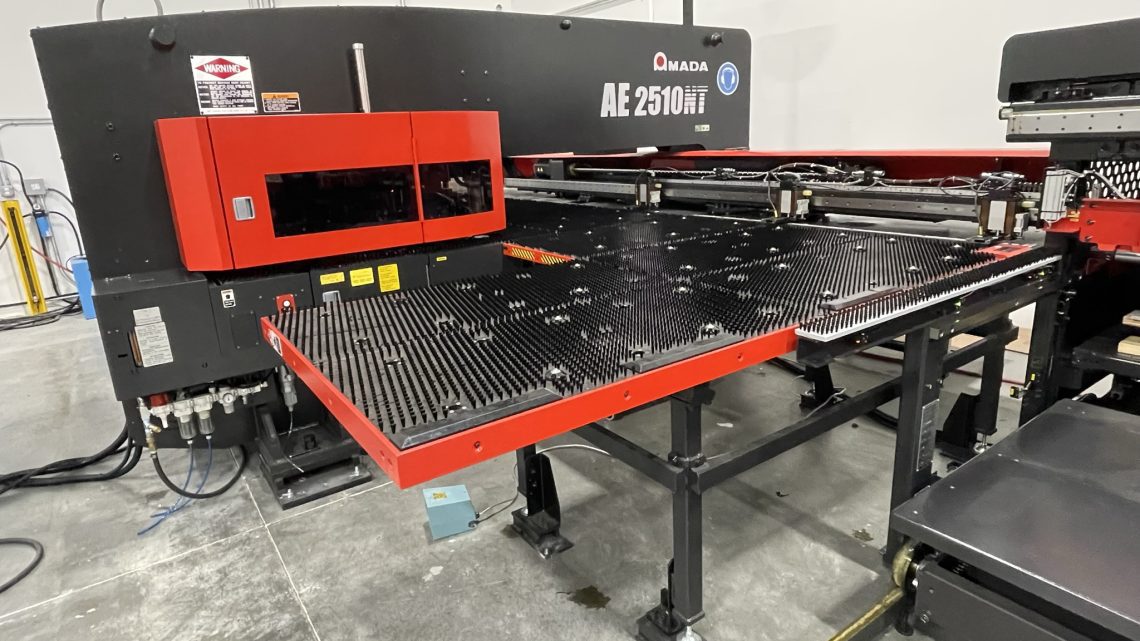
Smart Buyer’s Guide: How to Choose the Right Pre-Owned, Used, Secondhand, Surplus CNC Equipment Before Purchasing Amada AE2510 Turret Punch 22 Tonnes made in Japan
Here’s a Smart Buyer’s Guide / Checklist for evaluating a pre-owned / used / surplus Amada AE2510 (AE-2510 NT / similar) turret punch press (≈ 22-ton class, Japan origin) — what to check, risks, and how to decide whether a deal is solid.
Because turret punches combine mechanical, electrical, tooling, and control subsystems, you need a holistic approach. Below I first sketch the nominal/typical specs of the AE2510 family so you know what to expect, then a detailed inspection checklist, common failure modes, negotiation tips, and post-purchase recommendations.
1. Know the Target Machine: Key Specs & Features
Before inspecting any candidate machine, you should arm yourself with the “as-new” (or typical) specifications and distinguishing features of the AE2510 (or equivalent) so you can spot deviations or red flags.
Typical / Nominal Specs for Amada AE-2510 / AE-2510 NT series
Here’s a summary from datasheets, used listings, and Amada marketing materials:
| Parameter | Typical / Quoted Value | Notes / Variation |
|---|---|---|
| Punching force / tonnage | ~ 200 kN (≈ 20 ton) (some sources list 22 tons) | “20 ton / 200 kN” is common; some advertising uses “22 ton” as a nominal rating |
| Work envelope (X × Y) | 1,270 × 2,500 mm (i.e. 50″ × 98.4″) | This is “without repositioning” travel. With repositioning, effective length can double in Y direction for long sheets. |
| Max sheet thickness | ~ 3.2 mm mild steel (brush table) | Some sources list optional “high density brush table” up to ~6.4 mm |
| Positioning / Accuracy | ±0.10 mm typical (±0.07 mm in “FA mode”) | Accuracy will degrade with wear |
| Hit rate / stroke speed | Up to ~480 strokes/min (for 25.4 mm pitch / 3 mm stroke) | For fine pitches, hit rate will reduce |
| Turret stations / auto indexing | 45 / 51 / 58 stations options; 4 auto-index (AI) stations common | The more stations / auto-index capability, the more flexibility for tool change |
| Turret rotation speed | ~30 rpm (turret advance) / auto-index ~60 rpm in some versions | If turret is sluggish or imprecise, productivity suffers |
| Table / part support / loading | Max part load ~150 kg | Also check clamp / gripper systems |
| Drive / motor / control | Single AC servo motor punch drive, servo drives for axes, no hydraulic drive in NT series | One of the advantages is elimination of hydraulic pump, chiller, fluid maintenance |
| Power / electrical requirements | ~19 kVA supply (for full operation) | Standby / idle power is low (no hydraulic system) |
Knowing these numbers gives you a benchmark to compare against what a used machine is delivering or claiming.
Also consult Amada brochures (e.g. AE-NT series) for additional features (e.g. brush table, power vacuum slug pull, compact footprint, network connectivity)
2. Pre-Purchase Inspection Checklist & Key Focus Areas
Below is a detailed checklist and things to measure / test (in the shop or during inspection). Ideally, bring a trusted technician or use a third-party inspection if you can’t personally verify everything.
| Subsystem / Area | What to Inspect / Test | Acceptable Condition / Warning Signs |
|---|---|---|
| Documentation & History | Ask for original manuals, electrical / hydraulic / pneumatic schematics, parts lists, maintenance logs, refurbishment history, tool inventories | A machine with no records is risky. Prefer ones with documented periodic maintenance, part replacements, and ideally refurbishment by authorized service. |
| Frame, Base & Structural Integrity | Check for cracks, weld repairs, distortion, corrosion, straightness, mounting integrity | Any cracked frame, welded patches, or distortions are serious red flags; structural rigidity is essential for punching precision |
| Guides, Linear Rails, Bearings | For the X and Y axes, check for smooth motion, backlash, uneven wear, binding at ends, alignment over full travel | Significant backlash, binding zones, or “tight spots” are warning signs |
| Drive Systems (Ball screws / Rack & Pinion / Servo Motors / Couplings) | Verify backlash, integrity of couplings, uniform motion, encoder feedback, temperature and noise during movement | Any irregular motion or electronic faults are red flags |
| Punch Ram / Slide / Die Clearance System | Inspect the ram guides, slide surfaces, clearance settings, wear, squareness to table | Excessive wear or misalignment in the punch ram will degrade cut quality and tool life |
| Turret & Indexing Mechanism | Rotate turret (if possible) manually or under slow drive; check indexing accuracy, slop, motor torque, auto-indexing stations, cam tracks, locking mechanism | Turret must index cleanly and lock solidly; any looseness, hesitation, noise or misalignment is a red flag |
| Tool Holding / Tool Change Mechanism | Inspect tool seating surfaces, turret holders, insertion / ejection mechanisms, locking pins, alignment | Worn holders or misaligned seating will reduce punch accuracy and cause tool damage |
| Clamping / Gripper System / Workholding | Inspect pneumatic / hydraulic / servo clamps, gripper arms, vacuum or pressure systems, clamps’ force and repeatability | If clamping is weak, erratic, or jammed, part registration will be inconsistent |
| Table / Support Structure | Check table flatness, condition of brush table or slats, drainage or coolant channels, leveling | Warped or worn table or support surfaces can lead to part distortion |
| Electrical / Control Cabinet / Wiring | Open the panel: check for cleanliness, overheating, burnt wires, dust, corrosion, spare slots, circuit breakers, signal wiring integrity | Any signs of heat damage, poor wiring, missing covers, or broken connectors are red flags |
| CNC / Control / Software | Boot up the control, check axis homing, load sample programs, check functions, verify tool library, backups, error codes | If control is nonfunctional, obsolete, or unsupported, repairs or replacement will be expensive |
| Servo Drives / Amplifiers / Encoders | Check status LEDs, measure signals, test axes motion, check encoder feedback loops, look for error logs | Any unstable axis, encoder misreads, or drive faults are critical issues |
| Hydraulics / Pneumatics (if applicable) | Check for leaks, pressure stability, response times, valves, cylinders, filters | Leaks, sticking valves, or poor pressure regulation reduce reliability |
| Coolant / Lubrication System | Inspect lubrication lines, pumps, filters, reservoirs, cleanliness, oil condition, flow to ways and guides | A dried-up or clogged lubrication system is often a sign of neglect; parts may suffer accelerated wear |
| Slug Removal / Vacuum / Chip Handling | Check the vacuum or air slug removal system, slug conveyors, chip trays, blowers, filters | If slug removal is inadequate or broken, punched parts may clog or damage tooling |
| Run / Punch Tests | Request a demonstration punch on sample material (ideally same thickness / material you plan to use). Check cut quality, burr, alignment, repeatability, hole accuracy. Also test with small pitch / dense punching | If the machine can’t cleanly punch test parts to your spec, that’s a disqualifier |
| Thermal / Stability Checks | In a longer test, check for drift or thermal expansion issues during continuous operation | If machine diverges over time or axes “creep,” structural or thermal issues may be present |
| Spare Parts / Tooling Inventory | Ask what punches, dies, tool holders, spare parts, replacement parts are included. Check availability of tooling for your region | If the seller is not including tooling or there is no supply chain nearby, you may have big additional cost |
| Acceptance / Test Period Clause | Negotiate a trial / acceptance period (e.g. X days, test two or three production runs) or ability to reject if performance isn’t satisfactory | Always leave a window to verify performance before “locking in” the purchase |
3. Common Failure Modes & Warning Signs
When buying a used turret punch, these are recurring issues to watch for — catching them early (or avoiding machines with them) saves cost and downtime.
| Problem / Failure Mode | Symptoms / How to Detect | Implication / Cost |
|---|---|---|
| Worn or slack turret indexing / lost positional accuracy | Turret mis-indexes, slop, hammering, backlash in indexing | Turret rebuild or replacement, major downtime |
| Damaged tool holders or turret seats | Poor tool seating, punch wobble, inconsistent cuts | Tool damage, accuracy loss, increased scrap |
| Deteriorated or damaged punch ram guides | Inconsistent ram trajectories, uneven cutting | Requires regrinding or re-manufacturing surfaces or guide components |
| Faulty servo / drive systems or failing encoders | Axis errors, servo alarms, inconsistent motion | High repair cost, possibly obsolete parts |
| Control / software obsolescence or unsupported systems | Control crashes, inability to load modern programs or integrate | May need replacement of control, software, or retrofit which is expensive |
| Worn clamping / gripper assemblies | Loss of clamping force, mispositioned parts, slippage | Part registration failure, scrap parts |
| Poor maintenance of lubrication / coolant systems | Dry or rusty ways, excessive wear, clogged lubrication lines | Accelerated wear, potential expensive line rebuilds |
| Electrical damage, wiring faults, fan / power supply failures | Burned wiring, broken connectors, intermittent faults | Electrical repair, component replacement |
| Undocumented repairs or modifications | Unknown changes, spliced wiring, mismatched components, poor workmanship | Hard to maintain, diagnose, or service in future |
A machine with unreliable turret indexing, poor drive health, or control obsolescence is typically not worth the risk unless heavily discounted.
4. Setting Acceptance Criteria & Thresholds
Before viewing or negotiating, define your “go / no-go” thresholds. Some example acceptance criteria might include:
- Turret indexing error ≤ X mm (e.g. ≤ 0.05 mm)
- Punching repeatability / hole position deviation ≤ your part tolerance
- Ability to cleanly punch your toughest material / thickness
- No major electrical or drive faults
- Control system operational and able to accept your program formats
- Turret rotation speed within spec
- Clamping system holds consistently
- Tool seating and punch / die alignment is within tolerance
- Total cost (purchase + refurbishment + transport) remains within budget compared to replacement or alternative machine
Document your criteria in writing and use them during inspection and negotiation.
5. Valuation & Pricing Considerations
When assessing whether the asking price is fair, consider the following:
- Compare with new machines or comparable used machines. The AE-NT series offers energy savings (since no hydraulics)
- Deduct expected refurbishment / repair cost (turret rebuild, drives, wiring, control upgrades, parts replacement).
- Factor in cost of transporting, dismantling, reinstalling, alignment, tooling setup.
- Consider tooling inventory: having good punches, dies, holders included adds value.
- Consider the availability of spare parts and support in your region
- Age and hours of usage matter, but more important is condition, maintenance history, and how heavily it was used.
- If the seller is offering only “as-is, where-is,” you must assume full risk (i.e. no warranty, no borrowing period).
Used listings for AE2510 machines, e.g.:
- AE-2510 NT, 2012, ~17,500 h, 200 kN, work area 2,500 × 1,270 mm, 51 stations, 0.7 kW to 3.5 kW power draw, ±0.1 mm tolerance, turret speed 30 rpm, etc.
- Amada AE 2510, 22 ton, 50″ × 98.4″, 45 stations, auto-indexing, etc.
- AE2510NT, 22 ton, 45 stations (4 AI), 50″ × 98″ basic stroke travel, etc.
Use those as rough market comparators but adjust for condition, upgrades, included tooling, and distance.
6. Negotiation & Red Flag Strategies
- Live demo & full testing: Insist on a full test on your material and program, not just “machine powers on.”
- Unplug it / view cold: Inspect when not in operation to find hidden wiring problems, internal damage, or corrosion.
- Test parts / “golden part” check: Use a representative part to verify accuracy, punch quality, throughput.
- Conditional acceptance clause: Allow a test/acceptance window (e.g. X days or Y production hours) to return or adjust if machine underperforms.
- Clearly list defects: Use your inspection checklist, note every defect, and deduct cost into your offer.
- Spare part availability as bargaining chip: If control or electronics are obsolete or parts are rare, demand discount or spares.
- Factor in logistic risk: Dismantling, shipping, reassembly, leveling and calibration risk should be assigned and priced.
- Walk away threshold: If a machine fails one of your key acceptance criteria, be willing to pass.
7. After Purchase: Commissioning & Validation
Once you’ve acquired the machine and installed it:
- Precision alignment & leveling: Use granite surface plates, dial gauges, laser alignment tools to align axes, ensure perpendicularity, reference surfaces.
- Baseline test runs: Run your most demanding part(s), measure hole accuracy, burr, repeatability, throughput. Record and compare to your acceptance benchmarks.
- Tooling check / calibration: Inspect all punches, dies, holders; replace anything worn beyond tolerance; confirm seating and alignment.
- Loop calibration / compensation: If the control supports compensation (backlash, distortion, interpolation), calibrate and zero them.
- Preventive maintenance schedule: Immediately establish intervals for lubrication, checking turret indexing, checking drive systems, cleaning filters, electrical inspections.
- Spare parts / tool stock: Stock critical spares for drives, encoders, punch/die sets, sensors, control boards.
- Performance monitoring: Keep logs of part accuracy, any drift over time, failures or alarms. Use this to detect wear or need for repair.
8. Summary & Final Tips
- The Amada AE2510 / AE-NT series is a capable turret punch with servo drive (no hydraulics), decent hit rates, and good flexibility. Use its nominal specs (force, travel, turret stations, control) as your benchmark.
- A used machine should be inspected holistically — mechanical, electrical, tooling, control subsystems all matter.
- Turret indexing, drive health, control condition, wear on slide / guides, and tool seating are among the most critical risk areas.
- Define your acceptance tolerances in advance, insist on demonstrations/test runs, and negotiate defects into price.
- After purchase, calibrate thoroughly, validate with production parts, and set up preventive maintenance.