Performance Matters: How to Choose a Reliable Pre-Owned, Used, Surplus, Secondhand HELLER RB50/1600 Radial Drill made in Germany without Regret
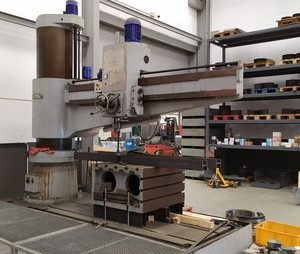
Here’s a tailored guide—along with cautionary tips—to help you wisely evaluate a pre-owned / surplus / secondhand HELLER RB50/1600 radial drill (made in Germany) so you can minimize risk and avoid costly surprises. (If you already have a listing you’re considering, I can help you walk through that too.)
Why buying a used radial drill has risks — and rewards
Radial drills are robust machines, designed for heavy drilling and boring over wide areas. A well-maintained one can last many decades. But many used machines suffer from neglect, wear, or undocumented repairs. The reward of a good used machine is that you can get a large, capable tool at a fraction of the new cost. The risk is hidden damage, misalignment, obsolete parts, or more cost in refurbishing than you expected.
For the HELLER RB50/1600 in particular, here’s what is known from existing listings and specs (as a reference baseline) and where trouble often lies:
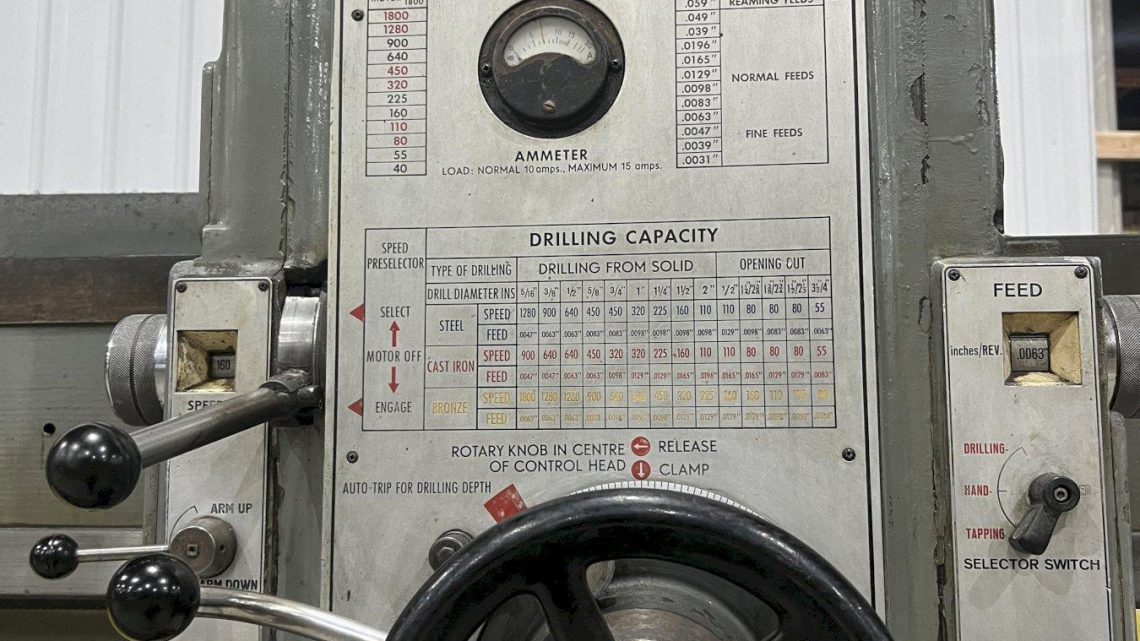
- According to a seller listing, the RB50/1600 has 12 speeds, from ~ 40 to ~ 1,800 rpm with a #5 Morse taper spindle.
- Another listing states its specs: drilling capacity ~ 50 mm in steel, throat depth (“column span”) 1,600 mm, horizontal travel 1,250 mm, vertical quill travel 315 mm.
- The machine is heavy (~ 3.5 tonnes in one listing) and was built with industrial duty in mind.
Given its design, common wear or failure points include the column & arm sliding mechanism, the radial arm’s alignment and clamping, spindle and quill bearings, the gearboxes or speed-change mechanisms, the head feed / quill feed, and the machine’s rigidity under load.
So your job as buyer is to verify structural integrity, mechanical motion fidelity, alignment, serviceability, and parts support.
A Structured Evaluation Checklist & Process
Here’s a recommended multi-stage approach. Bring someone with mechanical / machine tool experience if possible, and plan to spend a few hours (or a full day) on inspection, testing, and measurement.
| Stage | What to Do / Check | What to Look / Warning Signs | Why It Matters |
|---|---|---|---|
| Pre-visit / Documentation Request | Ask the seller for maintenance logs, repair history, parts replaced, any rebuilds, original documentation or manuals, serial number, build date, and past utilization (hours, cycles). | No records, vague claims (e.g. “not much used”), missing or partially missing panels, spares inventory unknown. | Helps you assess how much the machine has been “used hard,” how well it was maintained, and what parts might already have been swapped. |
| Visual & Structural Inspection | Walk around the machine, examine column, base, radial arm, guides, way surfaces, locking clamps, welding repairs, guard panels, rust, chips, oil leakage, wear on sliding surfaces. | Cracks, weld repairs, pitting, corrosion, misaligned covers, obvious “band-aid” fixes, sloppy guards, missing covers, signs of impact. | Structural or gross damage is often prohibitive to correct; signs of neglect hint at deeper problems. |
| Column, Arm, Slideways, and Clamping | Move the radial arm inward/outward, up/down (if adjustable), test its movement under manual force. Test its locking/clamping mechanism (with hydraulic or mechanical locks). Check for smoothness, binding, play, backlash, uneven resistance. | Arm sag, binding or stiff regions, uneven friction, inability to lock tightly, looseness even when clamps engaged, visible wear on sliding surfaces or rails. | The arm-column slide is critical to positioning; if it’s sloppy or worn, precision suffers and repair is expensive. |
| Quill / Spindle / Head Movement | Operate the quill feed (if possible), manually move the spindle head (in and out), test feed mechanism. Use a dial indicator to measure spindle runout (by holding a test bar). Listen for bearing noise or roughness. | Excessive runout, roughness, bearing noise, play or wobble, broken or worn quill rack/pinion, jerky or inconsistent motion. | A failed spindle or worn bearings degrade drilling accuracy and are expensive to repair/replace. |
| Gearbox / Speed-change Mechanism | If possible, cycle through all speed settings (or have the operator do so), from low to high. Listen for unusual noises (grinding, whining, clashing). Check that speed selection, shift mechanism, and reversal (if present) work cleanly. | Grinding, backlash, shifting hesitation, gear chatter, slipping, missing gears, suspect synchros. | The gearbox is central to usable speed ranges. If it’s compromised, you might lose many usable speeds or have to rebuild. |
| Motor, Electrical & Drives | Inspect the motor(s) and drive systems. Check wiring, panels, fuses, connectors. If motor(s) can be run, observe for vibration, overload, overheating, smoothness. | Signs of overheating, burnt wires, poor insulation, modifications or splices, mismatched or non-original wiring, motor hum or vibration. | Motor or drive failure is expensive; poor electrical condition may hide future reliability problems. |
| Clamps, Locks, Brakes | Test all clamps, locks, and brakes (for the radial arm, head, column) under load. Check that locks engage firmly, don’t slip, and release cleanly. | Slippage under load, stuck or stiff locks, worn or missing locking surfaces, hydraulic leak (if hydraulic locks), weak or decayed springs. | A radial drill must hold position under load; any slipping or movement under load is unacceptable. |
| Test Cut / Drilling Operation | If the seller permits, run a drilling test on a sample block. Drill different diameters, spindle speeds, at different arm positions. Measure alignment, straightness, runout, hole accuracy, surface finish. Use a dial test indicator or measure holes after with gauges. | Hole taper, inaccuracy, chatter, tool deflection, inconsistent performance across arm positions, poor surface finish. | The machine must be able to perform to spec under real load. This is the ultimate “proof.” |
| Alignment & Straightness Checks | Use a surface plate or known straight edge to check that the radial arm is level, that travel is straight, that the head moves parallel. Use dial indicators to test runout and alignment across the travel. | Non-linear movement, cumulative error over travel, “wobble” or tilt in the arm, sag in extended positions. | Even if everything “runs,” if the geometry is off, usable accuracy is lost. |
| Parts, Spares & Supportability | Ask whether spare parts (bearings, gears, sliding elements, locks, motor) are still available from HELLER or third parties. Check for aftermarket compatibility or alternative suppliers. | Parts are obsolete, long lead times, custom or one-off parts, no available spares, dismantled or missing key components. | If you can’t get parts, a broken machine becomes a paperweight. Always assume you’ll need wear parts or repairs. |
| Cost Estimation & Risk Buffering | Based on your inspection, estimate the cost to refurbish (bearings, repairs, alignment, cleaning). Subtract that from your target purchase price. Leave ample margin for unknowns (~20–30 %). | Underestimating repair costs or assuming “it won’t be that bad.” | A seemingly cheap machine may become expensive once you start opening it. |
| Rigging, Transport & Reinstallation Risk | Because radial drills involve heavy columns and arms, disassembly, transport, and reassembly may misalign components, damage surfaces, or stress welds. Choose experienced rigging, plan supports, and budget for post-move alignment. | Signs that machine was moved improperly before (scratches, realignment marks, bent parts), seller cannot support disassembly or alignment. | A perfect machine can be ruined by poor moving. Ensure careful dismantling and reassembly. |
| Inspection by Expert / Third Party | If possible, bring a machine tool expert, or arrange for a third-party inspection. They may detect subtle misalignments, micro-cracks, or wear you might miss. | Seller refuses inspection, no detailed access allowed, unwillingness to allow tests. | The minor cost of expert inspection is often justified by avoiding a disastrous purchase. |
| Negotiation Levers & Return Terms | Use your findings (wear, needed repairs, parts risk) as leverage in negotiating price. Ask for acceptance/test period, return allowance, or limited warranty if possible. | Seller insists “as is, no inspection” or refuses any return. | You want options if you only later discover deeper faults. |
Specific Issues & “Gotchas” for HELLER / RB50/1600
From what is known about this model and radial drills in general, here are additional cautions and recommendations specific to this machine:
- Arm sag / deflection toward the outer reach
As the radial arm extends outward, sag and deflection increase. Even a small bend or wear can drastically affect accuracy in outer positions. Always test drilling at full extension to see if holes drift or taper. - Column to arm slide wear
The surfaces or rails on which the arm slides up and down or swivels may wear unevenly over time. These are often heavily loaded surfaces and can show grooves, scoring, or clearance irregularities. These are harder to repair than replaced. - Locking and clamping strength
If the arm, column, or head locks are weak or slipping (especially under load), performance is compromised. It’s not sufficient that locks “hold” in a no-load test; test them under moderate load. - Gearbox complexity / parts mismatch
Because this machine has multiple speed stages, the gearbox and its internal gears, shafts, bearings present many points of failure or wear. Sometimes parts get mixed or replaced from incompatible machines. Listen for odd gear noise, backlash, or shift hesitation. - Quill feed mechanism wear / backlash
The rack/pinion (or screw / feed) that drives the quill can wear, causing backlash or “jumping.” Even slight looseness here harms drill accuracy, especially for reaming or boring. - Bearing and spindle integrity
If spindle bearings have slammed or been overloaded, inner races may be cracked. Sometimes vibration/fatigue damage isn’t obvious until runout is tested under load. - Corrosion, rust, and lubrication neglect
If the machine has sat idle for years, lubrication may have leaked or dried, and rust could form on sliding or internal surfaces. Inspect internal sliding surfaces, rails, and bearings carefully. - Obsolete / hard-to-get parts
While HELLER (a reputable German maker) may have had spares historically, some gear sets or internal components might be discontinued. Check whether compatible aftermarket or refurbished parts can be found. - Hidden misrepair or “patch jobs”
Sometimes sellers or prior owners will patch cracked welds, regrind surfaces, or “tweak” components to mask deeper damage. Be cautious of fresh welds, inconsistent colors, or “blended” surfaces on guiding ways or sliding parts. - Rigging / relocation damage
Previous dismantling or moves may have stressed components or shifted alignment. Particularly check for alignment marks, unusual wear not matching usage, or signs of forced fits.
What a “Good Candidate” Looks Like (Ideal Characteristics)
When you find a RB50/1600 that exhibits many of these “good” traits, that becomes a safer bet:
- Clean and consistent maintenance documentation
- Smooth, even motion of radial arm and column, with minimal play
- Strong, secure locks and clamps with no slip under moderate load
- Spindle with minimal runout, quiet operation, no harsh bearing noise
- Gearbox shifts cleanly through all speeds with no grinding
- Quill feed mechanism tight, smooth, with low backlash
- No obvious structural damage, weld repairs, or cracks in castings
- Parts availability is confirmed (bearings, gear sets, spares)
- Seller allows test drills under load and returns or inspection
- Transport / rigging history is reasonable, or seller supports proper dismantling and reassembly
- Price leaves margin to address minor refurbishing or adjustment costs