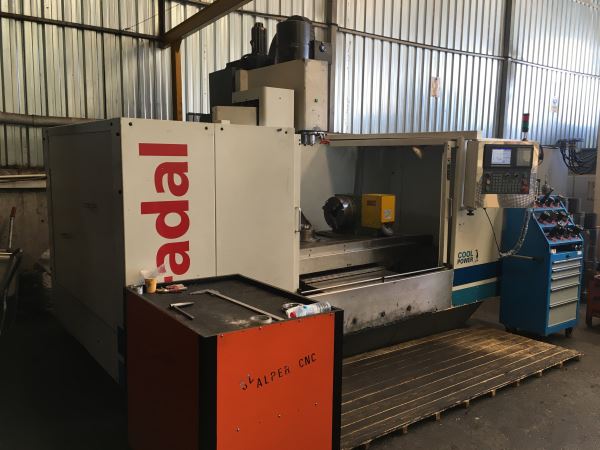
Performance Matters: How to Choose a Reliable Pre-Owned, Used, Surplus, Secondhand FADAL VMC 6030 CNC Vertical Machining Center made in USA without Regret
If you’re considering buying a pre-owned / surplus / secondhand FADAL VMC-6030 (USA-made) — or any large CNC vertical machining center — there are many pitfalls, but also clear methods to substantially de-risk your decision. Below is a structured guide — with specific tips and warning signs — to help you choose wisely, minimize regrets, and (ideally) end up with a machine that will serve you well.
Why the risk is real (and also why a smart buy can pay off)
Before diving into the checklist, it helps to understand why such machines often come with hidden problems — and what makes a “good” one.
- A VMC-6030 is a large, heavy, high-capacity machine. Its sheer size, weight, and complexity mean moving, re-leveling, aligning, and repair can be expensive.
- Many used machines were run hard for years before being sidelined; wear on spindles, ball screws, way surfaces, and electronics is common.
- The control electronics, drives, wiring, and parts availability are critical in a CNC — these age and can be difficult (or expensive) to replace.
- On the upside: a well-chosen used VMC-6030 (if still structurally sound, and with decent control and parts support) can offer decades of service at a much lower cost than buying new or large-capacity modern machines.
Thus, your aim is to filter for structural integrity, remaining useful life, repairability, and supportability.
What to understand about the FADAL VMC-6030
Before inspecting a candidate, familiarize yourself with the machine’s baseline specs and typical failure modes:
- Travel: ~ X = 1,524 mm, Y = 762 mm, Z = 762 mm (approximate)
- Spindle: often up to 10,000 RPM (CAT-40) in many rebuilds/listings
- Control: many use FADAL’s own 88HS or “HS”-series control; many older FADALs have been upgraded “guts” to HS style in aftermarket/refurbishing setups
- Over time, common wear items include spindle bearings, ball screws (especially on long axes), way surfaces / wipers, way covers, control boards, wiring, and the tool changer mechanism (especially the arm, gripper, magazine, and actuators).
Knowing those aspects helps you interpret what you see on the floor.
A 7-Stage Inspection & Evaluation Framework
Below is a stepwise procedure (which you could turn into a checklist) to evaluate a candidate machine. You should ideally bring a skilled CNC technician (or friend) with you.
| Stage | What to Do / Check | What to Watch for / Red Flags | Why It Matters |
|---|---|---|---|
| 1. Pre-visit preparation & documentation | Request maintenance logs, repair history, upgrade history, original manuals, parts lists. Ask about total hours (power ON, cutting, axis motion). | No or sketchy maintenance records; contradictory hours; missing documentation. | A machine that’s been well-maintained is far less risky. |
| 2. Visual & structural inspection | Walk all around the machine. Inspect the frame, column, base, covers, way wipers, way cover condition, work envelope surfaces, bolts, welds, leaks, rust, condition of sheet metal guards. | Cracks, distortion, weld repairs, heavy rust or pitting, dented covers, missing covers, sloppy guards, chips inside covers. | Structural damage is costly or impossible to fully repair; signs of neglect often correlate with deeper issues. |
| 3. Way surfaces, guideways, wipers, ball screws | Pull back the way covers or wipers (if possible) and inspect the guide surfaces. Run axes by hand or jog at slow speed. Look for scoring, wear grooves, burs, unevenness. Use feeler gauges to check for consistent clearance. Check ball screw ends and nut areas for wear / play. | Deep grooves, pitting, uneven wear, metal-to-metal contact, binding, excessive play, backlash. | These are fundamental to precision and life expectancy. |
| 4. Spindle & bearings | Run the spindle (if seller allows) at various speeds, listen for noise, feel for vibration or wobble. Use a dial indicator on a test bar to check runout. Ask about known spindle rebuilds. | Noise, vibration, excessive heat, wobble, runout beyond spec, evidence of water intrusion, oil in places it shouldn’t be. | Spindle or bearing failure is one of the most expensive repairs. |
| 5. Control electronics, drives, wiring | Open the electrical cabinet (if allowed); inspect wire routing, cleanliness, signs of burn marks, modifications, loose wires, disconnected cables. Check drives, servo amplifiers, power supplies. Power up the control and run through the diagnostic screens (if possible). | Burned insulation, odd wire splices, lots of aftermarket wiring, missing cover panels, signs of overheating, broken connectors. Control boards that smell burnt or visibly damaged. | The control and electronics are the brain — if that is unreliable or obsolete, the “good” mechanical parts may be useless. |
| 6. Tool changer, coolant system, auxiliary systems | Test (or see videos) of tool change operation. Inspect grippers, magazines, arm rails, sensors, switches. Inspect coolant tank, pumps, hoses, piping, filters, coolant cleanliness or contamination. Check pumps, overflow, leak points. | Tool changer that fails under motion, misalignment, slips, sensor errors. Coolant leaks, rust or scaling inside tank, hose cracks, clogged filters, dead pumps. | These systems can cause downtime, part quality issues, and repair bills. |
| 7. Test cuts, accuracy checks, performance run | Ask the seller (or insist) for a trial part run. Use a test block (a known geometry), cut a circle or boss, then measure accuracy, repeatability, surface finish. Use a laser interferometer or ballbar test if possible. Inspect backlash, interpolation, jumpiness. Also check axis velocities, acceleration, and smoothness. | Inability to hit dimensions, excessive taper, poor surface finish, vibration chatter, stalls, lost motion. Also, servo or control errors during motion. | Ultimately, the machine must do accurate work. Even if mechanical is good, if control/servo is weak it’s worthless. |
It’s also wise to photograph / video every test and suspicious area (when seller allows) so you can analyze later or share with an expert.
Additionally, listen attentively during motion — odd sounds, squeaks, grinding, or chatter are red flags.
Additional Considerations & Red Flags
- Parts availability & support: Check whether replacement spindles, bearings, servo drives, pulleys, motor controllers, encoders, and tool-changer parts (grippers, arms) are still available for FADAL or aftermarket equivalents.
- Upgradability / modern retrofit: Some older FADALs have been retrofitted (e.g. newer electronics, drives). Ask whether the candidate machine has been upgraded, and whether future upgrades (e.g. spindle inverter, 4th axis, modern control) are feasible.
- Machine relocation / rigging risk: Transport, moving, uncrating, leveling, and reinstallation can introduce alignment errors, damage wiring or cabling, or misalign guides. Be sure the seller or rigging contractor is experienced in heavy machine moves.
- Inspection by third-party expert: As many community users recommend, getting a local FADAL service technician or experienced CNC inspector to check the machine is worth the inspection fee (often $200–$500) to avoid a catastrophic purchase.
- Seller credibility and warranty / return period: Prefer sellers who offer a short test-acceptance period, return window, or some warranty. Be wary of “as is, where is” sales with no recourse.
- Cost estimation of upcoming repairs: Based on what you find, make a conservative repair/replacement budget (spindle rebuilds, ball screw replacement, control board fixes) and subtract that from your offer price.
- Opportunity cost of downtime: Even a used machine that “works” might require a lot of early maintenance; factor that risk into your decision.
What a “Safe Buy” Looks Like (Ideal Characteristics)
A less risky candidate machine would ideally present with:
- Clean, documented maintenance history (PM logs, parts replaced)
- Moderate total hours (not extremely overworked)
- Upgraded or healthy control electronics and original wiring
- Minimal wear on way surfaces, good wipers, minimal scoring
- Spindle in good condition (low runout, no noise, proper bearings)
- Tool changer working reliably with minimal faults
- Functional coolant, lubrication, and auxiliary systems
- Good structural condition (no cracks, distortion, rust)
- Willingness of seller to allow tests, returns, or inspection pass
- Parts availability (either OEM or aftermarket)
- Reasonable price margin allowing for a buffer of unexpected repairs
If you find a machine that checks most of these boxes, your chances of getting a reliable VMC-6030 go way up.