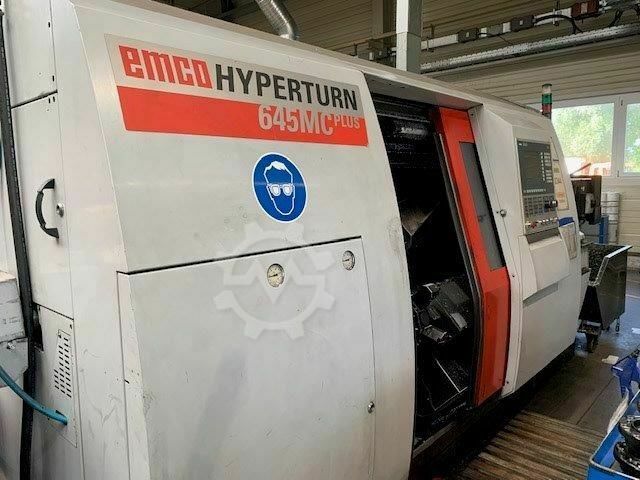
Performance Matters: How to Choose a Reliable Pre-Owned, Used, Surplus, Secondhand EMCO Hyperturn 645 MC Plus CNC Turning Center made in Austria without Regret
Acquiring a pre-owned / surplus / secondhand EMCO Hyperturn 645 MC Plus (or variant) demands the same care and rigour as any high-end multi-task CNC turning/milling center. These machines are complex (multi-axes, turrets, driven tools, indexed axes, counter-spindle, etc.), and failures or misalignments can lead to severe losses in accuracy, productivity, or downtime. Below is a disciplined methodology (plus a Hyperturn-specific lens) to help you choose “without regret.”
What is the EMCO Hyperturn 645 MC Plus — baseline understanding & critical subsystems
Before diving into inspection, you must understand what makes the machine “tick,” what its expected capabilities are, and where the Achilles’ heels commonly lie.
Typical specs & capabilities
From public listings and datasheets, here are relevant reference specifications for the Hyperturn 645/665 MC Plus family.
| Spec | Approx / Typical Value | Notes / Comments |
|---|---|---|
| Number of axes / multi-tasking features | Up to 8-axis (X1, X2, Z1, Z2, Y, B, C, etc.) in full configuration | |
| Spindle speed (main and counter) | ~0–7000 rpm | |
| Drive power (main / counter spindles) | ~22 kW (some variants higher) | |
| Travel (X, Y, Z) & ranges | X1/X2 ~ 280/205 mm, Y ±50 mm, Z ~ 900/750/750 mm in multi-spindle config | |
| Swing / turning diameter | ~430 mm turning diameter, swing over bed ~600 mm | |
| Turrets / driven tools / indexing | Dual turrets, driven tools, B- or C-axis indexing, tool magazine (e.g. 24 stations) | |
| Machine footprint, weight | ~3,400 × 2,550 mm footprint, ~9,500 kg weight (for many variants) | |
| Cooling / coolant / oil systems | Integrated coolant pumps, filtration, temperature control / monitoring | |
| Control / CNC | Many are delivered with Siemens 840D controls |
Because the 645 MC Plus is a “multi-tasking” lathe (turning + milling / driven tools / indexing axes), its complexity is higher than a plain lathe. Thus, each subsystem (spindles, turrets, axes, electronics, hydraulics, cooling) must be examined meticulously.
Core principles for buying any used CNC / lathe — recap
Before drilling into Hyperturn-specifics, here are universal best practices when buying used CNC equipment (especially lathes / multitaskers):
- Demand complete documentation: mechanical drawings, control manuals, wiring diagrams, spare parts lists, calibration reports, service logs.
- Know the service / maintenance history: repairs, overhauls, crash incidents, replacement parts, upgrades.
- Check hours of operation: “power-on hours” and “cutting hours” (or loaded hours) are more meaningful than total runtime.
- Verify parts availability / obsolescence risk (control cards, spares, electronics).
- Use contract protections: conditional acceptance, holdbacks, warranty clauses, trial runs after delivery.
- Always do on-site physical & functional tests: motion, backlash, spindle health, turret indexing, load tests, etc.
- Estimate a “repair / refurbishment budget” and deduct that from your offer.
- Know your walk-away threshold — i.e., how much risk or cost you will accept before rejecting the deal.
Many of these points are also emphasized in guides to buying used CNC lathes and machines in general.
Tailored inspection & evaluation checklist for EMCO Hyperturn 645 MC Plus
Below is a structured checklist you (or your technical team) should use when inspecting a candidate machine. Where possible, bring precision measuring tools, vibration analyzers, diagnostic gear, and ideally someone experienced in multi-task / complex CNC machines.
A. Pre-visit preparation & information requests
Before going to the site, ask the seller for:
- Machine serial number / build data
You’ll later be able to contact EMCO (or authorized dealers/spares houses) to verify parts support, original factory specs, and past retrofits. - Original machine specifications & configuration sheet
(Which axes, which turrets, control version, options installed) — you need to know exactly what you’re buying. - Full service / repair log
All maintenance tasks, repairs, replacements, crash history, torque limiter events, parts swaps, etc. - Control version, software version, upgrade history
E.g. if it has Siemens 840D, which release, whether CNC cards were replaced, whether software licenses are current. - Hours of use
Breakdown of power-on hours, cutting / loaded hours, idle hours, etc. - Recent calibration / alignment reports
If they have documents on last geometric calibration, laser checks, axis alignment, this is gold. - Spare parts inventory (if any) offered
Especially for consumables, wear parts, critical electronics. - Photos & video / remote inspection
Request high-resolution photos of interior mechanical components, wiring, turrets, spindles, etc. Or even a video call walkthrough.
If the seller resists providing these, it’s already a red flag.
B. Structural & visual inspection
Once on-site:
- Frame, base, machine casting
- Inspect castings and base for cracks, weld repairs, distortion, corrosion, surface anomalies.
- Look for evidence of overheating (discoloration), stress fractures, or modifications.
- Way covers, telescopic covers, scrapers / guards
- Check for integrity, alignment, tears, misalignment, damage.
- Damaged covers often indicate neglect — chips or coolant may have penetrated internal slides.
- Guideways, linear rails, carriages
- Visually inspect for scoring, pitting, uneven wear.
- Check lubrication condition (oil films, cleanliness).
- Turrets & tool stations
- Inspect indexing face, coupling surfaces, turret keys, turret drive motors, guarding.
- Look for play, signs of misalignment, wear or impact.
- Spindle housings, bearings, seals
- Check for coolant leakage, seal integrity, discoloration, coolant stains.
- Look for signs of overheating or lubricant contamination.
- Hydraulic / pneumatic / lubrication systems
- Inspect lines, fittings, reservoirs, pump units, filters.
- Leaks, bent lines, or sloppy maintenance are red flags.
- Coolant / filtration system
- Inspect the coolant tank, pumps, piping, filtration media.
- Check cleanliness of coolant, clarity, suspended solids, corrosion.
- Electrical cabinets & wiring
- Open cabinets to inspect wiring harnesses, look for heat damage, discoloration, dust, moisture, corrosion.
- Check for properly sized wiring, secure routing, strain reliefs.
- Covers, access panels, safety interlocks
- Make sure all doors, covers, interlocks, sensors, e-stops are functioning.
C. Motion, axes & mechanical precision testing
- Jog / slow motion test of axes
- Using low feed rates, move each axis (X, Y, Z, B, C) through its full range, observing for smoothness, binding, or rough spots.
- Backlash / reversal test
- Use a dial indicator to test reversals and backlash in each axis (especially near extremities).
- Positioning accuracy / linear deviation
- If possible, mount a precision indicator or laser interferometer to check axis linear error over full travel.
- Repeatability tests
- Execute repeated moves between fixed points and measure consistency.
- Turret indexing & tool change cycles
- Cycle turrets many times (forward & reverse), including insert changes.
- Check for hesitation, misindexing, error messages, mispicks.
- Spindle testing (main + counter)
- Run spindle unloaded over its speed range (low → medium → high). Listen for abnormal noise or vibration.
- Mount test bar / tool and measure runout (radial, axial).
- Let spindle run for an extended period (30-60 min) to check for temperature rise or changes in behaviour.
- Vibration / spectral analysis
- If available, mount an accelerometer on spindle housing, turret, or key structural points and record vibration signatures.
- Control interpolation, coordinated moves
- Run programmed moves combining multiple axes (e.g., simultaneous X+Y+B+C moves). Watch for smoothness, latency, stutter, or axis mis-synchronization.
- Alarm / error log review
- Dive into the CNC’s event / fault history; multiple prior errors or warnings indicate deeper issues.
- Torque limiter / collision detection test
- If the machine has torque limiters or collision protection, test them in a subtle (safe) way to ensure they respond.
D. Functional / load & real-cut testing
- Light test cut / machining pass
- Bring in a test workpiece (steel, aluminum, similar material) and run a representative turning + milling operation (if applicable).
- Monitor how the machine handles load: chatter, tool deflection, vibration, stability.
- After cutting, measure dimensional accuracy (diameter, taper, profile) and surface finish.
- Thermal stability / warm-up drift
- Let the machine run under light load for an hour or more, then re-check alignment or position offsets to detect drift.
- Extended run / production test (if allowed)
- If the seller permits, run the machine for multiple hours in “production mode” to catch creeping faults.
- Full turret + spindle use in cycle
- Use both turrets, tool changes, and perhaps features like B-axis rotations or C-axis functions.
- Simulate real production sequences to stress all subsystems.
E. Interpretation, risk scoring & decision making
As you conduct the above, you must decide whether the machine is “safe,” “conditionally acceptable,” or “too risky.” Here’s how to interpret findings:
| Observation | Severity / Risk | Implication / Likely Repair Cost | Leverage for Negotiation or Deal-breaker |
|---|---|---|---|
| Slight way wear or minor surface scoring | Low to moderate | May require re-lapping or light regrind | Ask for discount or minor rework before purchase |
| Moderate backlash or axis wear | Medium | May need ballscrew replacement, realignment or axis rebuild | Deduct estimated cost or insist on contractor-provided remedy |
| Turret indexing hesitation, misalignment, or tool pick errors | Medium to high | Turret rebuild, key replacement, coupling rework | Major negotiation leverage, possibly reject |
| Spindle runout beyond tolerance, noise, vibration | High | Spindle rebuild / bearing replacement, or worse | High discount or walk-away |
| Repeated control / drive errors in log | High | Electronics or module replacement required | Potential deal-breaker, demand correction |
| Structural cracks, weld repairs on frame | Very high / deal-breaker | Frame repair is often impractical or costly | Reject or demand deep discount |
| Obsolete / unsupported control cards / drives | High | Upgrading electronics could cost as much as machine value | Significant risk — build cost buffer or avoid machine |
| Coolant / lubricant system failure or contamination | Medium | Replacement of pumps, filters, cleaning required | Deduct or ask for parts inclusion |
| Missing or incomplete documentation | Moderate to high | Repair and maintenance become much harder | Ask seller to provide or reduce price accordingly |
You can create a risk score (e.g. 1–10) based on the severity and multiplicity of issues. Machines scoring in the lower bracket (1–3) are ideal; 4–6 are negotiable if the discount compensates; above 7 may be unwise unless you have deep resources and are expecting major rebuild.
Contractual protections and purchase tactics
No matter how good the inspection, unknowns always remain. Use contractual safeguards to protect your investment.
- Conditional sale / “acceptance after trial”
Make your purchase contingent on performance tests in your facility (with your operators, parts, running hours). - Payment holdback / escrow
Retain 10–20 % of purchase price until final acceptance and performance verification. - Include spare parts / wear package
Negotiate that the seller provides critical spare parts (e.g. turrets keys, seals, bearing sets, interface boards). - Short-term warranty / guarantee
While used equipment rarely comes with long warranties, push for 30–90 days coverage for major systems (spindle, drives, turrets). - Final installation / alignment in your shop
Require that the seller or seller’s contractor handle the final rigging, leveling, alignment, calibration, then allow you to test. - Penalties / refund conditions
Define tolerances (positional, repeatability, drift) that, if unmet, trigger repair costs paid by seller or partial refund. - Clear allocation of transport / insurance / liability
Make sure shipping, rigging, insurance, and damage in transit are clearly addressed. - Title / liability transfer upon acceptance
Hold title until after satisfactory acceptance. - Upgrade / modernization clause
If you discover a critical obsolete module, have a clause for seller to reimburse or facilitate its replacement.
Hyperturn-specific risk zones & red flags to watch especially carefully
Because the Hyperturn 645 MC Plus is a multi-task machine, here are particular subsystems or features where issues tend to surface, which deserve special scrutiny:
- Turret systems & coupling
Dual turrets, indexing mechanisms, driven-tool coupling surfaces, turret keys, and tool holders are heavily stressed. Worn coupling faces or misalignments degrade part accuracy severely. Any hesitation, noise, or play during turret indexing is a warning sign. - Driven / milling tools, B-axis, C-axis function
These add complexity and failure modes. Check that the B / C axes command smoothly under load, that torque couplings or clamping mechanisms function, and that driven tools behave as expected (no abnormal vibration, errors, heat). - Dual spindles & synchronization
If your machine has a counter-spindle or twin spindle configuration, synchronization, alignment, and matching of axes between spindles is critical. Any mismatch leads to part inaccuracy or scrap. - Cooling / thermal control across multiple spindles
A multi-spindle machine has more thermal drift potential. Check whether coolant, thermal control, coolant return, temperature regulation, and sensor systems are functioning and stable. - Control electronics complexity / modularity
The more axes and functions, the more electronics (servo drives, interface cards, specialized modules). Obsolescence or failures in one module can immobilize the machine. - Software, licensing, CNC upgrades
In some cases, older Hyperturn machines may have customized or legacy software. Confirm that software licenses, updates, patches, and support are intact. - Machine geometry / alignment drift under load
Given the complexity, if structural or guiding systems are worn or misaligned, multi-axis interpolated motion will suffer exponentially more than in a simple lathe. - Calibration / metrology history
For precise machining, multi-task machines must remain within tight alignment tolerances. Ask for records of laser calibration, alignment reports, full machine metrology sweeps. - Wear on linear axes / anti-backlash systems
Given many axes (X, Y, Z, etc.), backlash compensation, preload, and wear on ball screws or linear guides matter more.
If you detect wear or drift in any of these subsystems, discount heavily or require the seller to rebuild / certify.
Decision heuristics: When to walk, when to negotiate, when to commit
- If mechanical and structural condition is excellent, turret and spindles test cleanly, electronics are intact, and control software is upgradable, that machine is a prime candidate.
- If you see one moderate issue (e.g. slight turret wear) but everything else is solid, that can be tolerated with a repair allowance and in-contract protections.
- If you uncover two or more serious issues (spindle runout, turret misindexing, repeated control faults), proceed only if your discount + repair buffer leaves you well under “safe value.”
- Never overpay. Always subtract a realistic refurbishment budget from your offer, based on what you uncovered.
- If availability of spare parts or control modules is questionable, the risk climbs steeply — favor machines with documented ongoing support.
- Retain the option to walk away if your acceptance tests fail.