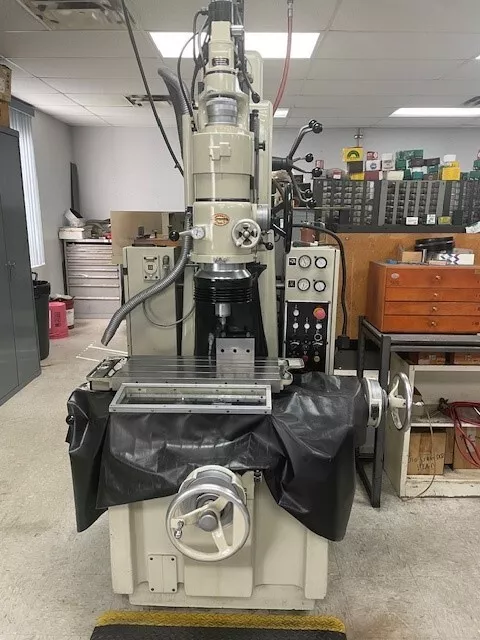
Make the Right Move: Proven Steps to Evaluate a Used, Second-Hand, Surplus, Pre-Owned MOORE G-18 JIG Grinder Machine made in USA
Here’s a specialist’s, step-by-step guide to help you evaluate and choose a good used / surplus / second-hand / pre-owned Moore G-18 jig grinder (made in USA). It is built around risk mitigation, technical inspection, performance validation, and contractual protection.
1. Know What You’re Looking At — Baseline Specs & Architecture
Before you make a trip, arm yourself with reference specs so you can spot deviations. Here’s what a typical Moore G-18 offers (or what sellers often list):
| Parameter | Typical / Reference Value | Notes / Sources |
|---|---|---|
| Table size | 11″ × 24″ | Common spec for G-18 models |
| Table travel (X × Y) | 18″ × 11″ (or similar) | Many listings for G-18 show this travel |
| Vertical spindle / head travel | ~ 3-5/8″ quill + ~12-5/8″ vertical slide | Remanufacturing data lists these values |
| Table top to wheel collet | 2″ (min) to 18″ (max) | Standard range seen in many specs |
| Spindle speeds / grinding wheel RPM | Variable head speeds (e.g. 9,000–40,000 RPM) | Some G-18 listings mention similar ranges |
| Spindle feed / cycles | ~2 to 120 cycles per minute (or more) | Common feed spec in listings |
If the machine you inspect deviates wildly from these (say, much reduced travel, incorrect spindle speed range, etc.), that’s a red flag you must explore.
Also, Moore (Moore Special Tool Co.) historically builds these in the USA; parts, spindles, and technical support often originate from U.S. supply chains.
2. Pre-Visit Remote Screening
Before spending travel time or money, screen possibilities to eliminate weak candidates:
- Ask for complete spec sheets, serial number, build year, and photographs (interior, column, head, table, wiring cabinet).
- Request video of the machine running (axis motions, head travel, grinding spindle).
- Ask about recent repairs, spares replaced, maintenance history.
- Ask whether the seller allows a power-on test under your supervision.
- Check whether key spares (bearings, spindles, motor parts) are still available for that serial/model.
- Look at market listings / comparables (for example, used G-18 units going for some different prices in some markets)
If those remote signals are weak (missing docs, no willingness to power-on, vague answers), skip or negotiate hard.
3. On-Site Inspection & Technical Audit
Once you get onsite, systematically walk through these checks. Use calibrated measurement tools (indicator, micrometers, test bars) wherever possible.
A. Structural & Machine Condition
- Frame & Column Integrity
- Inspect for cracks, weld repairs, distortions, or damage in the base, column, saddle.
- Use a straightedge, surface plate, and precision rule to detect twist or warp.
- Table & Slideways
- Check the table for flatness, burrs, worn spots, or gouges.
- Move the table cross and longitudinally by hand or at slow feed, listening/feeling for roughness, binding, or deviations.
- Inspect the guide surfaces, wipers, lubrication points, and wear patterns.
- Lead Screws / Nut Assemblies
- Measure for backlash. Push-forward/backward in X and Y and record play.
- Inspect screw threads for wear, signs of pitting, scuffing, or corrosion.
- Check whether screws and nuts are adequately lubricated, and whether oil bath or drip lubrication (if present) is intact.
- Vertical Slide / Quill / Head
- Move the grinding head vertical slide and quill; look for stiction, uneven motion, or binding.
- Measure alignment: check whether the spindle axis is perpendicular to table surface in multiple positions.
- Spindle / Grinding Head
- Mount a test arbor or collet, spin up to rated head speed, and measure runout (radial / axial) using dial indicator or better.
- Listen/feel for noise, bearing wear, vibration.
- Run for extended period and record temperature rise.
- Table to Collet Distance / Travel
- Confirm the distance range between table top and wheel collet (min to max) matches spec (e.g. 2″ to 18″).
- Check that the head can move to extremes without collision or interference.
- Spindle Feed / Cycles
- Test the head’s feed / infeed movement or cycles (if equipped).
- Ensure feed rate control is stable and responsive over full travel.
B. Electrical / Controls / Motors
- Control Cabinet & Wiring
- Inspect inside for burnt wiring, corrosion, overheated connectors, dust or moisture.
- Verify proper wire routing, labeling, cable strain reliefs, shielding.
- Drive Motors & Amplifiers
- If servo or motorized axes are present, test drives for faults, noise, heating, and correct supply voltages.
- Check motor nameplates vs expected voltage/phase (matching your shop).
- Power-on Diagnostics & Controls
- Power up the control / readout (if any).
- Verify axis motion commands, limits, overrides.
- Inspect error logs, alarms, diagnostic history.
- Sensors, Limit Switches, Interlocks
- Check limit switches for each axis and verify they trigger motion shutdown.
- Confirm any safety interlocks, E-stop, door covers, etc. function correctly.
C. Functional / Performance Testing
- Dry Motion / No Grinding Runs
- Move axes through full travels without load. Listen for smoothness, clicks, stiffness, or deviation.
- Cycle the head up/down, table traverse, full travel test.
- Sample Grinding / Test Piece
- Prepare a test workpiece (material and shape relevant to your future use).
- Run a simple grinding operation (hole, face, or contour) and measure results: surface finish, dimensional accuracy, surface runout, concentricity.
- Vary feed rates / infeed and examine whether quality remains consistent.
- Stability Under Load / Extended Run
- Run multiple cycles under load for 30–60 minutes. Monitor drift in dimensions, thermal growth, measure before/after for deviation.
- Watch for control or mechanical backlash, drift, vibration.
- Repeatability / Return to Zero Tests
- Command the same position multiple times and measure positional deviation.
- Check whether backlash compensation, zero-return behavior is consistent.
- Extreme Position / Corner Case Test
- Command the head and table to extremes (full reach) and test performance there.
- Especially important on older machines.
D. Documentation, History & Parts
- Machine Identity / Serial / Build Data
- Verify the serial or model number, year of build, factory documentation if available.
- Confirm any retrofit or rework history.
- Maintenance / Repair History
- Request logs of past repairs, replaced parts (spindle bearings, slides, screws, head rebuilds).
- Look for gaps in logs (long unattended periods).
- Spare Parts & Tooling Availability
- Verify that critical spares (spindle bearings, motors, collets, control modules) are still available.
- If the machine uses legacy or discontinued parts, understand procurement difficulty and lead times.
- Refurbishment / Rebuilds
- Check whether any major rebuild has been done (rewinding motors, regrinding slides, spindle rebuilds).
- Inspect those repairs for quality — sloppy jobs may introduce misalignment.
- Contract / Warranty / Acceptance Terms
- Negotiate a conditional acceptance or holdback period after installation.
- Insist on the seller guaranteeing certain performance specs (e.g. positional accuracy, spindle runout) under your test.
4. Red Flags & Pitfalls to Avoid
Even if everything looks smooth at first glance, these issues can sink a deal later:
- Severe wear on slides, tables, or lead screws (hard to repair).
- Spindle bearings that rattle, overheat, or show excessive runout.
- Mechanical modifications or repairs that altered alignment (if not corrected properly).
- Missing or damaged control / electronics with no replacement path.
- Obsolete or unavailable parts particular to the G-18 model.
- Hydraulic / lubrication failure or neglect (if lubrication systems are faulty).
- Heavy corrosion, rust, or damage from environmental exposure.
- Poor wiring, dangerous modifications, or rewiring by amateurs.
- Seller’s refusal to allow a full performance test or to document parameters.
- No test parts, or inability to reproduce grinding performance.
If you spot any severe red flag without acceptable discount or remedy, either reduce your offer heavily or walk away.
5. Acceptance Criteria & Decision Rules
Before you commit, set measurable thresholds you’re willing to accept. Some examples:
- Spindle runout (radial + axial) no worse than a few microns (as your process requires).
- Positional repeatability in X and Y within tolerance (e.g. ± 5 µm or better for your work).
- Table and head travel match spec closely (within a few percent).
- Sample grind results meet your required finish & dimensional tolerance.
- Performance under load remains stable over time (no drift).
- All safety and control features operate reliably.
- Cost of any remedial repairs / spares remains within your budget margin.
- Transfer of all documentation, spares list, manuals, and control parameters.
- Seller allows post-installation acceptance or holdback until tests passed.
6. Logistics, Installation & Commissioning
Once you decide to purchase, ensure:
- You arrange proper rigging, lifting, crate/cradle support, and movement with care (these machines are precise and heavy).
- At site, level and align the base, grouting if necessary to reduce vibration and ensure stability.
- Calibrate axes, inspect alignments (table to head, head perpendicularity), check slides after settling.
- Re-run the same test parts to verify everything holds after relocation.
- Keep spares (bearings, collets, belts, wiring) on hand.