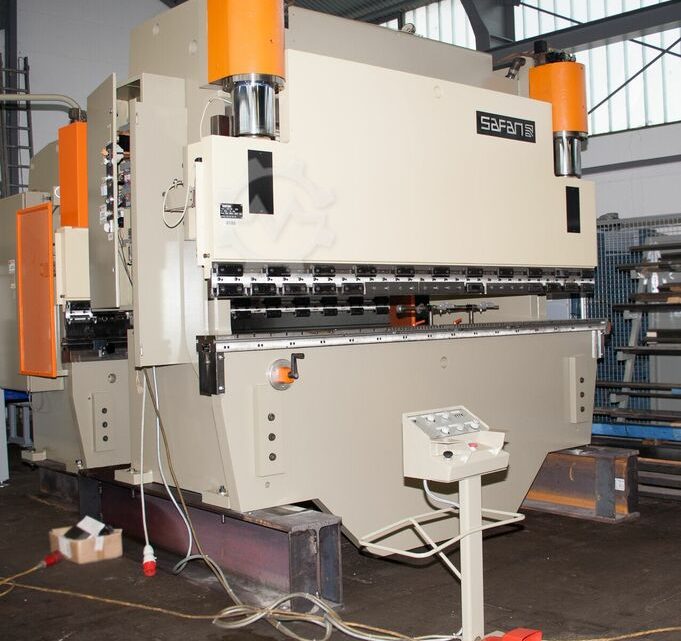
CNC Specialist’s Guide: Selecting the Right Used, Surplus, Secondhand, Pre-Owned SAFAN UCK 225-3200 Press Brake 225 Tonnes made in the Netherlands
1. Typical Specifications (Benchmark Expectations)
While I could not find a public spec sheet specifically for UCK 225-3200, you can infer approximate benchmark ranges based on comparable SAFAN / UCK machines and press brake norms:
| Parameter | Expected / Approximate Value | Notes & Assumptions |
|---|---|---|
| Bending length (beam width) | ~ 3,200 mm | Based on the “3200” in the model name |
| Capacity / force | 225 tonne (≈ 2,208 kN) | The “225” designation |
| Throat depth | ~ 300 to 400 mm (or more) | Should suit your bending needs |
| Stroke / ram travel | ~ 150 – 250 mm (or more) | To allow full bending flexibility |
| Back gauge travel / depth | At least 500 mm (ideally more) | For deep part bending |
| Hydraulic pump / motor power | ~ 30-50 kW (or as required for 225 t) | Depends on the size of hydraulic system |
| Machine footprint / weight | Several tons; footprint perhaps ~4 m × 2 m or more | For transport and foundation planning |
| Control / CNC option | Possibly older CNC module (e.g. ESA, Safan’s own, or retrofit) | For bending programs, crowning, etc. |
These are ballpark figures. The crucial point is: any used machine should come reasonably close to these, or deviations must be explained and acceptable in terms of use-case and cost.
2. Technical Inspection & Purchase Checklist
Below is a detailed on-site inspection and test checklist tailored to press brakes, especially the SAFAN UCK series.
2.1 Structural & Mechanical Integrity
- Frame, bed, uprights & crossbeam
- Inspect for cracks, weld repairs, deformation, bending of uprights or cross-structure.
- Use straightedges, test bars, and feeler gauges to check flatness of bed surface and parallelism of ram slide.
- Check for corrosion or damage, especially around corners and large cuts.
- Ram / slider / guide ways
- Observe wear marks, scoring, pitting, signs of metal-to-metal contact or misalignment.
- Check lubrication paths (oil channels, pads, bushings) for blockage or starvation.
- Move the ram up and down manually (or via hydraulic slow mode) and observe binding, uneven movement, or “sticking” zones.
- Hydraulic cylinders & seals
- Inspect cylinders, piston rods, seals, and connections for oil leakage, damage, or scoring.
- Extend and retract the ram fully and watch for leaks or irregular motion.
- Check cylinder end caps, ports, and piping for integrity.
- Back gauge / positioning systems
- Inspect the back gauge axes, guides, carriages, lead screws or ball screws, and keyways.
- Check for backlash, positioning errors, binding, or misalignment.
- If the back gauge is CNC-driven, test motions and repeatability.
- Tools / tooling platen, die holders, clamps
- Check the top tool mounting platen for wear, flatness, and mounting accuracy.
- Inspect clamping systems or tool holders; see if required tooling is included.
- Test whether the tooling clamping is firm, symmetric, and reproducible.
- Ram / beam alignment & parallelism
- Use test indicators to check that the ram is parallel to the bed across its stroke, especially near the ends.
- Measure at multiple points along the beam width for tilt or skew.
2.2 Hydraulic System & Power & Auxiliary Systems
- Hydraulic pump, motor, reservoir
- Inspect the pump, motor, hoses, fittings, and reservoir. Check for leaks, damage, or signs of overheating.
- Look inside the reservoir (if possible) for sludge, metal particles, or contamination.
- Check filters, strainers, and whether they have been regularly changed.
- Valves, proportional valves, flow control & pressure regulators
- Test control valves, relief valves, proportional controllers, and see whether they operate smoothly.
- Verify pressure settings, whether they hold under load, and no drifting or creeping.
- Oil condition & filtration
- Request the hydraulic oil sample (if possible) and inspect clarity, presence of metal particles, coloration, contamination.
- Check the condition of filters, filter elements, bypass valves, and whether maintenance was consistent.
- Cooling / oil heat exchanger (if present)
- If the machine has an oil cooler or heat exchanger, inspect its condition, clearance, fan, fluid paths, and cleanliness.
- Electrical motor & drives for pump
- Inspect the motor powering the pump(s). Run the motor under no-load and load (if possible) to see if it holds speed, draws current consistent with spec, and doesn’t overheat.
2.3 Electrical / Control / CNC & Safety
- Control panel / CNC / interfaces
- Power up the machine control (if CNC-equipped). Check display, interface, parameter access, menus, and diagnostics.
- Look at control program backups, memory, error logs, and whether the control is intact and original.
- If it’s a manual or semi-automatic hydraulic press, check any circuitry, limit switches, and control relays.
- Electrical wiring & cabinet
- Open the control/electrical cabinet and inspect for burnt wiring, overheated connectors, capacitor bulging, dust or moisture ingress.
- Check cable routing, wire labeling, insulation integrity, and shielding.
- Safety interlocks, doors, guards, emergency stop (E-stop), limit switches
- Test that door guards, safety screens, interlocks, and E-stop circuits work reliably (i.e. machine stops when guard opened).
- Check limit switches for ram travel, back gauge limits, and ensure their proper wiring and operation.
- Sensors and feedback
- If the machine uses position sensors (linear scales, limit sensors), verify their correct functioning, absence of stiction, and signal integrity.
2.4 Functional Tests & Bending Trials
- Test cycle run / no-load motion
- Operate the machine through full stroke under light or dummy load (no sheet), check for smooth motion, noise, vibration, any binding.
- Cycle multiple up-down runs and gauge consistency.
- Simple bend test with sample material
- Bring a sheet piece (of material you’ll commonly process) and perform straightforward bending tasks.
- Measure bend angle accuracy, repeatability, flatness, spring-back compensation, and gauge whether the machine can reach set angles consistently.
- Test across the full bending length (at edges and center) to see if there is variation or sag.
- Gauge back gauge accuracy
- Program back gauge positions, move to positions, bend, and measure whether dimensions are correct.
- Repeated cycles to see if drift or wear manifests.
- Load stress test
- Perform longer runs (many cycles) under full load conditions. Monitor hydraulic system temperature, pressure stability, oil behavior, deformation or drift in angles or positioning.
- Angle repeatability / crowning test
- If the press has crowning (mechanical or electronic), check whether crowning adjustment works and improves angular consistency across the beam width.
- Test bends of identical parts in different positions and see deviation in angle / dimension.
2.5 Documentation, History & Spare Parts
- Serial numbers, build documentation, origin records
- Verify the machine serial number, build year, factory origin, and assembly location (Netherlands).
- Ask for original design specs, acceptance test reports, and as-built drawings if available.
- Maintenance / service / repair history
- Request records of hydraulic system servicing, oil changes, parts replacement, alignment recalibrations, repairs, component overhauls.
- Note gaps in records or long periods of neglect.
- Spare parts / tooling / accessories availability
- Confirm whether key parts (hydraulic valves, seals, cylinders, pumps, dies, clamping systems, control components) are still obtainable in your country or via suppliers.
- If the machine used non-standard parts or proprietary components, check their cost and lead times.
- Tooling, dies, clamping systems included
- Determine if the purchase includes required dies, tools, clamps, tool sets. If not, estimate the cost.
- Check included fixtures (if any) and their condition.
- Warranty / acceptance period
- If possible, negotiate a conditional acceptance period or performance guarantee (e.g. must produce correct bend angles on test material).
- Get in writing responsibilities and what happens if performance is subpar.
3. Risk Factors & Red Flags to Avoid
When dealing with used press brakes, particularly older hydraulic ones like the SAFAN UCK, watch out for these red flags:
- Hydraulic leaks or oil contamination — could indicate worn seals, cylinder wear, internal damage.
- Irreversible structural damage — cracked frames, welded repairs poorly done, twisting or sagging.
- Worn or misaligned guideways — will degrade angle accuracy across the beam.
- Cylinders with scoring, worn rods, or poor seals — may leak or lose stiffness under load.
- Weak or failing hydraulic system (pump, valves, regulators) — inability to hold pressure or drift under load.
- Non-functional or degraded control / CNC units — missing parameters, corrupted backups, locked control features.
- Safety safeguards disabled or removed — risking operator safety and regulatory compliance.
- Missing or obsolete parts — inability to source replacements for valves, seals, electronics.
- Lack of documented maintenance / long neglected periods — suggests deferred repairs and hidden wear.
- Ram / beam misalignment or skew — difficult or impossible to correct on-site.
- Back gauge failure or excessive backlash — making dimensional bending unreliable.
- Refurbishment by unprofessional parties — cosmetic fixes hiding serious mechanical flaws.
- No trial or test bending allowed by seller — you should always test before committing.
If you spot one or more of these, either require a price discount or walk away, unless you have deep resources to refurbish.
4. Acceptance Criteria & Decision Rules
Before purchase, define a clear set of acceptance metrics you will require. Examples:
- The press must achieve target bend angles on your test material within your tolerance (e.g. ±0.2° or better).
- The ram must move smoothly over full stroke with no binding or skew and with acceptable parallelism to bed.
- Back gauge must position to within your dimensional tolerance (e.g. ±0.5 mm or tighter).
- Hydraulic pressure must hold under load, with minimal drift, and oil temperature and stability must be acceptable over continuous cycles.
- Safety interlocks, limit switches, guards must function properly.
- The seller should provide full documentation (drawings, control files, maintenance records) and tooling (or clarity about what is missing).
- Spare parts list must be available, with confirmed suppliers.
- The total cost (machine + transport + repair/refurb + tooling) must leave you margin vs new or better used machines.
- Insist on a test period / conditional acceptance after installation.
5. Suggested Acquisition Workflow (Step by Step)
- Remote Pre-screening
- Request photos (interior, hydraulic parts, control panels, frame, beam).
- Ask for serial number, build year, documentation, hydraulic schematics, tooling pictures.
- Request a video of bending cycle or hydraulic ram movement.
- On-site Mechanical & Structural Inspection
- Follow the structural & mechanical checklist above with straightedges, test bars, visual checks.
- Bring measurement tools and indicators.
- Hydraulic & Auxiliary Systems Inspection
- Examine pump, valves, seals, oil condition, fittings, cooling, hoses.
- Ask seller to run the machine and show hydraulic pressure curves, temperature rise, and gauge consistency.
- Electrical & Control Inspection
- Open control cabinet, examine wiring, drives, relays, connectors, insulation.
- Power up the control, check interface, modes, memory, error logs.
- Test Bending Trials
- Use sample sheet(s) to perform bending cycles — simple bends, multiple positions along the beam.
- Measure angles, repeatability, flatness.
- Test back gauge positioning, run cycles with varying positions.
- Thermal Load / Stress Test
- Run many cycles over extended period under load and watch for pressure drift, heating, oil behavior, variation in angle.
- Evaluation & Negotiation
- List all deviations, repair/ part replacement needs, missing tooling, control issues.
- Get quotes for refurbishing (hydraulic overhaul, seal kits, control repair).
- Adjust offer accordingly or request seller to fix critical issues.
- Contractual Safeguards
- Include acceptance clauses, hold-back portions of payment, guarantee periods, test performance commitment.
- Ensure full transfer of documentation, control files, drawings, tooling, spares list.
- Transport, Installation & Commissioning
- Plan safe rigging, foundation, leveling, alignment of frame and beam.
- After installation, repeat bending trials, calibration, and final validation.