Insider Advice: What Successful Manufacturers Consider Before Buying a Used, Second-Hand, Pre-Owned, Surplus Matsuura RA-1X CNC Vertical Machining Center made in Japan?
Buying a used RA-1X can be a smart, cost-efficient move — but experienced manufacturers evaluate far more than just price. Here’s what serious buyers look at before closing a deal.
1️⃣ Machine Geometry & Structural Integrity (Most Critical)
The RA-1X is known for Japanese rigidity and precision. However, after decades of use:
- Check spindle taper runout (micron-level inspection)
- Ball screw backlash measurement
- Linear guide or box way wear condition
- Machine level and twist condition
- Inspect casting for stress cracks (especially around column & base)
Successful buyers always request:
- Ballbar test results
- Laser calibration report
- Recent accuracy inspection data
If unavailable, budget for re-calibration.
2️⃣ Spindle Condition & Maintenance History
Spindle replacement is one of the highest costs.
Check:
- Bearing noise during warm-up
- Temperature stability after 30–60 minutes
- Surface finish quality on test cut
- Toolholder seating condition
- Spindle hours (if recorded)
If original spindle → factor in possible rebuild cost.
3️⃣ Control System & Electronics
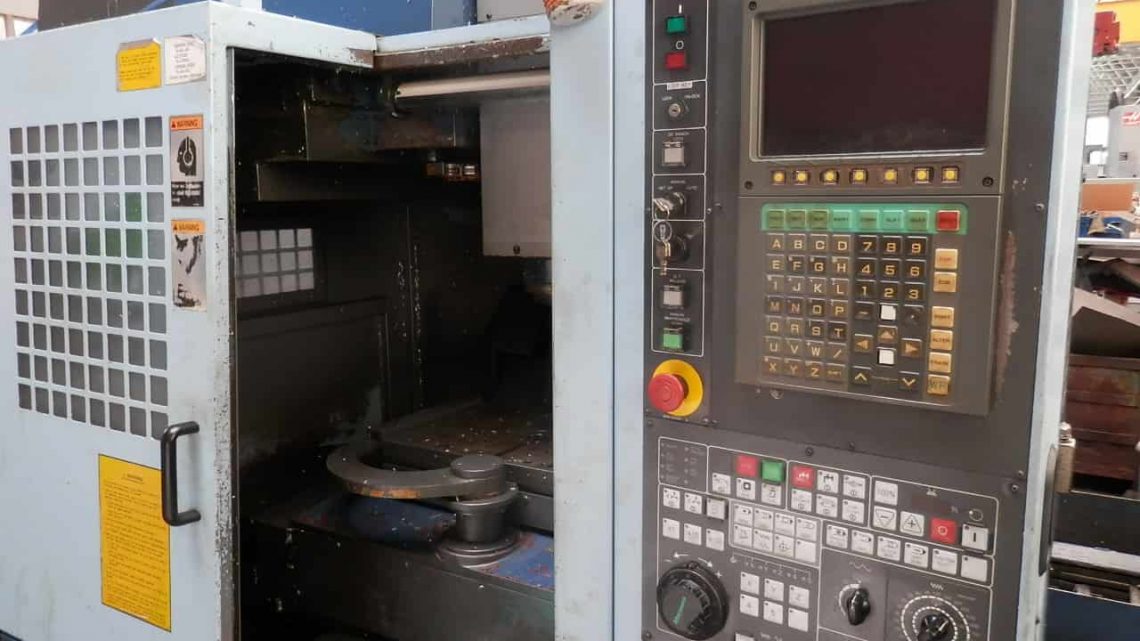
Most RA-1X units use older generation CNC controls (often Fanuc-based).
Ask:
- Is the control fully functional?
- Any alarm history?
- CRT monitor replaced?
- Battery backup status?
- Parameter backup available?
No parameter backup = major risk.
4️⃣ Tool Changer & ATC Reliability
The RA-1X tool changer is durable but must be tested.
Inspect:
- Tool arm alignment
- Magazine indexing accuracy
- Tool pocket wear
- ATC cycle time consistency
Run at least 20 consecutive tool changes during inspection.
5️⃣ Parts Availability & Support
Although Matsuura Machinery Corporation has strong global support, RA-1X is an older model.
Before buying:
- Confirm local distributor support
- Check availability of:
- Spindle parts
- Control boards
- Servo drives
- Verify whether retrofit options exist
Sometimes retrofit to modern Fanuc/Siemens is more economical long-term.
6️⃣ Application Fit (Not Just Price Fit)
Successful manufacturers ask:
- What tolerance is required?
- Is this machine for roughing or finishing?
- What material will be cut?
- Required spindle speed vs original spec?
If production requires:
- High-speed machining
- Heavy titanium cutting
- 24/7 unmanned operation
RA-1X may require upgrades.
7️⃣ Electrical Compatibility
Japanese-built machines may require:
- Voltage conversion
- Transformer installation
- Phase compatibility check
- Frequency (50/60 Hz) adjustment
Confirm:
- Power requirements
- Control cabinet condition
- Cooling system compatibility
8️⃣ Provenance & Usage History
Serious buyers investigate:
- Original owner type (toolroom vs heavy production)
- Operating environment (clean aerospace shop vs harsh casting facility)
- Maintenance logs
- Storage conditions (humidity damage risk)
Toolroom machines generally have less structural fatigue.
9️⃣ Total Cost of Ownership (TCO)
Never focus only on purchase price.
Calculate:
- Purchase cost
- Transportation
- Rigging
- Installation
- Calibration
- Tooling investment
- Possible retrofit
- 12-month maintenance reserve
Sometimes a “cheap” machine becomes expensive.
🔟 Test Cut Requirement (Non-Negotiable)
Before final payment:
- Perform actual machining test
- Measure dimensional accuracy
- Check circularity
- Inspect surface finish
- Evaluate repeatability
No test cut = high risk.
Final Insider Perspective
Successful manufacturers don’t buy used CNC machines based on brand name alone — even a respected Japanese machine like the RA-1X must be evaluated technically, financially, and strategically.
A well-maintained RA-1X can deliver:
- Excellent rigidity
- Reliable precision
- Long service life
But only if verified properly.
1. Machine Type & General Configuration
- Machine Type: 3-Axis CNC Vertical Machining Center
- Manufacturer: Matsuura Machinery Corporation (Japan)
- Control System (Typical): Yasnac J300 CNC
- Spindle Taper: BT40 / ISO 40
- Number of Axes: 3 (X, Y, Z)
- Automatic Tool Changer (ATC): Standard configuration
The RA-1X is known for its rigid Japanese casting structure, compact footprint, and reliable medium-duty machining performance.
2. Axis Travels & Work Envelope
| Axis | Travel (Metric) | Travel (Inch Approx.) |
|---|---|---|
| X-Axis | ~550 mm | ~21.6 in |
| Y-Axis | ~400–410 mm | ~15.7–16.1 in |
| Z-Axis | ~460 mm | ~18.1 in |
| Table Size | ~600 × 380 mm | ~23.6″ × 14.9″ |
These travels make the RA-1X suitable for small to medium precision components.
3. Spindle Specifications
- Maximum Spindle Speed: Up to 15,000 RPM (depending on version)
- Spindle Power: Approx. 5.5 – 7.5 kW (≈ 7.5 – 10 HP)
- Spindle Taper: BT40
- Drive Type: Belt-driven or direct (varies by build year)
Higher spindle speed versions are especially suitable for aluminum and light alloy machining.
4. Tool Changer (ATC)
- Tool Capacity: Typically 30 tools
- Tool Type: BT40
- ATC Type: Arm-type automatic tool changer
- Tool Change Time: Varies (usually fast for its class)
Inspection of ATC alignment and indexing accuracy is critical when buying used.
5. Table & Workpiece Capacity
- Maximum Table Load: Approx. 250–300 kg
- T-Slot Configuration: Standard T-slot table
- Workpiece Size Capability: Medium-sized components within 3-axis envelope
6. Feed Rates & Motion
- Rapid Traverse Rate: Typically robust for its class (exact values vary)
- Cutting Feed Rate: Programmable via control
- Axis Drive System: Ball screws with servo motors
Backlash condition should always be checked in used units.
7. Machine Dimensions & Weight
- Approximate Footprint: ~2.7 m × 2.8 m × 2.8 m
- Machine Weight: Approximately 4,000 – 4,600 kg
Compact size makes it suitable for smaller workshops or toolrooms.
8. Electrical Requirements
- Japanese voltage configuration (often 200V 3-Phase)
- May require transformer depending on installation country
- Frequency compatibility (50 / 60 Hz) must be verified
9. Common Optional Features (Depending on Seller)
- Chip conveyor
- Coolant system
- Touch probe
- Tool presetter
- Work light & enclosure upgrades
- Possible control retrofit
10. Typical Applications
The RA-1X is commonly used for:
- Precision toolroom machining
- General metal cutting
- Aluminum and mild steel components
- Small batch production
- Prototype manufacturing
It is not typically designed for heavy high-torque roughing or large mold machining.
Important Note for Buyers
Since most RA-1X machines are older generation models:
- Confirm control functionality
- Check spindle condition and noise
- Verify parameter backup
- Measure ball screw backlash
- Perform a real test cut before final payment