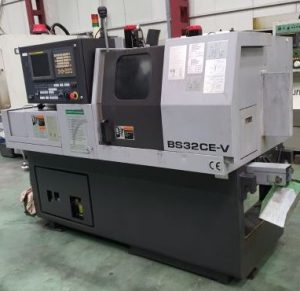
How to Avoid Common Pitfalls When Buying a Pre-Owned, Second-Hand, Surplus, Used Tsugami BS32CE-V CNC Swiss Lathe made in Japan?
Buying a used Swiss-type lathe can be extremely profitable — or extremely expensive if you overlook critical details. The Tsugami BS32CE-V is a high-precision sliding headstock machine widely used in medical, aerospace, automotive, and precision components manufacturing. Below is a professional buyer-focused guide including technical details and real inspection advice.
1️⃣ Know the Machine First – Technical Overview
Tsugami BS32CE-V – Typical Specifications
| Item | Specification |
|---|---|
| Machine Type | CNC Swiss-Type Sliding Headstock Lathe |
| Max Bar Diameter | 32 mm (1.26”) |
| Main Spindle Speed | Up to 8,000 RPM |
| Sub Spindle Speed | Up to 8,000 RPM |
| Control | Fanuc 31i / 32i (varies by build year) |
| Number of Axes | 6–7 Axes (X1, Z1, Y1, C1 + X2, Z2, C2) |
| Live Tool Speed | Up to 6,000 RPM |
| Tool Positions | 21–26 tools (depending on configuration) |
| Guide Bushing | Rotary / Non-rotary type |
| Rapid Traverse | 24 m/min (approx.) |
| Power Requirement | Approx. 20–25 kVA |
| Machine Weight | Approx. 3,500–4,000 kg |
| Coolant System | High-pressure capable (optional 70–140 bar) |
| Bar Feeder | Typically LNS, IEMCA, FMB compatible |
2️⃣ Most Common Buying Mistakes
❌ 1. Ignoring Guide Bushing Condition
Swiss machines rely heavily on the guide bushing system.
What to check:
- Excessive wear inside bushing sleeve
- Runout on main spindle
- Surface finish on turned test part
- Oil leakage around bushing housing
A worn guide bushing can destroy part accuracy and cost several thousand dollars to rebuild.
❌ 2. Not Checking Axis Backlash
Swiss lathes work in microns. Small backlash becomes big problems.
Test:
- Measure repeatability with dial indicator
- Run circular interpolation test
- Check servo load meter stability
Excess backlash usually indicates:
- Worn ball screws
- Linear guide wear
- Servo tuning issues
❌ 3. Overlooking Sub-Spindle Alignment
The BS32CE-V has a sub-spindle for back working.
Check:
- Part transfer smoothness
- Concentricity between main & sub spindle
- Synchronization timing
Misalignment causes:
- Burr formation
- Off-center back machining
- Rejected aerospace parts
❌ 4. Not Verifying Live Tool Condition
Live tools are expensive.
Inspect:
- Noise during rotation
- Toolholder bearings
- Vibration marks
- Live tool speed consistency
A damaged live tool spindle can cost significant money.
❌ 5. Ignoring High Pressure Coolant System
Swiss machines require good chip evacuation.
Check:
- Coolant pump pressure
- Filter system condition
- Through-tool coolant leaks
- Chip conveyor function
Poor coolant performance leads to:
- Tool breakage
- Surface defects
- Frequent downtime
❌ 6. Skipping Control Diagnostics
Most BS32CE-V machines use Fanuc control.
Check:
- Servo alarm history
- Axis load history
- Machine hour counter
- Backup parameters availability
Always request:
- Parameter backup file
- Ladder backup
- Electrical drawings
3️⃣ Mechanical Inspection Checklist
Spindle
- Check vibration at 8,000 RPM
- Listen for bearing noise
- Check warm-up cycle stability
Axes
- No stick-slip movement
- Smooth rapid traverse
- No abnormal servo noise
Hydraulic System
- Check pressure stability
- Look for oil leaks
- Chuck clamping force test
Electrical Cabinet
- Clean wiring
- No overheating marks
- Check cooling fans
4️⃣ Important Questions to Ask Seller
- What type of parts were produced? (medical? aerospace? automotive?)
- Was the machine running 24/7?
- Has spindle ever been rebuilt?
- Any crash history?
- Guide bushing replacement history?
- Is bar feeder included?
- Is tooling included?
5️⃣ Costly Hidden Problems to Watch For
| Risk | Impact |
|---|---|
| Spindle bearing wear | $8,000–$15,000 repair |
| Sub spindle encoder failure | Expensive downtime |
| Worn ball screws | Accuracy loss |
| Servo amplifier faults | Control instability |
| No parameter backup | Risk during relocation |
6️⃣ Test Cut Recommendation
Never buy without a live test.
Run:
- Ø20 mm steel bar
- 100 mm length turning cycle
- Back working operation
- Thread cutting test
Check:
- Surface finish (Ra value)
- Diameter tolerance
- Concentricity
- Tool mark pattern
7️⃣ Transport & Installation Risks
Swiss machines are sensitive to:
- Improper leveling
- Coolant contamination during move
- Control battery failure
Before shipment:
- Backup parameters
- Lock axes
- Drain coolant properly
- Secure sliding headstock
8️⃣ When Is It a Good Buy?
A used BS32CE-V is a good investment if:
✔ Under 35,000 spindle hours
✔ Clean maintenance history
✔ Stable spindle sound
✔ Smooth sub-spindle transfer
✔ No major alarms in control history
✔ Proper documentation available
9️⃣ Why This Model Is Popular
- Japanese build quality
- Excellent rigidity for 32 mm class
- Strong resale value
- High precision repeatability
- Compact footprint for capacity offered
Final Advice
A Swiss machine is not like a normal lathe. Small wear means big money in precision industries.
If buying remotely:
- Request full operation video
- Request test cut measurement report
- Request electrical cabinet video
- Use third-party inspection if possible