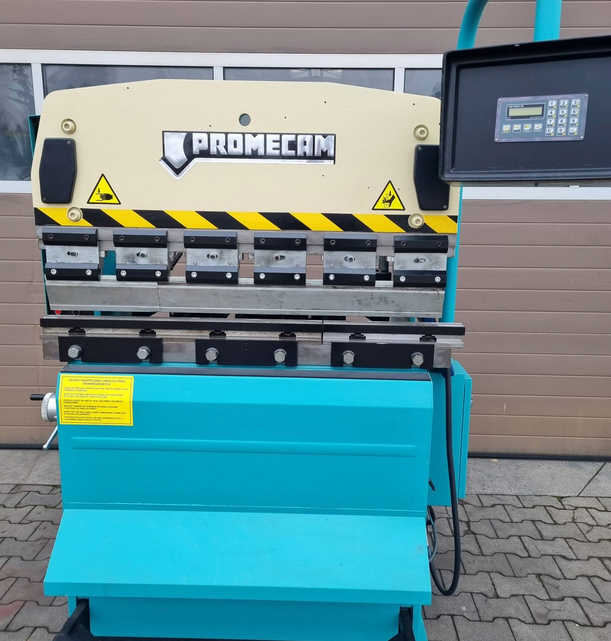
Industrial Insights: How to Spot Quality in Pre-Owned, Used, Secondhand, Surplus CNC Equipment Before Purchase Promecam-Amada RG 25-12 – Press Brake made in Japan
Here’s a tailored “Industrial Insights” guide for spotting quality in a used / secondhand press brake, with specific attention to a model like the Promecam / Amada RG 25-12 (25 ton, ≈ 1,250 mm bending length, hydraulic up-stroker) which is of Japanese / European origin. (Some specs known: bending length ~1,250 mm, 1020 mm between frames, throat ~195 mm, stroke ~100 mm)
You can use this as a detailed checklist when going to inspect, negotiate, or accept delivery.
Why a Used Press Brake Is Risky — What Can Go Wrong
Before diving into checks, here are key risk areas in used press brakes:
- Frame distortion, cracks or fatigue
- Wear or misalignment of the ram, bed, guides
- Hydraulic cylinder problems (leaks, scoring, seal wear)
- Worn tooling, die holders, clamps
- Degradation of control system electronics or programming (if CNC)
- Worn back-gauge axes or positioning errors
- Hidden repairs or “cosmetic fixes” that mask structural or alignment damage
- Obsolete spare parts or tooling not compatible with your shop
- Safety compliance lacking or outdated
A good used press brake, properly maintained and aligned, can still yield many years of service, but only if you pick carefully.
Key Specs / Reference for RG 25-12
First, it helps to know the “baseline” or typical design parameters of the RG 25-12 so you can compare seller claims to reality:
| Parameter | Typical / Known Value | Notes / Source |
|---|---|---|
| Bending length / width | ~1,250 mm | “Press Brake AMADA PROMECAM RG25-12 … Bending length: 1,250 mm” |
| Stroke (ram travel) | ~100 mm | Many RG 25-12 listings show ~100 mm stroke |
| Distance between uprights (frame span) | ~1,020 mm | Several specs reference ~1,020 mm between frames |
| Throat depth | ~195 mm | Many RG 25-12 specs list ~195 mm throat depth |
| Open daylight (clearance) | ~300 mm (without upper clamps) | In at least one spec listing for RG25-12 |
| Power / hydraulics | ~3 kW electric drive, hydraulic system | Eg in Rondean listing: “3 kW” other hydraulic listings also show hydraulic up-stroker configuration |
When you inspect, measure or verify these, deviations from spec can hint at modifications, wear, or even misrepresentation.
Inspection & Testing Checklist for a Used Press Brake
Below is a structured process you can follow when inspecting on site (or insist that the seller allows such inspection). Many of these steps mirror best practices from used machinery dealers and fabricator guides.
A. Documentation & Background
- Machine history & usage
- Ask for service logs, maintenance records, repair history, uptime hours or cycles.
- What kinds of jobs did it run (steel, stainless, heavy duty, etc.) — heavy or abrasive jobs accelerate wear.
- Original drawings / manuals / wiring diagrams
- Ensure you get the original mechanical drawings, hydraulic schematics, wiring, control manuals, and parts lists (especially for cylinders, seals, pumps, control cards).
- Tooling / die inventory
- Does the seller include tooling (punches, dies, holders)? Check condition, compatibility, and if they match your requirements.
- Even included tooling can be worn, bent, cracked, or mismatched.
- Modifications / upgrades
- Has the machine been modified (e.g. extended bed, change of cylinder, new control, re-machining)? Get documentation of what was changed and why.
- Sometimes modifications introduce geometry or alignment problems.
B. Structural & Mechanical Checks
- Frame integrity & straightness
- Inspect for cracks, weld repairs, corrosion, distortion, or damage in the bed, side frames, cross members.
- Use straight edges, level, or laser alignment tools to verify no bending or twist in the frame.
- Ram and bed surfaces
- Check the ram face and bed surfaces for gouges, nicks, weld repairs, surface wear.
- The ram should move perpendicular and parallel to the bed surfaces without significant tilt.
- Guide way / slide surfaces
- Inspect guide surfaces for wear, scoring, pitting, misalignment.
- Check for play (looseness) in ram guides or sides.
- Hydraulic cylinders & seals
- Examine cylinder rods for scratches, pitting, corrosion, or bending.
- Look for oil leakage around rod seals, ports, fittings.
- Test for smoothness of motion when operated slowly; it should move without binding or jerking.
- Hydraulic pump, valves, hoses, lines, fluid condition
- Inspect all hoses and lines for signs of fatigue, abrasions, leaks.
- Check for clean, transparent hydraulic fluid (no sludge, metal particles, discoloration).
- Open filters (if possible) and check for debris or metal shavings.
- Check control valves, relief valves for correct operation.
- Tool clamping / die holders & alignment
- Inspect upper and lower tool holders, quick clamp or bolted systems, ensure clamping surfaces are flat and not excessively worn.
- Check alignment of die holders: they must be straight and properly aligned so the punch/die sits square.
- Backgauge system / stops / axes
- If the backgauge (material positioning mechanism) is present, inspect its motors, slides, guides, scales, movement, repeatability, backlash.
- Make sure all axes (X, R, Z, etc.) move smoothly and position precisely.
- Control system / electronics
- If CNC or programmable control is present, check interface, displays, buttons, control modules, wiring for damage or corrosion.
- Check if firmware/software is still supported or if upgrades/parts are available.
- For hydraulic-only machines, check any simple limit switches, foot pedals, or controls.
C. Functional & Performance Tests
- Dry / no-load run
- With no workpiece, cycle the machine: lower ram, return, backgauge movement, etc.
- Watch for vibration, abnormal noise, jerky movement, hydraulic surges.
- Parallelism / ram alignment test
- Mount a dial indicator on one side of die holder and sweep across the length as the ram moves; deviations indicate tilt or nonparallel motion.
- Use a known straight bar or surface and probe at multiple points to confirm alignment and parallelism.
- Accuracy / repeatability / bending test
- Perform test bends on scrap material (of your material type) over the full length (e.g. full 1,250 mm) and multiple positions.
- Check bend angle consistency, bend deformation, springback, and uniformity.
- Record measurements and compare across several cycles to test repeatability. Manufacturing fabricator guides emphasize focusing on ram repeatability, reproducibility, and angle consistency.
- Load test near capacity
- Bend material near the rated capacity (e.g. if the machine is 25 ton, then test with thicker or stronger material) to see if it handles load without instability, oil pressure drop, stalling, or deformation.
- Pressure / force measurements
- If gauges or sensors are available, check actual hydraulic pressure, force output, and compare to expected specs.
- Watch for pressure drops during movement or under load.
- Leak / seal test
- Under pressure, look for hydraulic leakage in cylinder seals, ports, hoses, fittings.
- Also look for fluid creep or weeping over time.
D. Wear Estimation, Spare Parts & Risk Assessment
- Estimate remaining life of wear parts
- From condition of cylinders, seals, guides, check how much wear remains (e.g., moderate wear versus near end-of-life).
- Ask seller for cycles or operating hours; compare with typical life spans (if known).
- Availability of spare parts & support
- For a Promecam / Amada RG series, check whether replacement cylinders, seals, valve spares, control parts, tooling parts, etc., are still made or available.
- If cost or lead times for parts are excessive, that’s a risk.
- Refurbishment cost evaluation
- Some wear or damage may be repairable (regrinding guides, replacing seals, straightening frame), but evaluate cost and downtime.
- If structural damage (frame cracks, distortion) is present, repair may be expensive and degrade precision permanently.
- Safety compliance & guard systems
- Does this press brake meet local safety standards (guards, light curtains, emergency stops, interlocks)? If not, retrofitting safety is additional cost and liability.
- Transport, reassembly & alignment risk
- The machine must be properly rigged, transported, and realigned on site. Misalignment introduced in shipping often causes problems.
- When delivered, rerun alignment and performance tests before accepting.
- Inspection / acceptance clause
- Negotiate a “test / burn-in period” after delivery, during which you can reject or demand adjustments.
- Don’t accept “as-is” blindly; have a contractual right for adjustment if defects are found.
Red Flags / Warning Indicators
When inspecting, keep an eye out for these red flags:
- Ram or bed surfaces heavily gouged, patched with welding, or show signs of violent repair
- Bent or scratched cylinder rods
- Leaky or dripping hydraulics (especially slow weeping which suggests degraded seals)
- Jerky or uneven motion in ram or backgauge axes
- Large deviation in ram alignment or tilt across travel
- Repainted machines with hidden repairs (if it’s painted over alignment issues, ask to see it running)
- Obsolete control electronics or custom controllers with no spare support
- Poorly matching tooling, bent punches, uneven dies
- Backgauge that doesn’t hold position or shows heavy backlash
- Frame cracks, deformations, or signs of fatigue
- Hydraulic fluid full of metal particles, grime, or sludge
- The seller refuses to let you run test bends or measure alignment
One user from a forum thread also alerts:
“Use an indicator and a flat cold roll piece to measure the parallelism of the ram. Check for oil leaks around cylinder, pump, filter. If the machine has been repainted, ask to see it work – that paint may be hiding trouble.”
How to Use Findings in Negotiation
- Quantify any deficiencies you detect (e.g. “ram alignment off by 0.3 mm over length,” “cylinder seal leak requiring rebuild,” “backgauge backlash needing re-engineering”)
- Request that repair/refurbishment be done prior to purchase or have the seller discount accordingly
- If spare parts are risky, include a parts-support commitment or supply
- Use test bend results to push for better price if performance is weak
- Reserve a final acceptance test or “return / price adjustment” clause after installation