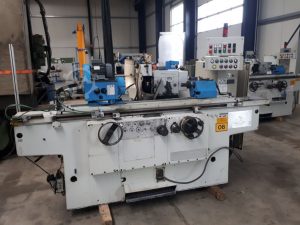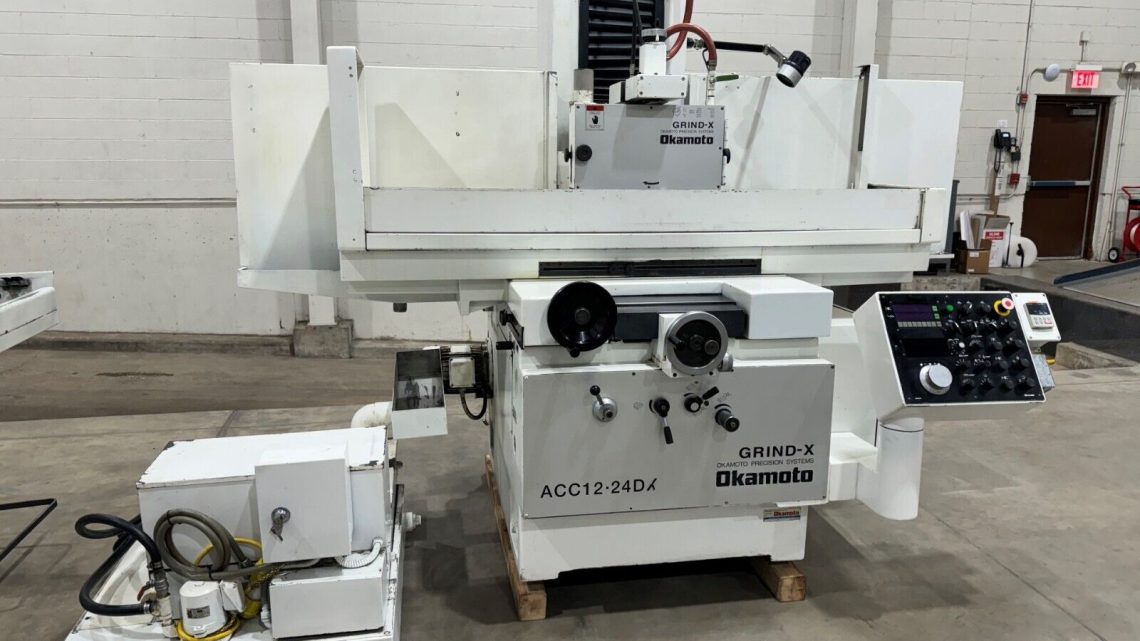
Industrial Insights: How to Spot Quality in Pre-Owned, Used, Secondhand, Surplus CNC Equipment Before Purchase Okamoto ACC-12.24DX Automatic Surface Grinder – Year 2012 made in Japan
When assessing a used surface grinder like the Okamoto ACC-12.24DX (Automatic / Hydraulic / Saddle type, circa 2012 or similar), your goal is to distinguish a machine that still has precision life left from one that is too worn, misaligned, or risky to refurbish. Below is a detailed “Industrial Insights” checklist and interpretive guide — tailored to the model in question — that you can use in your inspections, negotiations, and acceptance process.
Key Reference / Baseline Specs for the Okamoto ACC-12.24DX
Before inspection, it’s critical to know what “normal / new spec” looks like so you can compare what the used unit offers. Some known or typical specifications for this model or close variants are:
| Parameter | Typical / Published Value | Notes |
|---|---|---|
| Table size (W × L) | 12″ × 24″ (≈ 304.8 mm × 609.6 mm) | |
| Grinding wheel | 12″ diameter × 1.5″ width × 5″ bore | |
| Wheel speed | ~1,800 rpm (for this model) | |
| Longitudinal table traverse | Up to ~29.5″ (~750 mm) | |
| Cross saddle travel | ~14″ (~355 mm) | |
| Automatic downfeed increment range | 0.00005″ to 0.0015″ | |
| Power / motors | 5 HP spindle motor hydraulic feed motors, servo control for downfeed | |
| Maximum weight on table / workpiece | ~1,540 lbs (≈ 700 kg) | |
| Construction features | Rigid cast-iron castings, double-vee ways, cartridge spindle with preloaded bearings, automatic lubrication, programmable cycles, spark-out, electromagnetic chuck control, automatic dressing etc. |
These specs become your “benchmark envelope”. Deviation indicates either a modification, loss of performance, or misrepresentation — warranting deeper inspection or price adjustment.
What to Look For — Inspection & Testing Checklist
Here’s a structured, detailed checklist you can use when you visit the machine, before purchase (or request from seller, if remote). Use measuring instruments (dial indicators, test bars, surface plates, indicators, temperature sensors, vibration sensors) wherever possible.
A. Documentation & Background
- History, usage & maintenance records
- Ask for operating hours, major repairs, frequency of routine maintenance, whether coolant / filters / lubrication systems were cleaned regularly.
- Know what kinds of materials it ground (hard, abrasive materials vs mild steel) — heavy wear materials use up life faster.
- Original manuals, wiring diagrams, parts list, control software version
- Ensure you receive the original, as-built drawings, electrical schematics, control manuals, spare part lists, and any updates or modifications that have been made.
- Check what controller / interface it uses, and whether firmware or parts (cards, sensors) are still manufactured or obtainable.
- Included accessories / tooling / spares
- Are there wheel dressers, spare grind wheels, electromagnetic chuck accessories, coolant systems, filters, spare sensors, tooling fixtures? A well-equipped seller is a positive sign.
- Modifications / retrofits
- Ask whether features (e.g. upgraded motors, CNC interface, new controls, re-leveling of ways, regrinding) have been added. Get documentation and before/after test data.
B. Structural & Mechanical Condition
- Base, saddle, column, cross-saddle, ways
- Inspect for cracks, weld repairs, distortion, corrosion—even hidden under paint.
- Use a straightedge, granite surface plate, or reference bar to check flatness and straightness of table, saddle surfaces, and cross-saddle movement.
- Guideways / slide surfaces & wear
- Inspect the double-vee ways (typical in Okamoto ACC series) for signs of scoring, pitting, uneven wear or play.
- Check for uneven “step” wear along travel length.
- Test for backlash or slop, especially at ends of stroke or when reversing direction.
- Table traverse mechanism
- The longitudinal feed (hydraulic) must move smoothly at full stroke without sluggishness, stiction, or jerks.
- Cross-feed saddle movement must also be smooth and consistent.
- Spindle / wheelhead & bearings
- The spindle bearing should not have play. Use test methods (e.g. indicator on spindle nose, gently pushing/pulling) to detect looseness.
- Listen for chatter or roughness when the spindle is rotated slowly by hand (if possible, after removing wheel).
- Inspect the wheelhead for wear or looseness in its vertical feed guide or housing.
- Cartridge spindle designs (as Okamoto often uses) are preferable (preloaded, sealed, stiff) but check for damage or past replacement.
- Hydraulic system / feed motors / valves / pumps
- Inspect hoses for cracks, abrasion, leaks.
- Check all valves, ports, seals, and fittings for leaks or weeping.
- Evaluate the cleanliness of hydraulic oil — dark, contaminated, or metal shavings in fluid is a red flag.
- Check pump pressure stability under load; fluctuations or inconsistent flow may indicate internal wear or damaged valve spools.
- Automatic downfeed / servo / control axis
- The DX model has automatic incremental downfeed (servo / control). Test its responsiveness, accuracy, and consistency across full range (coarse & fine).
- Check the stroke ranges (0.00005″ to 0.0015″) and whether the machine achieves them accurately.
- Dressing / wheel change mechanism
- Inspect the wheel dresser (if included) for wear, smoothness, alignment.
- Check for ease of wheel change and whether safety interlocks or guarding are intact.
- Test the dress compensation system (if available) for reliability.
- Magnetic chuck & demagnetizer / electromagnet control
- Inspect the electromagnet chuck surface for flatness, wear, rust.
- Test the magnet / demagnetizer function for full power and clean release.
- Coolant / filtration / lubrication systems
- Coolant pump, lines, filters, lines, sump condition — look for sludge, contamination, leaks.
- Lubrication system (automatic lube) must be functioning, not clogged or run dry.
C. Functional & Precision Testing
- No-load run (dry test)
- Run the machine without workpiece: cycle longitudinal, cross, vertical motions; run the spindle; actuate automatic feeding. Check for vibration, noise, jerky motion, inconsistent speed, hydraulic surges.
- Table / saddle linear accuracy / repeatability
- Use a calibrated test bar or precision reference instrument to measure deviation across full length passes.
- Check for eject / return endpoints — how repeatable is the return to the starting point?
- Across multiple cycles, check whether the starting/ending position shifts (indicating slop or backlash).
- Vertical (Z / downfeed) accuracy & stability under load
- Engage the grinding wheel on a test block (with low or no removal) and monitor incremental feed, spark-out passes, and whether the programmed depth is accurate.
- Check stability: does the downfeed “creep” or shift during soak / dwell time?
- After cycles, measure resulting thickness or stock removed to verify the machine hits target depth with consistency.
- Test grinding on real workpiece sample
- If possible, run a grinding cycle on sample material (your typical workpiece) over part of the table length, in both directions. Inspect surface flatness, finish, parallelism, and consistency.
- Switch positions (left, center, right) to see if accuracy degrades toward extremes of travel.
- Use a surface plate / dial indicators to verify flatness of ground piece.
- Load test near capacity
- Use a heavier or larger sample near the rated workpiece size and see if machine sustains performance (no slow-down, no hydraulic fluctuation, no chatter, no loss of control precision).
- Thermal drift / warm-up behavior
- Run the machine for some time and then re-measure positions / reference points to check for drift due to heating (spindle, bearings, hydraulic oil, castings).
- Good machines with stable cast iron structure and well-managed thermal design show minimal drift.
- Leak test under full conditions
- With systems active and loaded, inspect for leaks (oil, coolant, hydraulic pressure).
- Even slow weepage is indicative of worn seals or poor maintenance.
D. Wear, Life Expectancy & Risk Evaluation
- Wear parts condition & remaining life
- Assess how worn the guideways, spindle, bearings, hydraulic components, seals, etc., appear.
- If wear is moderate, good refurbishment might be viable; if severe, cost may outweigh benefit.
- Parts availability & support
- For a 2012 or earlier unit, check whether control electronics, servo modules, sensors, hydraulic valves, seals, spindle bearings, and other critical parts are still fabricated or available on the aftermarket.
- If the control is custom or obsolete, obtaining replacement modules might be costly or impossible.
- Refurbishment feasibility
- Consider whether key components (e.g. regrinding ways, re-polishing surfaces, replacing seals or bearings) are economically feasible.
- If frame integrity is compromised (cracks, distortion), it may not be recoverable in alignment to precision levels.
- Safety & compliance
- Inspect safety covers, guards, interlocks, emergency stops, shielding.
- Make sure the machine meets or can be upgraded to local safety standards.
- Risk from shipping / transport
- This machine is heavy and sensitive; during transport it can suffer alignment shifts, damage to spindle, loose wiring, or vignette misalignment.
- Upon arrival, re-test alignment, motion, and precision before final acceptance.
- Inspection clause / acceptance period
- Insist on a period during which you can test and reject based on performance.
- Sophisticated buyers often require “under load acceptance” or “final alignment verification” prior to closing the deal.
Interpreting What You Find — Go / Borderline / Reject Indicators
Here’s how to interpret the results of your inspection:
| Observation | Verdict / Implication |
|---|---|
| Guideways show mild, uniform wear; no deep scoring | Acceptable, especially if refurbishable |
| Guideways have uneven, deep scoring or step wear | Major rework needed; negotiate heavily or reject |
| Spindle bearing play or roughness | Major red flag — spindle rebuild or replacement likely |
| Hydraulic system fluid contaminated or fluctuating pressure | Sign of internal wear — risky unless seller can fix |
| Downfeed servo misbehavior / inconsistency | Loss of precision; likely expensive to repair |
| Poor accuracy in longitudinal or cross traverse | Limits usable capacity, may need serious overhaul |
| Excessive thermal drift or misalignment after warm-up | Castings or structural integrity degraded |
| Missing parts, wiring, controls, accessories | High repair or replacement cost risk |
| Refusal to allow test grinding or accuracy checks | Strong warning — avoid or demand price / warranty adjustment |
If multiple major adverse findings appear, the machine might be too risky. Even if one or two minor issues appear, you can often negotiate a price reduction or require the seller to perform some refurbishment before delivery.