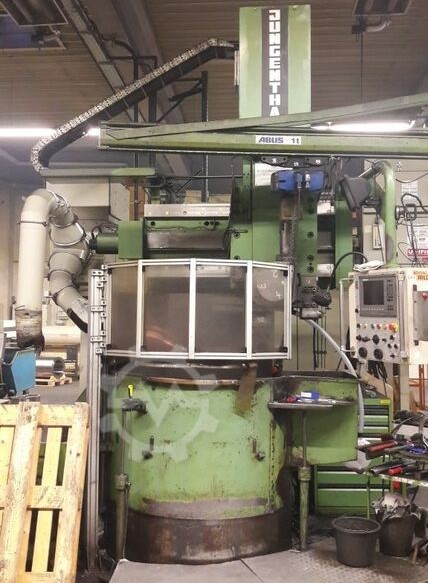
Industrial Insights: How to Spot Quality in Pre-Owned, Used, Secondhand, Surplus CNC Equipment Before Purchase JUNGENTHAL JU8F CNC Vertical Double Column Lathe
Here’s a rigorous, industrial-grade inspection guide for evaluating a Jungenthal JU8F CNC Vertical / Double-Column Lathe (or related VTL / turret-style vertical lathe) in a used / surplus context. Because machines of this class are heavy, structural, and rely on robust mechanical integrity and control systems, your due diligence must be thorough. I also include special caveats and red flags specific to vertical / double-column lathes.
What we know / what to expect (benchmarking & characteristics)
Although detailed specs for the JU8F are sparse in public, machine listings for a Jungenthal JU8F CNC carousel lathe provide some reference points:
- One listing shows: “Max Drehdurchmesser: 930 mm” (maximum turning diameter)
- “Turning length max.: 520 mm” is also noted in that listing.
- Spindle speed in gear stages: 0–110 rpm, 110–300 rpm (two gear stages) in that listing.
- The listing indicates the machine was “modernisiert 2005” (modernized / updated in 2005) and uses HEIDENHAIN control / 4110 module.
So, use those as your starting benchmarks (e.g. ~930 mm swing, ~520 mm axial travel) — any machine you inspect that deviates greatly (unless justified) is suspect.
Also, Jungenthal is a German maker, so parts, tolerances, and mechanical design likely follow robust German machine tool tradition.
Given its size and structure (double column / vertical lathe style), the machine likely puts large stress on bearings, structural rigidity, and vertical motion systems. So the highest risk areas are structural integrity, bearings, carriage motion, spindle drive, control electronics, and alignment under load.
Pre-visit preparation
Before going to inspect, do the following to maximize what you can verify and reduce surprises:
- Get as much documentation / history as possible
- Maintenance logs, refurbishment history (e.g. the 2005 modernization in one listing)
- Spindle run hours, carriage / slide hours, vertical motion hours
- Any crash events, repairs, rebuilds
- Control system backups, parameter files, original wiring diagrams, parts list
- Previous alignment / geometry checks, calibration records - Ask for a remote demo / video
- Jog the vertical and horizontal axes across full travel
- Rotate the worktable / spindle under different rpm settings
- Run a sample machining cycle (if allowed)
- Observe noise, vibration, hesitation, control errors - Bring inspection / measurement tools
- Dial indicators, gauge blocks, micrometers, straightedges
- Thermal probe / IR thermometer
- Stethoscope / vibration sensor (if available)
- Optical alignment tools (e.g. laser pointer) - Get or bring a machine tool / vertical lathe expert
- Someone familiar with VTLs, bearings, vertical slideways, large turning tables
- They can interpret subtle clues (bearing noise, control drift, backlash) - Check spare parts / support in your region
- Are bearing sets, control modules, feed drives, spindle drive modules, structural parts available or importable?
- Is there a service company experienced with Jungenthal or similar German VTLs near you? - Plan rigging / transport / installation
- These machines are massive — know crane, floor loading, foundation, enclosure path
- Expect you will need to re-level, re-align, recalibrate after move - Prepare a scoring / checklist sheet
- Predefine subsystems (structure, motion, spindle, control, carriage, alignment) and weight them
On-site inspection & test checklist
Below is a detailed checklist organized by subsystem. For each point, you should note what you measure / observe, compare with spec / expectation, and flag any deviation.
| Subsystem / Aspect | What to Inspect / Test | What “Good / Acceptable” Behavior Looks Like | Red Flags / Warning Signs |
|---|---|---|---|
| Structural / frame / casting integrity | Inspect columns, cross-beam, base, saddle, bridges for cracks, weld repairs, distortions, sagging | No visible cracks or suspect welds, uniform surface appearance, rigid, no signs of bending | Welds in critical load zones, hairline cracks, twisted parts, misalignment in columns |
| Column slideways / vertical motion guides | Move carriage upward / downward, feel for binding or stiction, reverse direction, measure backlash | Smooth, consistent vertical motion, minimal backlash, no “dead spots” | Binding zones, jerky travel, sudden stiffness, noticeable backlash or play |
| Cross-rail / horizontal slide (if double-column style) | Move cross-rail horizontally, test full motion, reverse direction, measure backlash | Smooth motion across full span, minimal backlash, no sag | Uneven travel, sag in middle, binding or roughness at ends |
| Worktable / spindle drive | Rotate the table/spindle at varying rpm, measure runout, listen for bearing noise, check for thermal increase | Quiet operation, minimal vibration, stable temperatures, low runout under test bar | Knocking / humming noises, excessive vibration, thermal drift, high runout |
| Spindle gearing / speed shifts (if multiple gear stages) | Engage different gear / rpm ranges, check for smooth shifting, absence of gear noise | Smooth transitions between gear stages, stable rpm, minimal gear noise | Hard shifts, gear whine, missing gear engagement, slipping or noise |
| Turret / tool carriage (if present) | Index tools, cycle tool changes, test carriage motion under load | Accurate indexing, secure tool clamping, repeatable positioning | Mis-index, tool slippage, poor clamping, play in tool carriage |
| Feed drives / servo systems | Command full feed in each axis, rapid moves, reversals, acceleration / decel, monitor for current / faults | Responsive, no axis fault trips, no overshoot, stable behavior under load | Drive faults, sudden stalling, overshoots, instability under rapid changes |
| Control electronics / wiring / cabinet | Open panel, inspect wiring, look for burnt connectors, dust, check fan operation; power up, inspect alarm logs, I/O status, parameter integrity | Clean wiring, no burnt or corroded parts, fans working, control boots clean, parameters stable, no persistent alarms | Burn marks, broken wires or connectors, fan failures, erratic behavior or errors at boot |
| Thermal drift / warm-up stability | Run machine for some time, then remeasure key dimensions or test repeat cycles | After warm-up, geometry stabilizes, minimal drift | Drifting axes or dimensions, hysteresis, shifting positions over time |
| Accuracy / repeatability tests | Use gauge blocks, test bar, dial indicators across multiple positions and repeats | Repeatability within acceptable tolerance (e.g. within a few microns or machine spec) | Variation outside acceptable range, inconsistent readings, drift across different regions |
| Load / cutting / machining test | If possible, mount a typical workpiece and attempt a machining cut (turning, facing, boring) | Stable cutting, no chatter, smooth transitions, accurate final dimensions | Chatter, tool deflection, control faults under load, dimensional errors, temperature effects |
| Software / control features | Check whether all CNC functions, offsets, macro features, parameter edits, backup, diagnostics, interpolation work | All features operational, parameter backup/restoration works, no error after complex motion sequences | Locked features, missing license modules, parameter corruption, control crashes under heavy moves |
| Documentation / parts / spares | Ensure operator / maintenance manuals, wiring diagrams, parts list, spare parts catalogue present | Complete documentation, parts list, backup parameter files | Missing manuals, incomplete schematics, undocumented modifications, no parts catalogue |
How to weigh your findings & decision logic
Once you’ve completed your inspections, you need to interpret them to decide whether to buy, negotiate heavily, or walk away.
Here are guidelines:
- Distinguish cosmetic vs fatal defects
Surface rust, paint wear, minor dents are less critical. But defects in spindle, bearings, alignment, structural cracks, or control electronics can be show-stoppers. - Repair / refurbishment cost vs discount
For each defect, estimate parts, labor, alignment, downtime. The discount from list (or fair market) must be enough to cover those costs + risk. - Spare parts / service availability
For a German lathe like Jungenthal, check whether you can access bearing sets, spindle modules, control modules, feed drive parts in Türkiye or nearby. If spares are scarce or prohibitively expensive, risk is much higher. - Remaining useful life & maintenance burden
If many subsystems show wear (e.g. table bearings nearing end, carriage motion with wear, control nearing obsolescence), you may inherit large future costs. Your offer must reflect “years remaining.” - Control / software obsolescence
Even if the mechanics are sound, an old or unsupported CNC or electronics system is a risk. Validate that the control is maintainable, backups exist, modules can be replaced. - Negotiate acceptance / testing window
Try to arrange a post-installation acceptance period (30–60 or 90 days) to run real production tests under load, and have the right to demand repair or reject if performance is below spec. - Budget for reinstallation & alignment
Any transport / craning can shift alignment. You should budget for leveling, alignment, test cuts, and final calibration after delivery. - Weighted scoring / pass threshold
Give extra weight to critical subsystems (spindle, structural integrity, guide motion, control electronics). A failure in a high-weight area may justify rejecting or demanding heavy price reduction, regardless of how well other subsystems perform.