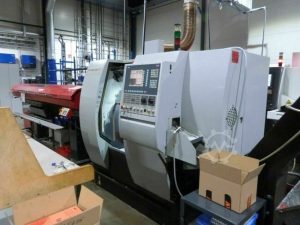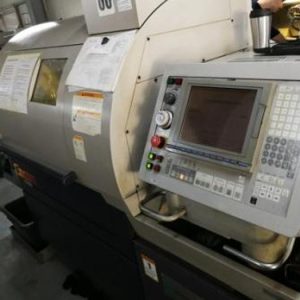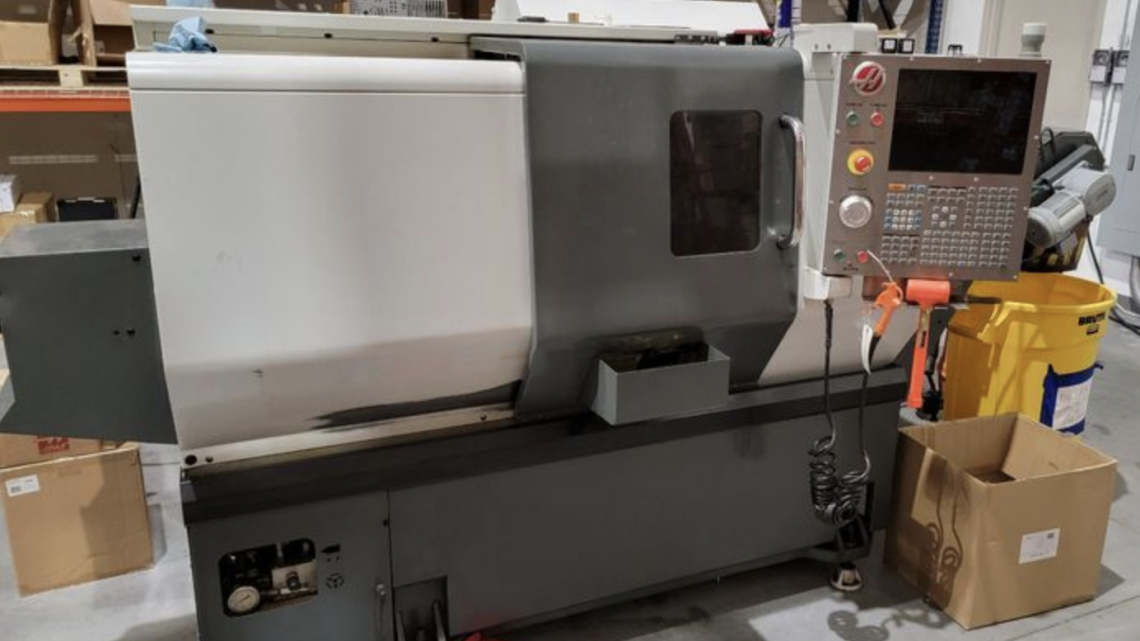
Industrial Insights: How to Spot Quality in Pre-Owned, Used, Secondhand, Surplus CNC Equipment Before Purchase HAAS ST10Y CNC Turning Center made in USA
Below is a specialized inspection & decision guide for evaluating a pre-owned / used / surplus HAAS ST-10Y CNC Turning Center (USA-made) — what to check, how to interpret findings, and when to walk away or negotiate hard.
First, I’ll list the published specs (so you know what the machine should do), then walk you through subsystem checks, red flags, and decision logic.
Reference Specs & Baseline for HAAS ST-10Y
These are the key specs you should verify (or expect) on a good ST-10Y. Deviations beyond acceptable tolerance are warning signs.
| Feature | Published Spec / Typical Value |
|---|---|
| Chuck size | 165 mm (6.5 in) |
| Max cutting diameter (with BMT45 turret) | ~ 279 mm (11 in) |
| Max cutting length (Z) | ~ 406 mm (16 in) |
| Linear travels | X: 200 mm; Y: ±51 mm (i.e. 102 mm total) |
| Z-axis travel / rapid | Z rapid ~ 30.5 m/min (approx) |
| Spindle speed / power | 6,000 rpm, 11.2 kW vector drive (~15 hp) |
| Bar capacity / spindle bore | Bar capacity ~ 44 mm; spindle bore ~ 58.7 mm |
| Turret / live tooling / C-axis | 12-station turret with live tooling, C-axis capability |
| Construction / origin | “Made in the U.S.A.” for HAAS machines (including ST-10Y) |
These specs act as your reference benchmarks. On inspection, deviations (especially in motion, spindle behavior, or live tooling) are red flags.
Key Areas to Inspect / Test — What to Look For (and What It Means)
Here is a structured checklist for all subsystems. Use it on-site, measure where possible, and look for “signature failures” that often cause surprises later.
| Subsystem / Feature | What to Inspect / Test | What “Good / Acceptable” Behavior Is | Red Flags / Warning Signs |
|---|---|---|---|
| Frame / base / structure | Visually inspect for cracks, weld repairs, deformation. Check base alignment. | No structural cracks or past repairs; frame straight and rigid. | Welded repairs around stress zones, cracked castings, sagging base, misalignment between bed and turret. |
| Way covers, bellows, guards | Manually move axes; see if covers drag or interfere; inspect for tears or misplacement | Covers slide freely, no binding or rubbing | Torn bellows, sagging covers, protective covers missing or bent, interference. |
| Linear guideways / ball screws / backlash | Jog axes in both directions, reverse, indicator measurement, feel for friction or “dead zones” | Minimal backlash (within spec), smooth movement across full stroke | Excessive backlash, binding in part of stroke, rough motion, clicking or chirping. |
| Spindle (turning spindle) | Run at various speeds, listen for noise, measure runout with test bar, monitor temperature | Quiet across speed range, minimal vibration, runout within microns, stable temp | Bearing grinding, knocking, high vibration, high runout, overheating during run. |
| Live tooling / C-axis / milling spindle | Activate live tools, command C-axis motions, do light milling or drilling, check performance | Smooth live tool operation, precise C-axis indexing, no chatter | Live tool chatter, C-axis slip, indexing error, misalignment, wobble. |
| Y-axis motion | Move +Y / –Y, check reversals, measure any errors or sloppiness in Y-axis | Smooth Y motion, minimal backlash, consistent response | Y-axis is sloppy, overshoots, drift, binding or inconsistent behavior. |
| Turret & tool changer | Cycle turret indexing, tool change under load, verify repeatability and locking | Fast, precise indexing with no misses, secure tool holding | Mis-index, tool drop, slop in turret, collision marks, delays or errors in tool change. |
| Servo drives / motors / electronics | Rapid traverse, direction reversals, acceleration tests, check for servo alarms or instability | Axes respond well, no faults, no dropouts, stable motion at all speeds | Servo faults, drive trips, overheating drives, jitter or instability. |
| Control cabinet / wiring / electronics | Inspect wiring, check for burnt components, fan operation, control stability, error logs | Clean wiring, no burnt or corroded parts, fans working, stable control behavior | Burn marks, broken wiring, fan failure, error logs, unstable control. |
| Thermal drift / stability | Run machine for a period, then re-measure axes, run test cuts to check drift | After warm-up, machine is stable, minimal drift over cycles | Significant dimensional drift over time, delayed stabilization. |
| Accuracy / repeatability tests | Use gauge blocks, test bars, multiple point measurement, repeated cycles | Good repeatability (within a few microns or per the ST-10Y spec) | Inconsistent repeats, large deviations, errors varying across work envelope. |
| Loaded / cutting test | Run a test part or contour under real cutting parameters, monitor behavior | Stable cutting, smooth movement, no alarm, expected surface finish | Chatter, tool breakage, instability, lost steps, surface defects, errors under load. |
| Software / features / backup & programming | Verify that all options (rigid tapping, tool compensation, macro features, G-code programs) work | All licensed features operational, backups available | Missing licenses, features disabled, control crashes, parameter memory errors. |
| Documentation / parts / spares | Ensure manuals, wiring diagrams, parts lists, backup parameter files are provided | Complete documentation, clear parts list, ability to order spares locally | Missing or incomplete documentation, undocumented modifications, obscure parts. |
How to Interpret What You Find — Decision Logic
After you complete the inspection, use the following guidelines to judge whether the machine is a good buy, needs heavy discount, or should be rejected.
- Separate cosmetic damage from functional defects
- Scratches, paint wear, decal fading, surface rust are often acceptable if mechanical systems are sound.
- But defects in the spindle, turret, live tooling, Y-axis, or control electronics are much more serious.
- Estimate repair / remediation cost plus downtime
- For any defect, estimate cost of parts, labor, alignment, calibration, and downtime.
- Use that to adjust your offer: your discount should cover remediation plus risk.
- Check spare parts / service support
- If critical modules (spindle bearings, live tooling units, servo amplifiers, control boards) are difficult to source in your region (Turkey or nearby), the cost and downtime risk increases significantly.
- Remaining useful life & usage history
- If the machine shows heavy use (many cycles, worn parts, multiple repairs), expect that major overhauls may be needed soon.
- Your valuation should reflect how many years of useful life remain.
- Control / software obsolescence risk
- A mechanically good machine but with an obsolete or unsupported control is risky.
- Confirm that the HAAS control, firmware, and modules are healthy and maintainable.
- Negotiate a testing / acceptance window
- Try to include a clause that after delivery you have a window (e.g. 30–90 days) to test the machine under production loads and reject it or demand fixes if performance is below spec.
- Plan for transport / reinstallation risk
- Precision machines often shift alignment during transit. Always budget time for re-leveling, alignment, calibration, and retesting.
- Weighted pass/fail logic
- Assign more weight to critical systems (spindle health, live tooling, Y-axis precision, control electronics).
- Even if a machine is good in many areas, failure in a high-weight subsystem may justify rejecting or deep discount.