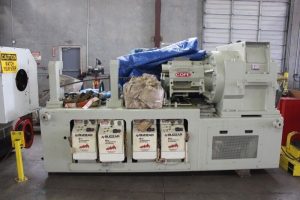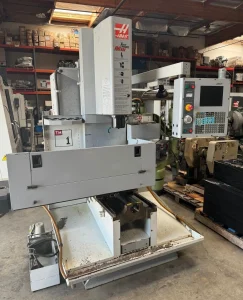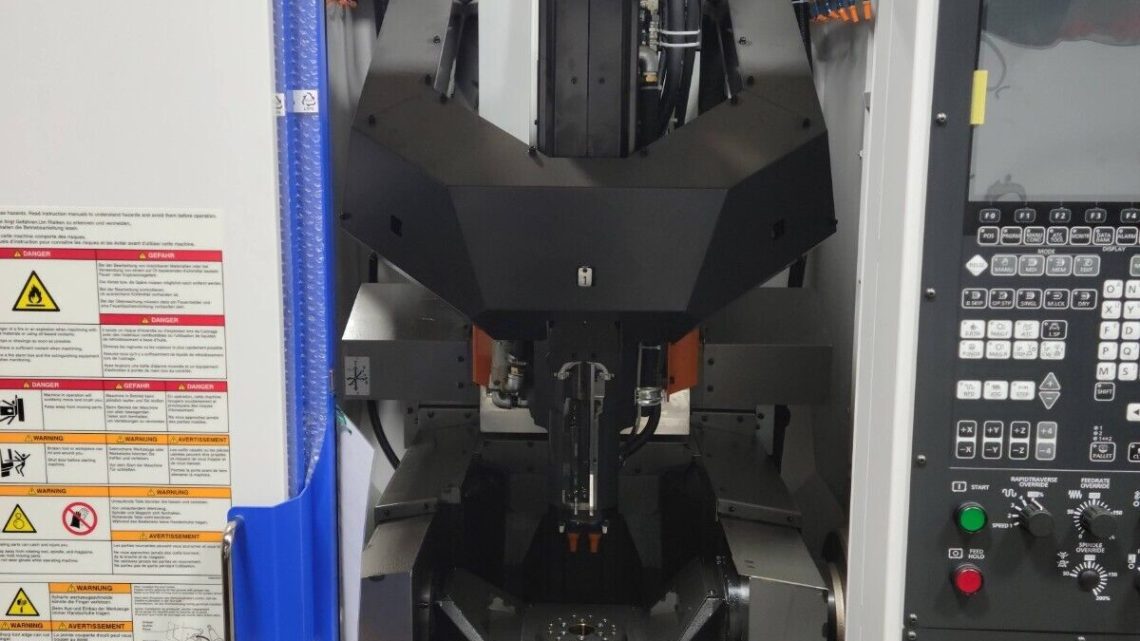
Industrial Insights: How to Spot Quality in Pre-Owned, Used, Secondhand, Surplus CNC Equipment Before Purchase Brother Speedio M200x3 CNC 5 axis Machining Center made in Japan
Below is a refined, industrial-level guide for how to spot quality when evaluating a pre-owned / surplus Brother Speedio M200x3 (5-axis / multitasking machining center made in Japan). I include known specs (to give you benchmarks), then a detailed inspection / test checklist, red flags, and interpretation / decision logic. Use this as your on-site “due diligence playbook.”
Reference specs & architecture (so you know what “good” should look like)
Before inspecting, you need reliable “target” specs to compare against. For the Speedio M200x3, these are known published values from Brother and machine listings.
| Spec / Feature | Typical / Published Value for M200x3 |
|---|---|
| Travels (linear axes) | X = 200 mm, Y = 440 mm, Z = 305 mm |
| Rotary / tilt axes | A: –30° to +120°; C: full 360° |
| Max spindle speed (milling) | 10,000 rpm standard (optional 16,000 rpm) |
| Turning spindle speed | 2,000 rpm |
| Tool magazine capacity | 22 tools |
| Rapid traverse (XYZ) | 50 m/min in X, Y, Z |
| Accuracy / repeatability (bidirectional positioning) | X, Y, Z: ~0.006 to 0.020 mm range; repeatability < 0.004 mm |
| Table / load capacity | Uniform load: ~ 40 kg on table side (for one configuration) |
| Indexing speed (A, C axes) | A: 60 min⁻¹ ; C: 200 min⁻¹ |
| Machine footprint / weight | Floor space: ~1,280 × 3,862 mm; weight ~2,880 kg |
Those specs set the benchmarks. In your inspection, deviations from these (beyond tolerances) may signal wear, damage, or compromise.
What makes a high-quality used Speedio M200x3: key features & risks
Because the Speedio line is compact and highly integrated (turn + mill + tilt + rotary axes), the following features are particularly important to inspect carefully:
- The tilt (A) axis and C-axis must be backlash-free and stable under load; wear here degrades 5-axis precision more severely than in simpler 3-axis machines.
- The dual-plunger locking mechanism (for turning tools) is critical; if lock integrity is poor, tool slippage or vibration may occur. Brother uses a double plunger lock design.
- The spindle dynamic behavior (runout, thermal drift, bearing wear) is more critical in a machine that cycles fast and may do aggressive multi-axis moves.
- Simultaneous 5-axis motion puts stress on the interplay of all axes; any axis with degraded performance may break the synchronization and ruin contours.
- Control electronics (CNC, servo amplifiers, wiring) tend to be custom in such machines; obsolescence or poor maintenance of control systems is a frequent failure point.
Because this is a premium integrated machine, small defects in one subsystem can cascade into poor performance overall.
On-site inspection & test checklist for Speedio M200x3
Here is a detailed, subsystem-by-subsystem checklist of what to check, how, what “good” looks like, and red flags. Always test across the full envelope, with direction reversals, under load if possible.
| Subsystem / Feature | What to Check / Test | What “Good / Acceptable” Behavior Looks Like | Warning Signs / Red Flags |
|---|---|---|---|
| Structural / frame / castings | Visually inspect for cracks, weld repairs, distortion in bed or column | No cracks or repair welds, uniform surfaces, no sag or misalignment | Weld repairs in structural areas, cracks especially near supports or joints, skewed frames |
| Way covers, bells, guards | Move linear axes slowly by hand (or low power), inspect covers / bellows for drag or interference | Covers slide freely, no sticking, no collision, no bent guard rails | Torn bellows, debris caught inside, sagging covers, covers scraping or binding |
| Linear guideways / ball screws / backlash | Jog axes, reverse direction, measure backlash with dial indicator, feel for friction, “dead zones” | Backlash within a few microns, smooth motion through full travel, no stiffness or loose zones | Excessive backlash, binding in portions of stroke, vibration or chirping in slow motion |
| Spindle & bearings (milling spindle) | Run spindle at increasing rpm, listen for noise, measure runout on test bar, check for heat, inspect bearing behavior | Quiet through range, minimal vibration, runout low (microns), stable temperature | Grinding sounds, knocking, high vibration, wobble in test bar, excessive runout, bearing overheating |
| Turning spindle (C-axis) & locking mechanism | Index rotation, apply load, check lock integrity, measure runout, test changeover between turning and milling mode | Stable rotation, lock holds without slip, transitions cleanly | Lock slip or failure, vibration under load, misalignment, wobble when rotating |
| Tilt axis (A-axis) & tilt drive / gearing | Command full tilt range (–30° to +120°), reverse direction, check for slop, play or binding | Smooth tilting, accurate indexing, minimal backlash, gear drive stable | Backlash in tilt, binding near ends, gear lash, jitter during motion |
| Simultaneous 5-axis motion test | Run programmed test contour that exercises all axes (X, Y, Z, A, C) simultaneously | Smooth motion in complex path, no axis conflict, no chatter, consistent surface finish | Axis desynchronization, lost interpolation, collisions, chatter, unstable contouring |
| Tool changer / magazine / ATC | Cycle all tool changes, test insertion / removal, check indexing, measure tool change times | Fast, repeatable tool changes without mis-index, secure holding | Tool drop, mis-index, slow or erratic changes, worn pockets, collision marks |
| Servo drives / motors / electronics | Rapid traverse, acceleration / decel, direction reversal, check for servo alarms, observe motor temps | Responsive axes, no drive faults, stable motion, mild heating within spec | Drive trips, overheating, axis faults, jitter or overshoot, unstable behavior |
| Control cabinet / wiring / electronics | Open cabinet, inspect wiring, look for burnt wires, dusty circuits, check fans; power up control, check alarm logs, parameter memory | Neat wiring, no burn marks, fans working, control boots clean, axis commands responsive, no persistent alarms | Burnt wires, broken connectors, fan failures, control boot errors, intermittent faults, corrupted parameters |
| Thermal stability / drift behavior | Run machine for some time, then re-check critical geometry or test repeats | After warm-up, geometry stable, drift minimal | Significant dimensional drift, position shifts over time, movement compensation failing |
| Accuracy / repeatability tests | Use gauge blocks, test bars, measure positions across envelope and repeat cycles | Good repeatability (e.g. < 0.005 mm or per spec), consistent across axis travel | Larger than acceptable deviations, inconsistent repeatability, variation across the envelope |
| Load / cutting test | If possible, run a real part or test contour under typical cutting parameters; check for vibration, chatter, surface finish | Quiet stable cutting, good finish, no alarms under load, axes hold contour | Chatter, tool overshoot, lost steps, poor surface finish, interrupting alarms, inconsistent motion |
| Software / CNC features / tool point control | Test control functions: compensation, tool point control, interpolation, macro routines, backup restore, error logs | All features functional, no disabled modules, stable behavior during complex motion | Disabled features, errors in kinematics, glitches during advanced routines, missing backups |
| Documentation & spare parts | Ensure original manuals, wiring diagrams, parts list, control backups, maintenance history exist | Complete documentation, parts lists, backup files, known part sources | Missing manuals, undocumented modifications, absent spare lists, unclear versioning |
How to interpret findings & decision logic
Once you have your test data and observations, you must interpret them carefully. Here’s how to turn findings into a decision:
- Categorize defects: cosmetic vs critical
- Cosmetic damage (paint, surface scratches) is manageable and acceptable to some extent.
- But defects in spindles, tilt axis, interpolation issues, major backlash are critical — they may be deal-breakers.
- Estimate repair / rework cost & downtime
- For each issue, get (or estimate) cost of replacement parts, labor, alignment, and calibration.
- Your price discount must more than absorb these costs and risk buffers.
- Check spare / part support & control obsolescence
- Because Brother uses integrated control and motion electronics, parts may be specialized.
- If you cannot reliably source critical spares (e.g. spindle bearings, servo amplifiers, tilt drive units, control modules) in Türkiye or via your supply chain, the risk is high.
- Assess residual life & usage profile
- If the machine appears heavily used — spindles near end-of-life, high axis loads, major repairs done — then “how many years remaining” becomes very important.
- Consider that even a good machine may need big overhauls later.
- Negotiate acceptance / testing window
- Insist on a “test period” after delivery (e.g. 30–60 days) during which you can run full production contours and reject or require fixes if performance is deficient.
- Allowance for reinstallation / recalibration risk
- Moving precision machines tends to knock them out of alignment. Budget time and cost for final calibration, alignment, leveling, and test runs after installation.
- Use a weighted scoring / pass threshold approach
- Assign high weights to spindle condition, tilt / axis precision, control electronics, interpolation accuracy.
- If the machine fails in a high-weight subsystem, that alone may be justification for rejecting or major discount.