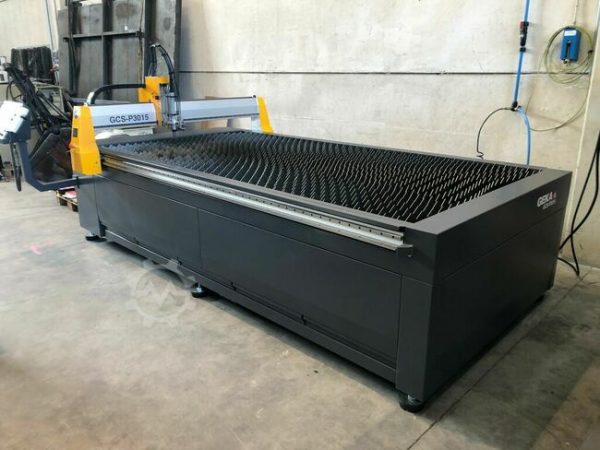
Industrial Insights: How to Spot Quality in Pre-Owned, Used, Secondhand, Surplus CNC Equipment Before Purchase GEKA GCS-P 4020 CNC Plasma Cutting Machine
Here is a detailed, industrial-level guide to help you spot quality and hidden risks when evaluating a pre-owned / surplus GEKA GCS-P 4020 CNC plasma cutting table. You can use this as an on-site inspection checklist and decision tool.
Baseline / reference specs & features (what “good” should look like)
Before you inspect, you should know what the machine is supposed to deliver (so you can spot deviations). For the GEKA GCS-P 4020, the manufacturer brochures and listings give the following reference data:
| Feature | Typical / Published Value |
|---|---|
| Cutting table size (X × Y) | 4,000 mm × 2,000 mm (≈ 157.5″ × 78.7″) |
| Max traverse / movement speed | ~ 40 meters per minute (i.e. ~ 40,000 mm/min) |
| Control resolution / positioning accuracy | ~ 0.01 mm resolution on X/Y axes |
| Z-axis / torch height range | Z (bridge / torch height) ~ 100 mm clearance above table (bridge height) |
| Torch / THC (Torch Height Control) integration | The machine is specified to have integrated THC (automatic height control) in the CNC control to maintain proper distance between torch and workpiece during cutting |
| Anti-collision / safety systems | The specification mentions a torch anti-collision system (i.e. machine stops on collisions) |
| Drive / motion systems | Linear guides with self-lubricated, sealed ball track (play-free) in axes; rack & pinion drive with servo motors; optional automatic lubrication |
| Construction / rigidity / base | Heavy duty base, robust steel chassis, designed for rigidity to minimize deflection during motion |
| Optional / auxiliary systems | Fume extraction (sectorized table or grating table with gas extraction), laser pointer for X/Y zeroing, automatic lubrication, Z‐axis collision detection, full CNC (TexComputer control, touch screen) |
Because this is a plasma table (rather than a spindle / servo machine), the failure modes differ somewhat (less concern for spindle bearings, more for motion systems, consumables, arc performance, and control). But many of the same principles hold.
Pre-visit preparation
Before you inspect in person, take these steps:
- Request documentation & history
• Maintenance logs / service records (including torch consumable replacements, plasma unit history)
• Operating hours / duty cycles (how many hours in plasma cutting)
• Any collision events (torch crashes) or repairs
• Control / CNC backups, parameter files, wiring diagrams
• Plasma unit model, spare parts used, consumables history - Get remote demo / video
Ask the seller to run:
• A full traverse in X and Y (both directions)
• Z (torch up / down) motion
• A sample cut (a simple geometry) under plasma power
• Watch for smoothness, chatter, audible issues - Bring inspection & measurement tools
• Dial indicators, straightedge, gauge blocks
• Laser pointer or height gauge to check Z repeatability
• A test coupon / sheet to cut (if allowed)
• Digital camera / smartphone for recording behavior - Bring or consult a plasma / motion expert
Someone who can interpret motion errors, CNC behavior, arc performance, diagnostics - Check spare parts & support
• Can you source torch consumables, plasma power supplies / modules, control electronics, linear guides, motors locally (or via import)?
• Is there a service / repair shop in your country or region familiar with GEKA or plasma CNC machines? - Logistics & installation planning
• Weight, footprint, crane / rigging path
• Power requirements for plasma supply, gas, cooling / ventilation / fume extraction
• Expect re-calibration after move - Prepare an inspection / scoring sheet
• List critical subsystems (motion axes, plasma source, control, Z-THC, structure) with weights so you can score on site
On-site inspection & test checklist (critical subsystems)
Below is a subsystem-by-subsystem checklist with what to look for, good behavior, and red flags.
| Subsystem / Feature | What to Inspect / Test | What “Good / Acceptable” Looks Like | Red Flags / Warning Signs |
|---|---|---|---|
| Structural / base & rigidity | Visually inspect frame, welding seams, chassis, check for signs of sag, cracks, deformation | No structural repairs, no cracks, no bending, rigid frame, no creaking under load | Weld repairs in load areas, cracked frames, visible distortion, sagging cross members |
| X / Y axis motion (linear guides / rack & pinion / servo system) | Traverse full stroke both directions; reverse direction and check backlash; listen for noise; check motion smoothness | Smooth motion, minimal backlash, no binding, repeatable travel | Binding or jerking motion, excessive backlash, noise in drive, “dead spots,” vibration |
| Z axis / torch height mechanism (lifting / lowering) | Move the torch up/down, check speed, check for binding, measure repeatability of Z full moves | Smooth vertical motion, stable stops, no sticking, repeatable position | Sluggishness, binding, drift in Z position, inconsistent stopping points |
| Torch Height Control (THC) / height sensing | Engage automatic height mode during a cut or simulation; see if torch maintains appropriate standoff to material | Torch maintains consistent distance, rapid correction, no oscillations | Torch hunts up/down, failure to maintain distance, crashes, oscillation, delayed reaction |
| Plasma power supply & arc performance | Operate plasma unit, run a sample cut, examine arc stability, cutting speed, edge quality, dross, cut perpendicularity | Clean cut, minimal dross, stable arc, consistent kerf, smooth edge finish | Arc instability, flicker, inconsistent cut, excessive dross, curved cuts, arc dropouts |
| Motion speed & acceleration / deceleration | Command full traverse speed (40 m/min or matching spec), and rapid acceleration / deceleration, test for lag or overshoot | Machine can reach and maintain rated speed, responsive stops, no overshoot | Cannot reach full speed, slow responsiveness, overshoot, instability at high speed |
| Anti-collision / limit systems | Test limit switches, collision stops, emergency stops; do a gentle “bump” test in safe mode to see if machine stops | Collisions / crashes are detected and motion stops, limit switches function reliably | Limit switches not accurate, collision not detected, emergency stop failure, no safe limits |
| Control electronics / CNC / software | Inspect control cabinet, wiring, check for burnt wires or evidence of overheating; boot control, check axes status, error logs, responsiveness | Clean wiring, fans working, no burnt parts, control responds, axis commands accepted, error-free movement | Loose or burnt wiring, fan failure, intermittent control faults, error codes, lag in response |
| Consumables / torch mounts / nozzle alignment | Check torch holder, collet condition, mounting surface, alignment of torch to machine axes | Tight mounting, no play, good alignment, torch perpendicular or within tolerance | Loose torch mounts, worn collets, misalignment, torch Tilt or drift |
| Bed / table condition (slats, beds, support structure) | Inspect table slats, grates, wear, warpage, damage, torch clearance, grounding condition | Slats or grates usable, minimal damage, good flatness, proper support | Warped bed, heavily damaged slats, misalignment, missing parts of grating, uneven supporting structure |
| Fume extraction / ventilation / gas exhaust | Check ducting, extraction fans, ports, condition of gas capture system, airflow condition | Ducts intact, fans operational, no major leakage, extraction works during cutting | Blocked ducts, fans not working, leaks, excessive dust buildup, poor suction |
| Motion / positioning repeatability / accuracy | Use test cuts or positioning commands with gauge / measurement, check how accurately it returns to zero or commanded positions | Repeatability within tolerance (e.g. in tenths of mm or better, depending on spec) | Position drift, inconsistent reposition, error in returning to zero, cumulative errors over distance |
| Safety systems / interlocks | Check that safety covers, viewing windows, door interlocks, emergency stops all work | All safety features functional, machine stops when guards open, E-stop responds | Missing safety guards, interlocks disabled, E-stop not functioning, safety bypassed |
| Documentation, consumables / spare parts | Ask to see operator manual, maintenance book, wiring diagrams, parts lists, spare torch consumables inventory | Complete documentation, spare consumables and parts listed, parts availability known | Missing manuals, no consumables list, unknown torch spare parts, undocumented modifications |
Interpreting findings & decision criteria
Once your inspection is done, here is how to interpret your observations and decide:
- Distinguish cosmetic vs performance-impacting defects
• Surface wear, minor scratches, paint loss are acceptable to some extent.
• But motion errors, torch problems, control issues, or frame defects are far more serious. - Estimate repair / remediation cost & risk
• For each issue, estimate cost of parts, labor, downtime.
• The discount you negotiate should more than cover expected repair costs + risk buffer. - Consumables / spare parts / local support
• A plasma machine’s value is heavily tied to torch / nozzle consumables, plasma power supply modules, parts for motion axes.
• If parts are hard to source in your region, that is a significant risk. - Remaining useful life & operating hours
• Plasma units (especially power supplies) have rated lifetimes (e.g. hours or duty cycle).
• Excessive hours or evidence of heavy use reduce expected remaining life. - Control / software obsolescence
• A machine mechanically good but with outdated or unsupported control is risky.
• Confirm control hardware, firmware, and software versions are stable and maintainable. - Negotiate acceptance / testing period
• Try to get a period after delivery (e.g. 30–60 days) to perform full production trials and reject or ask for remediation if performance is poor. - Allowance for realignment and calibration after transport
• Even after a clean inspection, moving the machine may shift alignment. Always allocate time to re-level, re-zero axes, calibrate before production use. - Weighted scoring / pass/fail threshold
• Give higher weight to critical subsystems (plasma arc stability, torch height control, motion axes, control electronics).
• If a machine fails a high-weight subsystem, that alone may justify walking away—even if many other subsystems are acceptable.