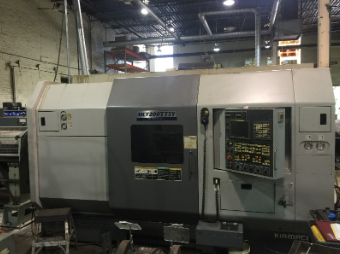
Industrial Insights: How to Spot Quality in Pre-Owned, Used, Secondhand, Surplus CNC Equipment Before Purchase Hyundai Kia SKT-200TTSY CNC Turning Center made in South Korea
When evaluating a used / surplus Hyundai KIA SKT-200TTSY CNC turning (multi-tasking) center, here’s a deep industrial-grade guide: what to expect, what to check, red flags, and decision logic. Use this as your on-site inspection playbook.
Typical / baseline specs & architecture (what “good” looks like)
Before inspection, you should know the nominal spec range so deviations stand out. Based on machine listings and manufacturer data:
| Spec | Typical / Published Value* |
|---|---|
| Swing over bed / saddle | 30.7″ (≈ 780 mm) / ~29.1″ (≈ 740 mm) |
| Max turning diameter (upper / lower turret) | ~ 15.4″ / 11.8″ (≈ 390 / 300 mm) |
| Max turning length / Z travel | ~ 36.2″ (≈ 920 mm) |
| Spindle speeds | 50 – 5,000 rpm on main and sub spindles |
| Spindle bore / bar capacity | ~ 3.1″ bore, bar capacity ~2.56″ (≈ 65 mm) |
| Motor power | ~ 33 HP / 20 HP (30 min / continuous rating) |
| Turrets / tool stations | Twin turrets, 12 stations each (upper & lower) |
| Y-axis (upper turret) | ± 2.4″ (~ ±60 mm) Y capability on upper turret |
| Live tooling & C / B axes (indexing) | Rotary / live tool capacity (e.g. 4,000 rpm for live tools) & C-axis indexing (0.001° resolution) |
| Rapid traverse / feed rates | Rapid X/Z ~945 ipm (≈ 24 m/min) in many listings |
| Control system | Often Fanuc 18i-TB in existing listings |
* Note: variants or custom configurations may deviate; always verify the specific machine’s posted spec sheet or nameplate.
Given that this machine is a multitasking / twin-spindle, twin-turret lathe with Y-axis and live tooling, the complexity is high; thus risk is higher too.
Pre-visit / preparatory steps
Before going to inspect:
- Obtain machine history & documentation
- Maintenance logs, overhauls, repairs, rebuilds
- Spindle hours, axis hours (not just “powered-on”)
- Calibration / alignment certificates
- Control parameter backups, wiring diagrams, parts lists
- Any incident / crash history
- Request demo / video in advance
- Jog all axes, cycle turrets, run spindle up/down speeds, engage live tooling, if possible run a simple test program
- Observe for unusual sound, vibration, control error codes
- Bring test / inspection tools
- Dial indicators, test bars, gauge blocks, edge finders
- Vibration meter or stethoscope, IR thermometer
- Reference “coupon” or gauge part if possible
- Bring or consult a specialist
- Especially someone familiar with multi-axis lathes / turn-mill machines
- Someone who can interpret control errors, servo behaviors, etc.
- Verify spare parts / support in your region
- Are critical parts (spindles, turrets, live tooling modules, control boards) available locally or via reliable import?
- Are there service firms familiar with this model or with Hyundai-WIA / Korean turning machines?
- Plan logistics / installation constraints
- Footprint, weight, path of removal, crane / rigging, power / utilities, foundation, vibration damping, floor capacity.
- Prepare a scoring / inspection checklist
- Predefine subsystems (spindle, axis drives, turrets, control, geometry) with weights so you can objectively score on site.
On-site inspection & tests: what to check, how, red flags
Here is a structured checklist, subsystem by subsystem, with “good vs warning signs.” Always test across the full travel, with direction reversals, under light load, and ideally under heavier or simulated load.
| Subsystem / Area | What to Inspect / Test | What Good / Acceptable Looks Like | Warning Signs / Red Flags |
|---|---|---|---|
| Structural / castings / frame | Visually inspect for weld repairs, cracks, distortion, misalignment of bed/ways | No visible cracks or weld repairs, uniform surfaces, no sag or tilts | Repair welds in load zones, cracked castings, misaligned ways, distorted frame |
| Way covers / bellows / guards | Move axes (X, Z, Y if present) slowly, inspect covers for dragging, deformation, interference | Covers move freely, no scraping, no sag, no interference | Torn bellows, sagging covers, collision with covers, debris caught under covers |
| Linear guides / ball screws / backlash | Jog direction reversals, measure backlash via dial indicator, feel for friction/humming, “dead zones” motion | Backlash within spec, smooth across full travel, no stiff/loose zones | Excessive backlash, binding in parts of travel, chatter in slow motion, vibration/humming |
| Spindle (main and sub) | Spin up through rpm range, listen for bearing noise, measure runout with test bar, thermal behavior | Quiet across rpm, minimal runout (microns), stable temperature | Bearing noise (grinding, knocking), high vibration, large runout, overheating |
| Turrets / index drives / tool change | Cycle indexing, dwell, tool change, test live tools, alignment of tool holders | Fast indexing, no misses, consistent repeatability, no collision | Misindexing, tool drop, slow indexing, worn turret gearing, backlash in turret system |
| Y-axis (upper turret) | Test Y axis motion under different tool load directions, check for backlash or drift | Smooth Y motion, responsive control, low backlash | Stiction, uneven motion, high backlash, drift, errors in synchronization |
| Live tooling / milling tools / rotary tools | Engage live tooling, run at rpm, do light cuts, check vibration, tool change behavior | Stable operation, no chatter, accurate output | Chatter, vibration, tool failure, excessive runout, instability at higher rpm |
| Axis drives / servo / motors / electronics | Full-speed rapid moves, acceleration / decel, direction reversals, monitor for servo alarms or instability | Stable, no axis faults, no trips, responsive motion across range | Drive errors, overheat, axis trips, jitter or oscillation in motion |
| CNC control / electrical cabinet | Inspect wiring, cleanliness, fans, signs of arcing; power up control, check logs, I/O, parameter memory, error code history | Neat wiring, no burnt wires, fans operational, control boots clean, parameter access, minimal or no persistent alarms | Burnt connectors, smoke / smell, missing modules, control boot errors, unstable parameter memory |
| Coolant / lubrication systems | Check condition of coolant (clean, no sludge), pumps, piping, filtration; check auto-lubrication for axes | Clean coolant, working pumps, no leaks, lubrication system functional | Clogged filters, leaks, pump failure, lubrication starvation, contamination, corrosion |
| Chip handling / conveyors | Run chip conveyor / chip auger, inspect for jamming or accumulation | Chips evacuated cleanly, no pile-ups, conveyor / auger motors functioning | Jams, broken chains, conveyor motor errors, chips stuck in inaccessible places |
| Thermal drift / stability | After warm-up, re-check key dimensional measurements, geometry or test cuts to see drift | Minimal drift, stable dimensions over time | Significant drift over time, parts changing size mid-cut, inconsistent geometry |
| Accuracy / repeatability | Use gauge blocks, test bars, multiple point measurements, repeat cycles and compare | Repeatability within tight tolerances, minimal deviation across envelope | Inconsistent results, drift, nonlinearity, deviation beyond acceptable tolerances |
| Full-load / cutting test | If possible, run a real part under production-style cutting conditions, monitor behavior | Stable machining, no chatter, good surface finish, no alarms under load | Chatter, tool breakage, servo overloads, variable finishes, tool failures |
| Software / control features | Test advanced features: synchronism, offsets, macro functions, canned cycles, error handling, collision detection, parameter change | All features function, no disabled modules, stable control behavior | Missing licensing, functions disabled, control instability, inability to run complex motion or macro cycles |
| Documentation & spares / tooling | Confirm manuals, wiring diagrams, parameter backups, spare parts lists, tooling list presence | Full documentation, clear spare parts listing, parameter backups | Missing manuals, no backups, undocumented modifications, lack of spare parts or tooling listings |
Interpreting Findings & Decision Strategy
Once you complete the inspection, here’s how to interpret what you found and decide whether to go ahead, negotiate, or walk away:
- Distinguish cosmetic wear from functional / fatal defects
- Surface scratches, paint fade, minor cover dents are often acceptable.
- But defects in spindles, turrets, axis backlash, control electronics, or geometry errors are more serious.
- Estimate remediation cost & downtime
- For detected issues, ask for a parts & labor repair quote (or estimate yourself).
- Compare the repair cost + risk vs. your discount vs. buying a better machine.
- Use discovered defects as negotiating leverage.
- Check spare parts / service support in your region
- The value of a machine is heavily tied to how easily you can source spares (turret parts, spindles, control electronics, live tooling modules).
- If parts or servicing is hard or expensive in your area, that devalues the machine significantly.
- Assess remaining useful life
- High spindle hours or heavy usage on many subsystems means you may inherit costly rebuilds soon.
- Factor “future capital expense” into your offer.
- Control / software obsolescence risk
- Even if mechanical systems are solid, an outdated or unsupported control or software environment can become a liability.
- Ensure the control is robust, modules are available, and you can load your programs or CAM toolpaths.
- Negotiate an acceptance / test-run window
- Try to arrange for an acceptance period (e.g. 30–90 days) after delivery, during which you can test under real load and reject or demand fixes if performance is inadequate.
- Account for transport / reinstallation risk
- Even a perfect machine can be misaligned or shifted during transport. Always plan re-leveling, re-check geometry, and validate performance after installation.
- Use a weighted decision / scoring matrix
- Not all subsystems are equal: spindle health, turret function, geometry, control electronics should be higher-weighted.
- If the machine fails a high-weight subsystem (say spindle or turret), that alone may justify rejecting it regardless of how well other parts do.