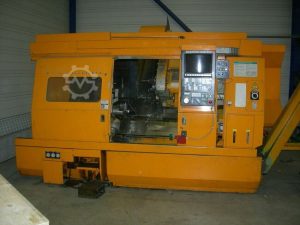
Industrial Insights: How to Spot Quality in Pre-Owned, Used, Secondhand, Surplus CNC Equipment Before Purchase DMG Mori CTX Gamma 2000 TC CNC MultiTasking Turn-Mill Center made in Germany & Japan
Here is a deep-dive, industrial-grade inspection, testing, and decision-framework guide for evaluating a pre-owned / surplus DMG Mori CTX Gamma 2000 TC (a high-end turn/mill multi-tasking center) before purchase. This is meant to help you spot hidden issues, assess risk, and decide whether a used machine is worth proceeding with.
Overview & baseline specs (so you know what “good” should look like)
Before going on site, you need a reference spec sheet. Here are typical specs and architecture for the CTX Gamma 2000 TC — use them as your baseline for comparison and red-flag detection.
Key published specs & architecture
- The CTX gamma 2000 TC is a turn + mill (turn/mill / multitasking) integrated machine offering six-sided complete machining (turning + milling in one setup).
- Capacity / envelope:
• Max workpiece diameter: ~ 700 mm (≈ 27.6 in)
• Max workpiece length: ~ 2,000 mm (≈ 78.7 in)
• X-axis travel: ~ 800 mm (≈ 31.5 in)
• Y-axis travel: ~ 420 mm (≈16.5 in)
• Z-axis travel: ~ 2,050 mm (≈ 80.7 in) (for the standard non-linear/linear version) - Spindle / drive architecture:
• Integrated turn/mill spindle “compactMASTER” with options (standard 12,000 rpm for milling, with torque and power specs)
• Main turning spindle rated (~ 4,000 rpm, ~60.3 hp) in standard form.
• C-axis (rotary axis) built-in with 0.001° incrementing resolution
• Tool magazine: standard 36-station disc magazine, optional chain magazine up to 180 stations - Control & feedback:
• Linear scales / direct measurement feedback on axes for accuracy and repeatability.
• Cooling systems for axis motors, turret drives, and spindle drives. - Options & features:
• Optional counter spindle enabling full 6-face machining in one setup
• Machining cycles including gear cutting, interpolation, tool monitoring, retraction cycles, etc.
Given the complexity and integration of turning + milling, multiple spindles, turrets, rotary axes, etc., this machine has many more potential failure points than a simpler CNC mill or lathe.
Pre-visit planning & preparation
Before you even set foot in the plant, do the following to maximize what you can verify, and to minimize your risk:
- Obtain documentation & history
- Maintenance / service logs (dates, parts replaced, major overhauls).
- Spindle hours (turning and milling), not just “powered-on hours.”
- Rebuild or refurbishment records (if any).
- Calibration / alignment records, geometry checks.
- Control backups, parameter files, axis zeroing files, firmware versions.
- Electrical schematics, parts lists, spare parts inventory.
- Any incident history (collisions, crashes, tool breakages).
- Request live demo / remote video
- Jog all axes in each direction, including the sub-spindle (if equipped).
- Cycle tool changes, turret indexing, spindle speed ramp-up, live tool actuation.
- If possible, run a short “test cut” or known sample program.
- Preferably catch behavior under load (some chatter, heavier cut) if feasible.
- Bring your inspection toolkit & reference parts
- Dial indicators, test bars, gauge blocks, edge finders.
- Vibration probe or stethoscope, infrared thermometer (for thermal checks).
- Known “master part” or reference gauge if feasible (small “coupon” you trust).
- Tools for calibration / geometry checks.
- Arrange expert support
- If you are not deeply familiar with multi-axis turn-mill machines, bring a mechanical + controls specialist.
- Someone who can interpret CNC feedback, error codes, servo behaviors, electrical oversight.
- Check spare parts & support logistics
- Are critical replacement parts (spindles, turrets, gearboxes, servo modules, control boards) accessible in your region or via your supply chain?
- Are there service firms nearby experienced in DMG Mori / CTX / turn-mill machines?
- What is the lead time and cost for key spares?
- Plan installation / transport
- Know machine weight, footprint, crane / rigging paths, foundation needs, floor loading, power and cooling requirements.
- Understand the risks of shifting alignment during transport — always expect to re-level and re-align after delivery.
- Prepare a scoring / inspection checklist
- Prebuild a list of subsystems (spindle, axis drives, turrets, control, geometry, etc.) with weightings so you can score the machine objectively on site.
On-site inspection: tests and red flags for CTX Gamma 2000 TC
Because CTX Gamma 2000 TC combines turning, milling, turrets, sub-spindles, and full 6-face machining, the inspection must be rigorous. Always test across the full travel and envelope, under different conditions (slow moves, rapid moves, loaded, idle).
Here’s a subsystem-by-subsystem checklist:
| Subsystem | What to Test / Observe | Good / Acceptable Behavior | Red Flags / Warning Indicators |
|---|---|---|---|
| Frame, castings, base structure | Inspect visually for cracks, weld repairs, distortion, misalignment | No structural repairs, no cracks, consistent surfaces | Weld repair scars, cracked castings, misalignment between main axes |
| Way covers / bellows / guards | Move axes; check for dragging, contact, sagging, deformation | Smooth sliding, no interference, no sagging | Bellows torn, sagging covers, contact with table, debris stuck inside |
| Linear guides, ball screws, axis drives (X, Y, Z, etc.) | Jog axes back and forth, measure backlash, check for binding, feel uniform motion across travel | Backlash within spec, smooth motion, no “dead spots” | Excessive backlash, binding in certain ranges, vibration or chirp during slow moves |
| Turn / mill spindle(s) | Run spindles through full rpm range; measure runout with a test bar; listen for bearing noise; temperature checks | Quiet operation, smooth rpm ramp-up, runout within a few microns | Bearing grinding, knocking, vibration, wobble, excessive heat under speed |
| Tool turret / turret drive / indexing | Index the turret repeatedly, engage live tool spindles, confirm tool change accuracy | Fast, repeatable indexing, no misfires, precise alignment | Missed indexing, tool drop, slow indexing, worn turret gear, backlash |
| Counter spindle / sub-spindle (if equipped) | Transfer a part between main and sub spindles, check coupling accuracy, run sub spindle rpm | Clean, secure transfer, no wobble, stable rpm | Misalignment in transfer, unstable or loose coupling, runout or vibration in sub spindle |
| Live tool / milling spindle & interpolated motion | Engage live tools, do milling operations, test interpolation between turning and milling axes | Stable milling, smooth transitions, no chatter, accurate contouring | Chatter, oscillation, mis-synchronization, poor surface finish |
| Servo drives / motors / electronics | Exercise rapid moves, acceleration / deceleration, test direction reversal, monitor for drive faults or thermal issues | Stable axis response, no servo alarms, minimal thermal drift | Drive faults, axis trips, overheating, erratic or improper response |
| CNC control & electrical cabinet | Inspect wiring, cleanliness, look for burnt wires or connectors, ensure fans run; power on the machine, check alarm logs, I/O integrity, control diagnostics | Neat wiring, no visible damage, no error codes, functional I/O, healthy control startup | Burn marks, broken wires, fan failure, control boot alarms, corrupt parameter files |
| Coolant / lubrication / hydraulic systems | Inspect coolant tank, pumping, filtration, piping; check lubrication system for axes & turrets | Clean coolant, working pumps, no leaks, proper lubrication flow | Clogged filters, leaks, pump failures, insufficient lubrication, contaminated coolant |
| Chip handling / conveyor system | Run chip removal systems (conveyors, augers) under typical scenarios | Chips evacuated cleanly, no jams, motors functioning | Jams, pile-ups, broken components, motor failure |
| Thermal drift / stability over time | After warming up, re-measure critical dimensions or perform test cuts to detect drift | Geometry remains stable over time; minimal drift | Significant drift, dimensional changes due to heat or expansion |
| Accuracy / repeatability tests | Use gauge blocks / reference parts / CMM / dial indicators across multiple points and repeated cycles | Repeatable within tight tolerances (manufacturer spec or your requirement) | Non-repeatable results, large variation across envelope, deviations beyond acceptable tolerances |
| Full-load / cutting test | If allowed, run a real or representative part under full load; monitor vibration, surface finish, thermal effects, tool behavior | Stable cutting, no alarms, good finish, consistent behavior | Chatter, tool breakage, alarms under load, varying finish, inconsistent performance |
| Software / control features & options | Validate that special functions (tool monitoring, collision detection, interpolation, thermal compensation, gear cycles, retraction cycles) operate correctly | All licensed features function, no software errors or disabled features | Missing licenses, software errors, crashes during complex motion, disabled or nonfunctional features |
| Documentation, spares & tooling | Confirm existence of manuals, parameter backups, parts lists, tooling lists, spare parts inventory | Full documentation, tool lists, spare catalogs, parameter backups | Missing or incomplete documentation, no spare parts info, undocumented modifications |
How to interpret findings & decision thresholds
After your inspection, you must weigh what you observe and decide whether the machine is viable, needs repair, or should be rejected outright. Here are guidelines and thresholds:
- Critical vs. cosmetic defects
- Some wear (cosmetic, minor cover dents, scratches) is acceptable.
- But defects in spindles, turrets, drive systems, geometry, or control electronics are far more serious.
- Repair cost, downtime & risk margin
- Whenever a defect is found, estimate cost of parts, labor, downtime, and potential risk escalations. Use that to adjust your offer (or walk away).
- If the cost to remediate approaches or exceeds the discount you’re getting vs. new replacement, that’s a signal.
- Spare parts availability & support
- If key components (spindle bearings, turret drives, control modules, specialty gearboxes, software modules) are not readily available regionally, that adds risk.
- If you can’t source or import spares reliably, a “good” machine may still become a liability.
- Residual life & usage profile
- High spindle hours or heavy usage history reduce the machine’s remaining useful life.
- Consider how soon you may have to do big overhauls and factor that into your valuation.
- Control / software obsolescence risk
- Even if mechanically sound, a machine with an obsolete or unsupported control or software environment can become difficult or impossible to maintain or upgrade.
- Ensure control software, firmware, modules, and licensing are in place, and verify that the machine can accept your production programs or CAM toolpaths.
- Acceptance / test-run window
- Negotiate a post-delivery acceptance period (e.g. 30–90 days) where you can fully test the machine and reject or demand repair if performance is unsatisfactory.
- Transportation & reinstallation risk
- Precision machines frequently lose alignment during transport. Always expect to re-level, re-check geometry, and adjust after installation.
- Weighted scoring / decision logic
- Use your inspection checklist and assign weights: e.g. spindle health, turret integrity, control electronics, geometry carry more weight than covers or paint.
- If the machine fails a high-weight item, that alone may justify rejecting it.