Industrial Insights: How to Spot Quality in Pre-Owned, Used, Secondhand, Surplus CNC Equipment Before Purchase Doosan Revo 3020 CNC Vertical Machining Center made in South Korea
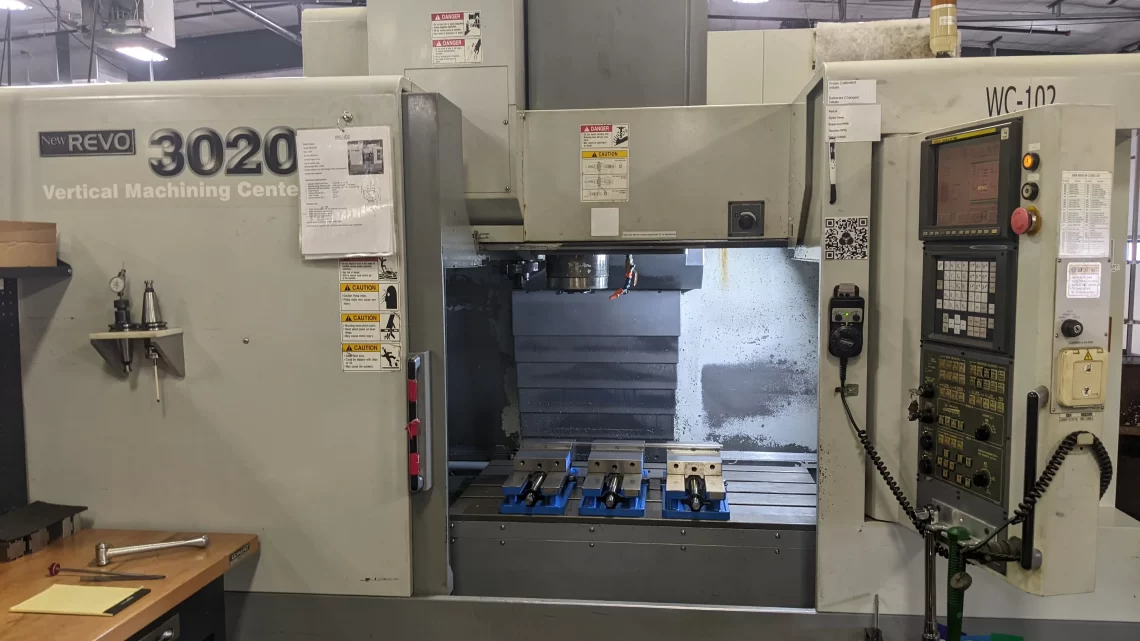
Below is a detailed “industrial-grade” checklist and insight guide for evaluating a pre-owned / surplus Doosan REVO 3020 (vertical machining center) before purchase. Use this to structure on-site inspection, testing, and decision making. I also include key known specs so you know what “normal” looks like.
Baseline / known specifications (for REVO 3020)
First, to detect deviations, you must know what the machine should deliver in ideal condition. Based on listings:
- The REVO 3020 is a vertical machining center.
- Travels: X ≈ 817.9 mm (~32.2 in), Y ≈ 508 mm (20.0 in), Z ≈ 510.5 mm (~20.1 in)
- Spindle: up to ~10,000 rpm, BT/CAT-40 taper
- Spindle power: ~14.9 kW (~20 hp)
- Tool magazine: ~30 tools / ATC slots
- Table dimensions: ~500 × 1,000 mm (W × L)
- Max table load, chip handling, etc., typical for mid-sized VMCs in its class.
With those specs in hand, you can compare what the machine actually does on site versus what it should.
Pre-visit preparation
Before you go, set yourself up to see as much as possible and avoid surprises.
- Request full documentation: maintenance logs, repair history, spindle hours, axis movement hours, rebuilds, alignment reports, control backups, wiring diagrams, parts lists.
- Ask for live video demonstration: jog all axes, spin the spindle through range, perform ATC cycles, if possible run a short test cut.
- Bring measuring / inspection tools: dial indicators, test bars, gauge blocks, edge finders, possibly a vibration meter or stethoscope.
- Bring or arrange someone experienced in CNC / machine tool evaluation (mechanical, control, electrical).
- Confirm spare parts / support: can you source spindle bearings, drives, control modules locally (or via your supply chain)?
- Know the logistics: footprint, weight, crane, foundation, power, cooling, transport path.
On-site inspection and tests: detailed checklist & red flags
Below is a structured checklist with what to observe, acceptable behavior, and warning signs. Always test across the entire travel / full envelope, not only near the center.
| System | What to Inspect / Test | Good / Acceptable Behavior | Red Flags / Warning Signs |
|---|---|---|---|
| Structural / frame / castings | Inspect for cracks, weld repairs, alignment of base surfaces, deformation | No cracks, no obvious structural repairs, fairly uniform look, no visible distortions | Welds in critical load paths, cracked castings, evidence of collision damage, twisted frame |
| Way covers / bellows / guards | Move axes (X, Y, Z) at slow speeds; examine covers for drag, contact, dents, deformation | Covers slide smoothly, no contact, no sag, no interference | Torn bellows, sagging covers, covers scraping other parts, debris stuck under covers |
| Ball screws / linear guides / bearings | Jog axes, reverse direction, check for backlash via dial indicator, feel for uneven motion, “dead zones” | Low backlash (within manufacturer tolerance), smooth motion throughout each axis | Large backlash, binding in parts of travel, stiff or loose patches, vibration or chirping under slow motion |
| Spindle & bearings | Run spindle at multiple rpm (low → high); check for bearing noise, vibration, temperature; test runout using a gauge / test bar | Quiet throughout speed range, minimal vibration, stable temperature, runout within microns | Grinding, knocking, loud hum, excessive vibration, large runout on test bar, overheated bearings |
| Tool changer / ATC / magazine | Cycle ATC fully, load / unload tools, ensure indexing is accurate and repeatable | Smooth, reliable tool changes, no mis-indexing, no jamming, accurate placement | Tool drop, mis-indexing, errors in ATC cycle, worn pockets, collisions, slow or inconsistent swapping |
| Servo drives / motors / interpolation | Exercise full rapid traverse, acceleration / deceleration, direction reversal, check for servo alarms or overshoot | Smooth acceleration / deceleration, no drive faults, stable behavior over full motion | Drive errors, servo trips, heating, instability, jerky or missed moves |
| CNC control & electronics | Open control cabinet, look for cleanliness, wiring condition, dust, signs of overheating; power up, monitor alarms, test I/O, parameter access | Neat wiring, functioning fans, no burnt smell or components, control boots clean, parameters accessible, no persistent alarms | Burnt terminals, broken wires, error codes, missing modules, fan failures, smoke / odor, wiring corrosion |
| Coolant / lubrication systems | Check coolant tank for cleanliness, pumps, filters, piping; verify that automatic lubrication (if present) is functional | Coolant is clean, filters not clogged, pumps working, no leaks, lubrication flows properly | Clogged filters, leaks, pump failure, no lubrication, contamination, rust in tank |
| Chip handling / conveyor | Run the chip conveyor / auger, check if chips exit cleanly, no clogging, motors function | Chips move out cleanly, conveyor runs reliably, no jamming | Chips piled up, conveyor motor faults, jams, broken belts or chains, poor chip evacuation |
| Thermal stability / drift | Run machine for a period to warm up, then re-measure key geometric references or perform test cuts to detect drift | After warm-up, geometry stabilizes; variation small and acceptable | Large drift, dimension changes after time, inconsistent behavior over different cycles |
| Accuracy / repeatability | Use gauge blocks, test bars, master part or coordinate measurement in multiple points; repeat moves to check repeatability | Accuracy and repeatability close to spec (e.g. within a few microns or within tolerance acceptable for your use) | Significant deviation, inconsistent across envelope, non-repeatable measurements |
| Full-load / cutting test | If possible, run a real or representative part under typical cutting conditions, monitor surface finish, chatter, tool behavior, stability | Stable cut, good finish, no alarms, consistent performance | Chatter, tool vibration, instability, early alarms, variable finishes, tool breakage |
| Software / control options | Verify that all control features, offsets, macro functions, interpolation, compensation (if applicable) are working | All licensed features functional, ability to load / run your production programs, no missing control options | Missing licenses, disabled features, control crashes or laggy behavior, inability to run advanced motion profiles |
| Documentation & spares | Confirm existence of manuals, wiring diagrams, spare parts list, backup parameter files | Complete documentation, parts list, access to spares, backups | Missing manuals, no wiring or parameter backup, unknown modifications without documentation, hard-to-find spares |
Interpreting inspection results & decision thresholds
After you run through the checklist, here’s how to interpret what you find:
- Distinguish cosmetic vs structural / functional defects
- Scratches, paint wear, cover dents are generally minor.
- But spindle bearing wear, serious backlash, structural cracks, or control failures are major red flags.
- Estimate repair effort & cost
- For any defect, estimate parts, labor, downtime, risk. Use that as leverage to reduce price or require remediation before purchase.
- Support & spare parts availability
- If critical components (spindle bearings, servo modules, control boards) are hard to procure locally (Turkey or from nearby sources), that risk must be discounted heavily.
- Remaining useful life
- A well-used machine with near-end-life subsystems may need major overhauls soon. Factor that “future capital expense” into your offer.
- Control / software obsolescence risk
- Even a mechanically sound machine may be hindered by outdated or unsupported control systems. Ensure control is robust, updatable, and compatible with your CAM / programming environment.
- Get a “test run / acceptance window”
- If possible, negotiate a period after delivery (say, 30–90 days) where you can test under real loads and reject or demand fixes if performance is inadequate.
- Transport / re-installation risk
- Large precision machines may shift alignment in transport. Plan to re-level, re-check geometry, and recalibrate after installation.
- Use a weighted scoring or pass/fail barrier
- Not all subsystems are equally critical. For example, spindle health, accuracy/repeatability, control electronics should carry higher weight. A machine failing in a major subsystem (e.g. spindle) may be rejected even if all else is fine.