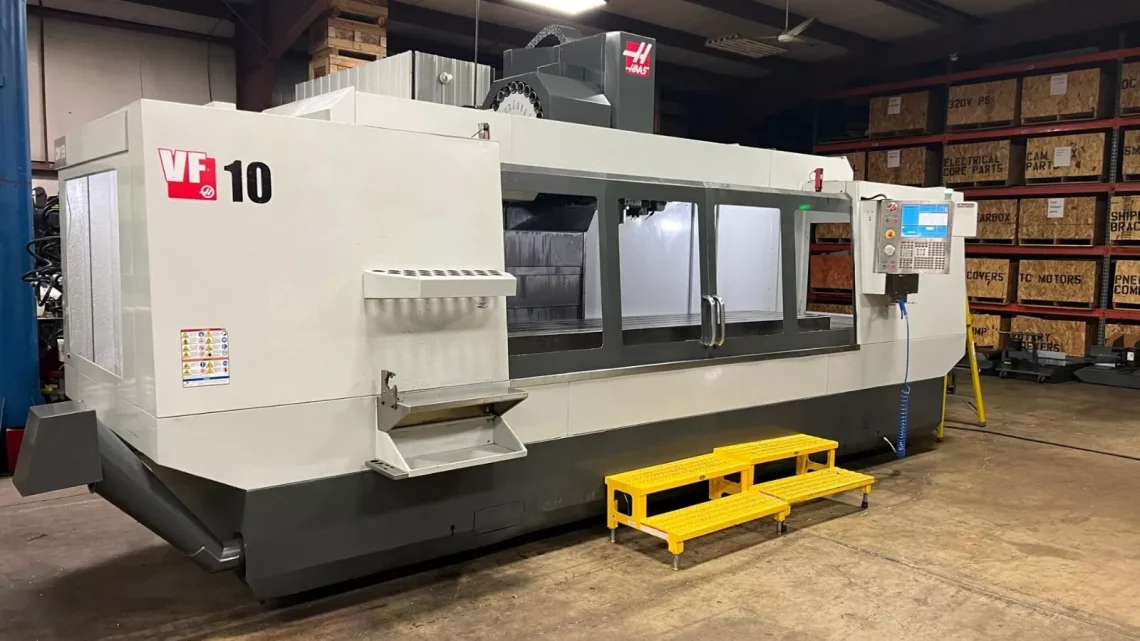
Industrial Insights: How to Spot Quality in Pre-Owned, Used, Secondhand, Surplus CNC Equipment Before Purchase HAAS VF-10/40 CNC Vertical Machining Center made in USA
Here’s a tailored guide for spotting quality (and risks) when evaluating a pre-owned / surplus HAAS VF-10 / VF-10/40 vertical machining center (VMC). Use this as a checklist and decision aid. I also reference relevant HAAS specs so you know what “good” should look like.
Overview: HAAS VF-10 / VF-10/40 basic specs & known features
Before you inspect, it helps to know what the “as-new” spec is so deviations stand out. From HAAS:
- The VF-10/40 is part of the large-frame VF series.
- Typical specs:
• Travels: X = 120.00 in (3048 mm), Y = 32 in (813 mm), Z = 30 in (762 mm)
• Spindle: 40 taper, 30 hp vector drive, up to 8,100 rpm.
• Tool changer: side-mount, 24+1 tools standard (some variants)
• Rapidity: fast rapids, e.g. Y/Z ~600 ipm, X ~9.1 m/min (~360 ipm)
• Coolant, chip auger, programming features are often options.
Also note that some VF-10 versions (e.g. VF-10/50) use a 50-taper spindle with 2-speed gearbox (for heavier work) rather than the 40.
But your target is likely a 40-taper version, so check which variant you are dealing with.
Knowing these helps you compare what “normal behavior” should look like (axis speed, spindle rpm, table size, etc.).
Why due diligence matters for used VMCs like the VF-10
- These machines are large, heavy, and expensive to repair. Hidden issues (spindle wear, ball screw wear, alignment drift, control board aging) can cost orders of magnitude more than initial savings.
- Because of the size (120″ X travel), wear over distance is more likely. Even small angular or linear errors become magnified over long travel.
- Because HAAS is a U.S. brand, parts, service support, and compatibility may depend on region; make sure your region (e.g. Türkiye) can support it (import spares, control electronics, etc.).
- The control and electronics degrade with age, so you must test them thoroughly.
Pre-visit preparations
Before going to inspect in person:
- Collect documentation
- Maintenance logs, repair history, spindle hours, axis motion hours (if recorded).
- Any calibration records, alignment checks, rebuilds.
- Original manuals, wiring diagrams, control schematics, parts lists.
- CNC program backups, if available.
- Ask for live video / remote demo
- Have them jog each axis, run spindle up to speed, perform a couple of test moves.
- Ideally, ask for a video of a real cut (if possible) on a typical workpiece.
- Bring your inspection tools
- Dial indicators, test bars, gauge blocks, edge finders, temperature thermometer, vibration probe if available.
- A small reference bar or known part you can test.
- Arrange expert support
- If you’re not a seasoned machine tool technician, bring someone who is (especially with CNC, controls, electrical, mechanical).
- Check spare parts & vendor support
- Can you get HAAS spindle bearings, servo drives, control modules, ball screws in your region?
- Are there local technicians familiar with HAAS machines?
- Know the installation and transport constraints
- The machine is huge; know its weight, crane requirements, floor loading, foundation, power, cooling, etc.
On-site inspection and tests: what to check & red flags
Below is a structured checklist tailored to VF-10 / large VMCs. For all items, test across full travel, under load, not just at one point.
| Subsystem / Feature | What to Test / Observe | What “Good” Looks Like | Red Flags / Warning Signs |
|---|---|---|---|
| Overall visual / structural | Look at castings, machine frame, painting, covers, way guards | No cracks, no major weld repairs, intact guards, minimal corrosion | Cracks in saddles, obvious repairs, damage, rust, missing covers |
| Way covers / bellows / guards | Move axes by hand or low power, inspect covers for deformation, tears, drag | Way covers are intact, slide smoothly, no scraping | Bellows torn, sagging, dragging, contact with table/dust build-up |
| Ball screws / linear drives | Jog axes slowly, measure backlash with dial indicator, check for roughness | Minimal backlash, smooth motion over entire travel | Excessive backlash, jerky motion, binding at extremes, vibration or rough spots |
| Spindle & bearings | Run spindle at low, medium, high speed; check temperature, listen for noise; test runout using a test bar | Quiet at all speeds, minimal runout (few microns), stable temperature | Bearing noise, knocking, high vibration, wobble/runout, overheating |
| Tool changer / tool magazine | Run full cycle, load/unload tools, check indexing and alignment | Smooth tool changes, precise alignment, no collisions | Tool change failures, mis-indexing, dropped tools, slow or erratic cycles |
| Axes drives / servo / motors | Command full travel, accelerate/ decelerate, rapid moves, changes in direction, look for overshoot or instability | Stable motion, no servo alarms, no axis faults, full travel reachable | Drive trips, stalling, motor overheating, control errors, abnormal vibrations |
| CNC Control / electronics | Open control cabinet, check wiring integrity, cleanliness, verify all fans run, look for scorch marks; power up, test all I/O, alarms, offsets | Clean cabinet, good wiring, no burnt parts, stable booting of control, all I/Os functional | Burnt connectors, broken wires, corroded contacts, overloaded circuits, frequent alarms |
| Coolant / lubrication systems | Check coolant tank, filters, pumps, piping, check whether coolant is clean; check the automatic lubrication system for axes | Clean coolant, filters maintained, pumps working, no leaks, good flow, proper lubrication ticks | Dirty coolant, blockages, leaks, failed pumps, lack of lubrication, rust/corrosion in tank |
| Chip handling / conveyors | Run chip auger or conveyor, check for jams, stray chips, smoothness | Chips are removed reliably, no jam or pile-up, conveyor motors working | Chips stuck, conveyor broken, motor faults, backed-up material |
| Accuracy / repeatability test | Use gauge block / master part or dial indicator to test positions across several points and repeat multiple times | Positional accuracy / repeatability within tolerances for your job use (e.g. a few microns) | Large deviations, inconsistent readings, drift over repeated cycles |
| Thermal behavior / warm-up drift | Let machine run for some time, then re-check geometry / positions to monitor drift | After warm-up, machine stabilizes, minimal drift | Significant shift over time, temperature-related drift |
| Full-load test / cutting test | If possible, mount a real part and run a representative cut; monitor for chatter, tool wear, axis performance | Smooth cut, stable surface finish, no alarms, stable motion | Chatter, abnormal noise, unstable tool path, control errors under load |
| Alignment / geometry checks | Use indicators, squares, test pieces to check squareness, parallelism, straightness | Within acceptable tolerances (depending on required accuracy) | Misalignments, non-orthogonality, tilt errors, out-of-spec geometry |
| Software / control options | Check that all options (rigid tapping, coolant through spindle, macro features, tool compensation, offsets) are operational | All licensed features work, no missing options, ability to load your programs | Missing licenses, disabled features, incompatible software, limited memory, corrupt NV memory |
| Documentation & spares | Ensure manuals, wiring diagrams, parts catalogs, firmware backups exist | Full documentation, parts lists, firmware stored, backups available | Missing manuals, lack of spare parts info, no backups, undocumented previous repairs |
How to interpret your observations & make a decision
Here are guidelines to weigh what you find:
- Wear that can be fixed vs. deal-breakers
- Surface wear (covers, paint, minor pitting) is often fixable.
- But major spindle bearing failure, severe ball screw degradation, structural cracks, or control board failures are very costly.
- Repair cost vs. discount needed
- When defects are found, estimate repair/parts cost, downtime, and risk, and subtract that from your offer.
- Insist that the seller address major flaws or reduce price accordingly.
- Support & spare parts availability
- If critical components (spindle bearings, drive modules, control boards) are hard to source in your region, you face long downtime or expensive imports.
- Residual life & future maintenance
- If spindle hours are high or ball screws show heavy wear, you may be close to a full rebuild. Factor that remaining useful life into your valuation.
- Software & control obsolescence
- Even a mechanically good machine may become a liability if control parts or software support are obsolete.
- Write an acceptance agreement
- Upon delivery, preserve an acceptance period (e.g. 30 days) during which you must fully test the machine under real jobs before final acceptance.
- Negotiate based on defects
- Use your inspection findings as leverage to negotiate a discount or require fixes before purchase.