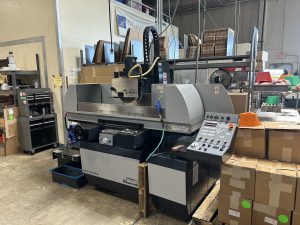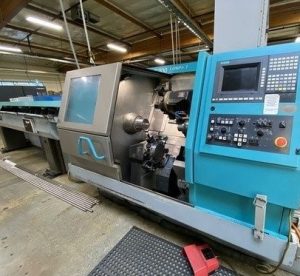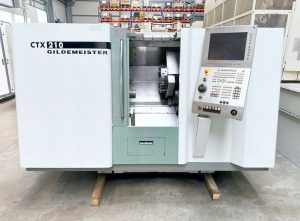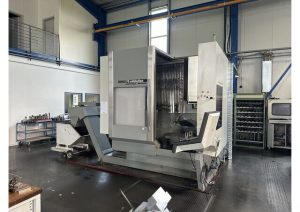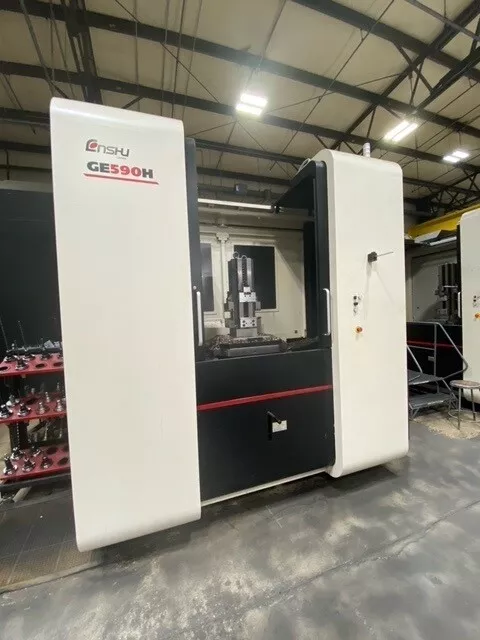
Industrial Insights: How to Spot Quality in Pre-Owned, Used, Secondhand, Surplus CNC Equipment Before Purchase ENSHU GE590H CNC Horizontal Machining Center made in Japan
Here is a technical, industrial-grade framework (with examples and red-flag indicators) to help you evaluate a pre-owned ENSHU GE590H or equivalent horizontal machining center (HMC) before purchase. Use this during on-site inspections and in your evaluation criteria.
1. Understand the Baseline / Nominal Specifications
Before going in, arm yourself with the “as built” spec sheet so you can immediately see where a candidate machine deviates. Here are typical specs for the ENSHU GE590H:
| Parameter | Typical / Published Value* |
|---|---|
| X travel | ~ 39.3 in (≈ 1,000 mm) |
| Y travel | ~ 35.4 in (≈ 900 mm) |
| Z travel | ~ 41.3 in (≈ 1,050 mm) |
| Pallet / table size | 630 mm × 630 mm (~ 24.8″ × 24.8″) |
| Pallet load / capacity | ~ 2,645 lb (≈ 1,200 kg) |
| Spindle taper | Big-Plus / CAT-50 (with optional BT / HSK) |
| Spindle speed | 10,000 rpm (integral type) |
| Spindle power / torque | ~ 54 HP, 525 Nm (or 60 HP at some listings) |
| Rapid traverse (X/Y/Z) | ~ 1,968 IPM (≈ 50,000 mm/min) |
| Cutting feedrate | ~ 590 IPM (≈ 15,000 mm/min) |
| ATC (standard) | 40 tools (with options for higher capacities) |
| Positioning accuracy / repeatability | ~ 0.00008″ (pos) / ±0.00004″ (repeat) in full stroke as published spec |
* These specs are derived from official Enshu datasheets and third-party listings. Always ask for the actual machine’s build data.
Knowing these gives you reference “red lines” — if what the seller claims or what you measure deviates significantly, you know there’s an issue.
2. Document & History Review (Before Visiting)
Ask the seller to provide:
- Usage / run hours: total power-on hours vs actual cutting hours
- Maintenance & service logs: repairs, part replacements (spindle, guides, ballscrews, coolant, chip disposal)
- Original factory documentation: schematics, parts list, wiring diagrams
- Control software / version / license (e.g. Fanuc 31iMB or whichever is installed)
- Machine calibration / alignment data done historically
- Upgrade history (if any): e.g. aftermarket retrofits, spindle rebuilds, control replacements
- Photos from earlier in life (if available) for comparison
This pre-review helps you catch “what the seller should tell you” before you get there.
3. Visual & Mechanical Inspection On Site
Once you arrive, walk through a systematic inspection focusing on structural, mechanical, and motion systems. Bring measuring tools (feeler gauges, dial indicators, possibly a laser) if possible.
3.1 Structure, Base & Rigidity
- Casting & base integrity: look for cracks, weld repairs, distortions in the base, ribs, and machine housing
- Machine leveling & base alignment: is the machine mounted on proper foundation? Is it level (or has been shimmed)?
- Chip troughs, coolant channels, chip disposal path: check for clogging, damage, rust, misalignment
- Access covers, machine doors, guards: all should be present and well-fitting; missing guards may indicate abuses
3.2 Guideways, Linear Motion & Bearings
- Guide rails / linear axes (X, Y, Z): look for wear, pitting, scratches, scuffs, signs of lubrication starvation
- Carriages / slides: manually jog (if possible) to assess smoothness, binding, stick-slip behavior
- Ballscrews / lead screws (if applicable): inspect for backlash, play, thread damage
- Encoders / feedback scales / linear scales: ensure read heads and scales are clean, aligned, un-damaged
- Wipers / seals / scrapers: functional and in good condition so debris is kept out
- Servo motor mounts & couplings: check for looseness, vibration mounts, misalignment
3.3 Spindle & Head Unit
- Spindle nose & taper interface: check for wear, burrs, damage to taper or tool holding interface
- Spindle runout: mount a test bar or known reference, check radial and axial runout
- Bearing condition: listen when spinning manually (if possible) for grinding, hum, roughness
- Cooling / lubrication lines: ensure oil, chiller lines, coolant-through spindle lines (if present) are intact, leak-free
- Seal integrity: check lip seals, O-rings, any hydraulic or pneumatic seals associated with the head
3.4 Tool Changer & Tool System
- ATC mechanism: operate the changer, watch pick-and-place actions, check for hesitation, misalignment or crashes
- Tool holders & pockets: inspect for wear, burrs, scoring
- Magazine rails & indexing: smooth movement, no sag or misindexing
- Tool-to-tool and chip-to-chip times: check whether those match spec or are degraded
3.5 Pallet / Workholding / APC (Automatic Pallet Changer)
- Pallet faces & mounting surfaces: inspect for flatness, damage, nicks, wear
- Clamping mechanism: hydraulic / pneumatic clamping should hold solidly and repeatably
- Pallet indexing & alignment: check repeatability of pallet exchange, whether pallets return to the same location
- Pallet change mechanism: rails, slides, actuators, limit switches — smooth, no binding
- Pallet life and usage history: inspect if pallet surfaces have been abused, re-machined or flattened
3.6 Coolant, Chip Removal & Auxiliary Systems
- Coolant system & pumps: check lines, filters, cleanliness, leaks
- Chip conveyor, tramp oil removal, filtration units: check for damage, proper alignment, flow
- Coolant chiller / oil chiller / temperature control units: ensure they are present and functioning
- Sensors and interlocks: level sensors, flood detection, door interlocks
3.7 Electrical Cabinets, Wiring, Controls & Interfaces
- Cabinet interior condition: dust, moisture, corrosion or rust are red flags
- Wiring routing & insulation: no chopped or crude splices, proper strain reliefs
- PCB boards / drives / servo amplifiers: check for burnt components, replaced modules, bad solder joints
- Fan / ventilation / cooling in cabinet: working fans, clean filters
- Grounding and shielding: proper earth connections, especially important in high-precision machines
- Control panel / operator interface: buttons, switches, display, emergency stop – all should work smoothly
4. Functional & Performance Testing
A machine may look great visually, but only through operation do hidden issues emerge. The tests below help you detect those.
4.1 Dry / No-Load Motion Tests
- Jog the machine through full travels in X, Y, Z at different speeds—listen and feel for jerks, binding, varying friction
- Reverse direction, abrupt stops and starts — how well does the control respond?
- In coordinate moves (e.g. linear interpolation without cutting) watch for smoothness, hesitation
4.2 Tool Change & Pallet Cycle Test
- Execute several tool changes in sequence, note any mis-picks, hesitation, indexing errors
- Run a pallet change cycle repeatedly — measure whether pallet returns to same precise position
- Watch for mechanical backlash, binding, or misalignment in the pallet system
4.3 Simulated Machining / G-Code Test
- Load a simple machining program (e.g. square pocket, simple contour) and run it (without deep cut) to observe motion dynamics
- Pause, reverse, step commands — check whether axes track accurately
- Monitor acceleration / deceleration behavior, lookahead, jerk control
4.4 Actual Cutting / Test Cuts
- Do test cuts on representative material (steel, aluminum, whatever your intended work is)
- Cut simple geometry (holes, pockets, slots) and measure dimensional accuracy, surface finish, taper, tool life
- Compare results to what you expect for a machine of that class
4.5 Long Run / Thermal Stability Test
- Run a sustained cutting cycle (or at least several hours of continuous operation)
- Monitor any drift in coordinates, expansion, changes in accuracy
- Pay attention to heating in bearings, motors, cabling, etc.
4.6 Repeatability & Backlash Checks
- Execute back-and-forth moves in all axes (e.g. move +X, then –X, then +X again) and measure any stiction or “settling error”
- Use a dial indicator or other metrology tool to evaluate how precisely it duplicates moves
- Verify that subtraction or returning to origin is consistent
5. Red Flags & Deal-Breakers
Here are the warning signs which should either reduce the price dramatically or make you walk away:
- Major wear or scoring on guideways / linear rails
- Cracked or distorted structure / base
- Excessive spindle runout or axial play
- Grinding noises, vibration, or erratic behavior in motion
- Tool changer mis-picks, crashes, or misalignment
- Pallet misindexing, loose clamping, or inconsistent returns
- Leaks or damage in coolant / hydraulic / pneumatic systems
- Burnt, corroded, or modified wiring / control boards
- Missing or nonfunctional auxiliary systems (coolers, conveyors, filtration)
- Unavailable or obsolete spare parts
- Lack of or incomplete maintenance history
- Control / software version that is unsupported or unlicensed
If multiple red flags appear, the risk of surprises (and hidden repair cost) is high.
6. Economic & Lifecycle Assessment
- Estimate remaining useful life of high-wear parts: servo drives, ballscrews, linear guides, spindle bearings
- Assess the cost/time to refurbish or realign critical components
- Check availability and cost of spares (especially from Enshu or third-party suppliers)
- Compare asking price vs “refurbishment + transport + alignment” cost
- Consider whether the vendor can support warranty or performance acceptance after purchase
7. Contract & Negotiation Safeguards
- Acceptance / Performance Clause: final payment contingent on passing your test cuts and performance metrics
- Holdback / Escrow: retain a portion of payment until after inspection / testing
- Spare Parts Package: require inclusion of consumables or spares (seal kits, coolant pumps, sensors)
- Documentation & Licensing: ensure you receive all manuals, software keys, wiring diagrams
- Refurbishment before handover: negotiate that the seller do a “ready-to-run” check and minor maintenance before shipping
- Return or support clause: some limited guarantee on key components