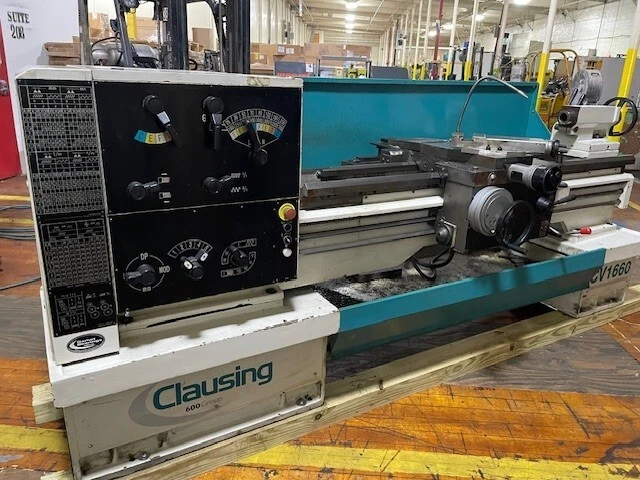
Industrial Insights: How to Spot Quality in Pre-Owned, Used, Secondhand, Surplus CNC Equipment Before Purchase CLAUSING COLCHESTER CV1660 Precision Geared Head Engine Lathe made in UK
When evaluating a pre-owned / surplus Clausing Colchester CV1660 geared-head engine lathe, you need a systematic, technically focused inspection. Below is a structured guide—what to look for, how to test, and what red flags should scare you off. You can treat it as a “due diligence” checklist for site inspections.
1. Know the Benchmarks / Nominal Spec References
Before inspection, have the ideal (or advertised) specifications for a CV1660 so you know where deviations matter. Some known specs:
- Swing over bed: ~16 in (≈ 406 mm)
- Swing over cross slide: ~10 in (≈ 254 mm)
- Distance between centers: ~60 in (≈ 1,524 mm)
- Spindle bore: ~4.125 in (≈ 105 mm)
- Spindle speeds: 26 to 1,700 rpm (16 steps)
- Feed ranges: longitudinal & cross feed (as advertised)
- Tailstock taper & quill travel: e.g. #5 Morse taper, ~6 in travel (depending on variant)
These give you red-line tolerances: if the machine under inspection deviates grossly (e.g. measured swing is much less, or the head cannot reach advertised rpms), it’s a warning.
Also, from comments in machining communities: Colchester lathes are generally considered solid, repairable, and well-supported in many markets. But as one user put it:
“Condition, condition, condition … plenty of spare parts”
So the base brand is good, but individual unit condition is everything.
2. Pre-Visit / Document Request
Ask the seller (or previous owner) to provide:
- Maintenance log / service history, especially major overhauls (spindle, bearings, gearbox, headstock)
- Operating hours (or spindle running hours) and what fraction was heavy work
- Any record of repairs, part replacements, or alignment / calibration adjustments
- Original manuals, spare parts lists, schematics, and exploded views
- Original gear charts, headstock gear train drawings
- Any modifications done (e.g. retrofits, added DRO, electronics, rewiring)
- History of reconditioning, if any (e.g. bed grinding, gib scraping)
- Previous accuracy test reports (if available)
This lets you cross-verify what you find on site with what should be the “as cared for” record.
3. Visual & Mechanical Inspection (On-Site)
When you visit, do a detailed walkaround. Use your eyes, feel, precision tools (feeler gauges, micrometers, straight edges, dial indicators) wherever possible.
3.1 Structure, Frame & Bed
- Bed & ways: inspect for scratches, gouges, corrosion, pitting, repair welds, filler, or reshaping.
- Flatness / level: check the bed is level; the saddle should align well along full travel.
- Gib surfaces & adjustment: check gibs for wear, adjustability, how tight/loose they are.
- Cross slide / compound / apron: look for excessive wear, play, or looseness.
- Tailstock: inspect the tailstock for alignment, smooth quill travel, and fit.
- Headstock housing & external casting: check for cracks, repairs, or distorted casting.
3.2 Headstock, Gear Train & Spindle
- Gear train & levers: operate the gearing switches (speed handles, feed selectors) to see if they engage cleanly. Look for missing or sloppy detents, worn gear teeth, noise, backlash.
- Spindle runout & end play: mount a test bar and use a dial indicator to check radial runout along its length and also end play (axial slack).
- Bearing condition: listen for grinding or hum when rotating the spindle manually; feel for smoothness vs roughness.
- Spindle bore & nose: inspect the bore for wear, scratches, or damage; inspect the spindle nose threads or camlock surfaces for wear.
- Lubrication / oil sump / oil lines: check for signs of leakage, cleanliness, oil condition, oil filters, and ensure oil supply lines are intact.
3.3 Motion, Carriage, Feed & Cross Slide Systems
- Lead screw & feed screw: inspect for wear, thread wear, backlash; check nut and engagement.
- Change gears / sliding gear train: operate through full feed rates and observe engagement.
- Power feeds: test longitudinal and cross feed under light operation, check for smoothness and consistency.
- Gibs and slides: verify smooth sliding motion with minimal play in all axes.
- Feed reverse, half-nuts (if any), shift mechanisms: check responsiveness and consistency.
3.4 Tailstock & Quill
- Smooth quill travel, no knocking, axial play should be minimal.
- Tailstock alignment: test whether the tailstock is aligned with the spindle (use test bar or dowel).
- Quill locking mechanism: functional and firm.
3.5 Accessories, Guards, Supports
- Chuck(s): inspect jaws, mounting surface, wear, runout
- Steady rest / follower rest (if present): condition, fit, adjustment
- Tool post / compound: condition, rigidity, freedom to move
- Splash guards, chip guards, way covers: presence and working order
- Gauges, stops, dial indicators: included or missing
3.6 Electrical & Control Systems (if any)
Even though CV1660 is a manual lathe, many may have added electrical retrofits (power feed motors, DRO, sensors):
- Wiring / conduit: check for damage, modifications, proper insulation
- Control panel (if present): condition, switch functionality, relays, fuses
- Motor & drive: inspect motor (for main, feed drives, coolant pump)
- Power cables, grounding: ensure proper earth / ground, no looseness or corrosion
4. Functional & Performance Tests
This is the litmus test: can the machine still do what it’s supposed to?
4.1 Manual Test / No-Load Movements
- Move the carriage and cross slide manually (idle) throughout the full travel — check for smoothness, no binding, abnormal stick/slip
- Engage feeds in low range, mid, high — check whether feed transitions and gear shifts are smooth
- Reverse, stop, start — see how responsive the system is
- Check backlash / slack in leadscrew and cross feed — measure with dial indicator
4.2 Turning / Test Cut
- Perform a simple turning operation on a typical material (e.g. mild steel bar)
- Cut a straight cylinder of known diameter, then measure diameter variation, roundness
- Turn cuts near both ends of travel (to test consistency)
- Cut shoulders, facing, parting, threads if possible — observe surface finish, chatter, deflection
- Measure taper (if you do a long length) to see whether alignment is preserved
4.3 Repeatability & Accuracy
- Use a test bar or gauge to command known moves and measure whether the lathe returns to same position
- Perform back-and-forth cuts or incremental steps and see tracking errors
- Measure over full travel to detect nonlinearity, bending or deflection
4.4 Extended Run / Thermal Behavior
- Let the machine run (turning or feed motion) for a period (≥1 hour) to see if warming affects accuracy, expansion causes drift, lubrication problems appear, etc.
- Monitor for vibrations, noise increasing, thermal drift.
5. Red Flags & Deal-Breakers
When inspecting, these warnings are serious. Any combination of several is a strong reason to decline or heavily discount:
| Red Flag | Implication / Risk |
|---|---|
| Severe wear, damage or gouging on bed ways or slide surfaces | Accuracy lost, major rework (grinding, scraping) needed |
| Excessive spindle runout or axial play | Will degrade precision in all turned work |
| Worn or sloppy gear train (loose detents, gear tooth wear) | Loss of feed accuracy, broken gear parts risk |
| Inability to smoothly shift feeds or spindles | Hidden mechanical failures, misalignment |
| Tailstock misaligned or sloppy | Trouble with concentric work and long parts |
| Missing or damaged accessories (chucks, rests, guards) | Additional unplanned cost |
| Signs of water or coolant damage in gearbox or headstock | Rust, contamination, bearing failure risk |
| Modified or “jury-rigged” wiring, poor retrofits | Electrical reliability issues |
| Lack of service history | You cannot trust claimed condition |
| Large deviations from spec in test cuts | Machine cannot meet required tolerances |
| Unavailable or obsolete replacement parts | Future maintenance becomes difficult |
6. Lifecycle & Economic Assessment
- Estimate remaining life of high-wear parts: bearings, lead nuts, gear teeth, slides.
- Assess how readily you can source spares (you’ll often find Colchester parts widely available).
- Costs and lead times for major refurbishment (bed grinding, spindle rebuilds).
- Benefit vs cost: is the asking price reasonable given expected rework?
- Consider including a contingency budget for unexpected repairs.
7. Contractual Safeguards & Negotiation Tips
- Acceptance clause: Final acceptance only after successful test-cut under your material and operating conditions.
- Holdback / escrow: Keep part of payment until acceptance criteria met.
- Spare parts package: Negotiate for included spares (gears, gibs, bearings) or accessories.
- Documentation / rights: Ensure you receive manuals, parts lists, exploded drawings, and rights to retrofit/modify.
- Refurbishment as part of sale: If possible, have the seller perform a basic mechanical cleanup, alignment, lubrication before handover.
- Warranties or guarantees (if any) for critical subsystems (spindle, main feed train)