How to Choose the Right Fiber Laser Cutting Machine for Your Business
Selecting the right fiber laser cutting machine is one of the most important decisions for any metal fabrication business. With the rapid development of laser technology, fiber laser systems have become the mainstream solution for cutting stainless steel, carbon steel, aluminum, and other metals with high precision and efficiency.
However, given the wide variety of configurations, power options, and machine models available on the market, selecting the most suitable one is far from an easy task. A wrong decision may lead to unnecessary costs, production limitations, or inefficient workflow.
This guide will help you understand the key factors to consider when selecting a fiber laser cutting machine for your business, ensuring you make a smart and cost-effective investment.
Understand Your Production Requirements
Before choosing any machine, the first step is to clearly define your production needs. Different industries and applications require different machine configurations.
Ask yourself the following questions:
What materials will you be cutting most often?
What is the maximum thickness of these materials?
What is your daily or monthly production volume?
Do you require high-speed mass production or small batch customization?
For example, a sheet metal fabrication workshop producing electrical cabinets will have different requirements compared to an automotive parts manufacturer or a steel structure factory.
Understanding your production needs will help you avoid over-investing in unnecessary machine power or underestimating your production demand.
Choose the Correct Laser Power
Laser power plays a critical role in determining cutting speed, processing capability, edge quality, and overall production efficiency. Choosing the right power configuration depends on the type of materials you process, the required cutting thickness, and your production volume.
Low-Power Fiber Laser Cutting Machines (1500W):
Low-power models are ideal for cutting thin sheet metals such as stainless steel, carbon steel, and aluminum. They are widely used in small workshops, light fabrication industries, advertising production, and businesses that focus on precision cutting with lower operating costs.
Medium-Power Fiber Laser Cutting Machines (2000W–3000W):
Medium-power machines are suitable for processing medium-thickness metal sheets and are commonly used in general industrial manufacturing. They provide an excellent balance between cutting performance, operating efficiency, and investment cost, making them one of the most popular choices for growing fabrication businesses.
High-Power Fiber Laser Cutting Machines (6000W and Above):
High-power models are designed for demanding industrial applications and thick metal plate cutting. These machines deliver higher cutting speeds, stronger penetration capability, and stable continuous operation, making them ideal for large-scale manufacturing environments where productivity, precision, and long-term reliability are essential.
Consider Material Types and Thickness
Different metals respond differently to laser cutting. Before purchasing a machine, you should clearly define your material range.
Common materials include:
. Stainless steel: requires stable power and clean cutting edges
. Carbon steel: easy to cut, widely used in industry
. Aluminum: reflective material, requires higher power and stable beam control
. Copper and brass: highly reflective, usually require high-power machines
Material thickness also plays a key role. A machine that can cut 20mm carbon steel may not perform efficiently on reflective materials unless properly configured.
Always match your machine capability with your real production materials.
Determine the Right Working Area
The working area of a fiber laser cutting machine determines the maximum sheet size that can be processed and directly affects production efficiency, material utilization, and factory workflow. Selecting the appropriate machine size is essential for optimizing both productivity and operating costs.
Common working area configurations include:
- 1. 3015 (3000mm × 1500mm): The most widely used standard model, suitable for most sheet metal fabrication applications. It offers an excellent balance between machine footprint, production flexibility, and investment cost.
- 2. 4020 (4000mm × 2000mm): Designed for processing larger metal sheets and improving productivity in medium to large manufacturing environments.
- 3. 6020 (6000mm × 2000mm): Suitable for heavy industrial applications and large-format metal processing where higher output and larger material capacity are required.
Among these options, the 3015 model remains the most popular choice because it is compatible with standard sheet metal sizes while maintaining efficient space utilization and lower operating costs.
When choosing the right working area, manufacturers should consider several important factors, including raw material dimensions, available workshop space, production volume, material loading efficiency, and future business expansion plans.
Selecting the correct machine size not only improves production efficiency and material utilization but also helps reduce material waste and overall manufacturing costs.
Evaluate Cutting Speed and Precision
Cutting speed and cutting quality are two major factors that directly affect production efficiency and final product quality. A high-quality fiber laser cutting machine should provide both fast processing capability and stable cutting accuracy.
Modern fiber laser systems can achieve:
. Smooth and clean cutting edges
. Minimal thermal deformation
. High positioning accuracy
. Stable repeated cutting performance
. Reduced secondary processing requirements
For industries such as precision sheet metal fabrication, kitchen equipment manufacturing, automotive components, and electrical enclosures, cutting accuracy is especially important.
When comparing machines, manufacturers should pay attention not only to maximum cutting speed but also to actual cutting stability under continuous production conditions.
Compared with traditional CO₂ laser systems, fiber laser cutting machines are generally more energy-efficient and can reduce energy consumption by up to 70%, while offering higher cutting efficiency.
Check the Quality of Core Components
The performance and lifespan of a fiber laser cutting machine largely depend on the quality of its core components. Choosing reliable and internationally recognized components can significantly improve machine stability, cutting quality, and long-term operating reliability.
Key components to evaluate include:
. Laser source
. Laser cutting head
. Servo motors and drive systems
. Guide rails and rack systems
. CNC control system
. Cooling system
A high-quality laser source ensures stable power output and longer service life, while an advanced cutting head improves cutting precision and automatic focus performance.
Reliable motion systems and precision guide rails are equally important for maintaining cutting accuracy during high-speed operation.
Although machines equipped with premium components may require a higher initial investment, they often reduce maintenance costs and downtime in the long run.
Consider Automation and Production Efficiency
As manufacturing competition continues to increase, automation has become an important factor in improving productivity and reducing labor costs.
Many modern fiber laser cutting machines offer advanced automation options such as:
Automatic loading and unloading systems
Dual exchange worktables
Tube cutting attachments
Automatic nozzle cleaning
Intelligent nesting software
For businesses with high production volumes, automated systems can help reduce material loading time and improve overall production efficiency.
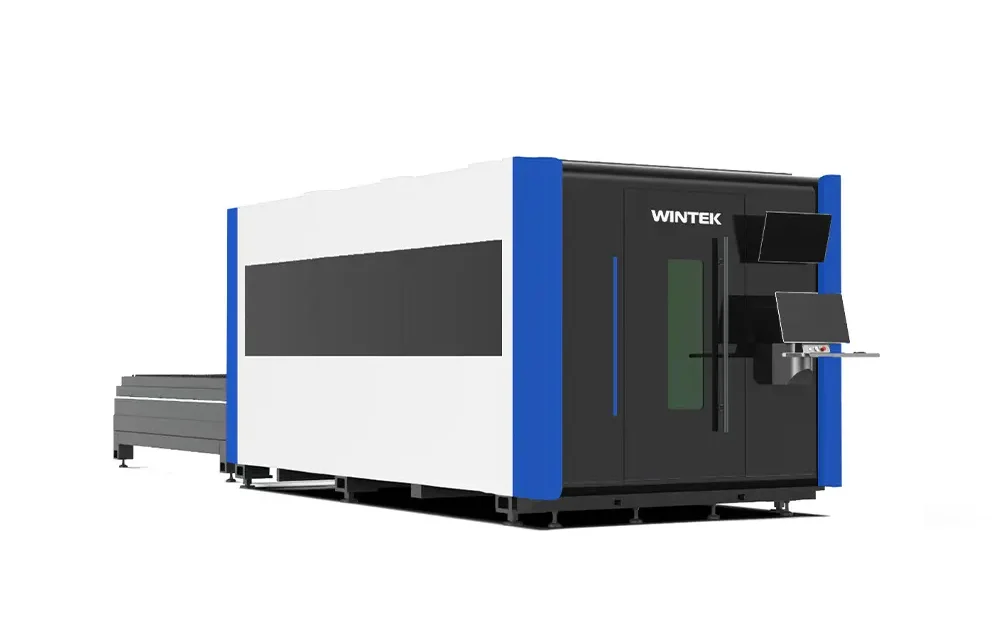
Exchange table fiber laser cutting machines are especially popular because they allow operators to load materials on one table while cutting continues on the other, minimizing downtime and increasing output.
Evaluate Software and Control Systems
The CNC control system and nesting software play a critical role in machine operation and production management. User-friendly software can greatly improve operating efficiency and reduce training time for operators.
Modern laser cutting software usually includes:
Automatic nesting functions
Intelligent path optimization
Real-time monitoring
Remote diagnostic capabilities
Production data management
An advanced control system not only improves cutting precision but also helps reduce material waste and optimize production scheduling.
Before purchasing, it is recommended to test the software interface and evaluate whether it matches your production workflow and operator experience level.
Focus on Safety and Environmental Protection
Fiber laser cutting machines operate with high-energy laser beams and require proper safety protection to ensure safe working conditions.
Important safety features include:
Fully enclosed protective covers
Laser safety windows
Automatic alarm systems
Smoke and dust extraction systems
Emergency stop functions
A fully enclosed fiber laser cutting machine helps reduce laser exposure and dust emissions while maintaining a cleaner working environment.
In many countries, environmental protection and workplace safety regulations are becoming increasingly strict, making safety compliance an important consideration when selecting equipment.
Consider After-Sales Service and Technical Support
Even the best machines require regular maintenance and occasional technical support. Therefore, choosing a reliable supplier with strong after-sales service is extremely important.
Before purchasing, evaluate:
Installation and training services
Technical support response time
Availability of spare parts
Warranty coverage
Remote troubleshooting capability
A professional supplier can help minimize downtime, improve machine utilization, and provide long-term technical assistance as your business grows.
For many manufacturers, reliable after-sales support is just as important as machine quality itself.
Balance Budget and Long-Term Investment
Price is always an important factor when purchasing industrial equipment, but the cheapest machine is not always the best choice.
Instead of focusing only on initial purchase cost, businesses should evaluate the total cost of ownership, including:
Machine lifespan
Power consumption
Maintenance cost
Production efficiency
Labor savings
Future upgrade potential
A higher-quality machine may provide better cutting efficiency, lower operating costs, and higher production stability over the long term, resulting in a faster return on investment.
Final Thoughts
Choosing the right fiber laser cutting machine requires evaluating production needs, material types, laser power, automation level, software capabilities, and long-term business goals.
There is no universal solution for every manufacturer. The ideal machine should match your current production demands while also supporting future business expansion and improving overall operational efficiency.
Many modern laser equipment manufacturers now provide a wide range of fiber laser cutting solutions designed for different industries and production requirements. From compact entry-level systems to high-power industrial models, Wintek Laser focuses on delivering reliable performance, advanced technology, and comprehensive technical support for global metal fabrication businesses.
By selecting the right fiber laser cutting machine, manufacturers can improve productivity, reduce operating costs, and enhance long-term competitiveness in modern metal fabrication.
Address: No. 2303, Building 4, United Fortune Plaza, No. 2177, Tianchen Road, High-tech Zone, Jinan City, China
Phone: 86-18769786070
Email: admin@winteklaser.com
Website: https://winteklaser.com/