06/10/2025
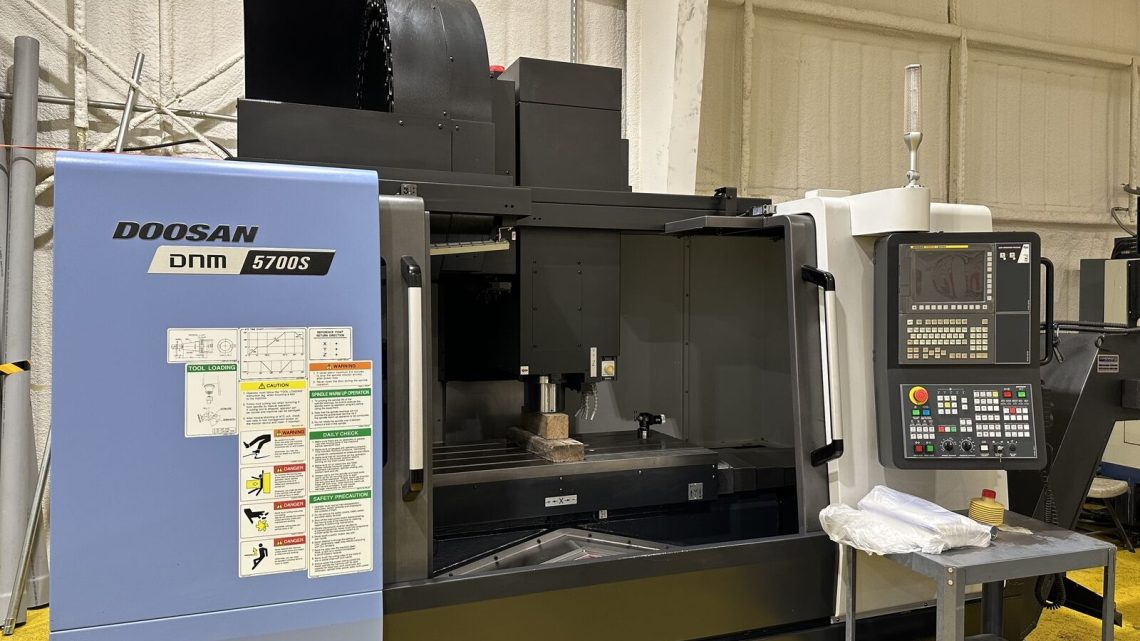
How to Avoid Common Pitfalls When Buying a Pre-Owned, Second-Hand, Surplus, Used Doosan DNM 5700S CNC Vertical Machining Center made in South Korea
When you’re considering buying a used / surplus / secondhand Doosan DNM 5700S (or equivalent DNM 5700 variant) CNC vertical machining center, there are common pitfalls that even seasoned buyers stumble into. Below is a structured guide (inspection checklist, gotchas, negotiation tips) to help you avoid expensive regrets.
Know What “DNM 5700 / 5700S” Should Be / Typical Specs
Having reference benchmarks is critical — deviations aren’t always problems, but undocumented ones often are.
From published sources:
- The DNM 5700 (4th Gen) offers X / Y / Z travels of ~1,050 × 570 × 510 mm.
- Spindle: up to 12,000 RPM (in base models) with ~18.5 kW power.
- Tool changer: usually 30 tools (side-mounted) in many used listings.
- Work load on table: ~1,000 kg (for many 5700 variants) in specs.
- The “S” variant (DNM 5700S) is the high-speed version, with a spindle rated for 15,000 RPM in many catalogs.
- In user forums, people highlight lubrication (grease cartridges), way covers (especially Z axis cover folding) as recurring notes.
- Some reported issues: The through-spindle coolant (TSC) system in DNM 5700 machines may clog or lose prime due to check-valve blocks.
- A user reported that in a DNM 5700, Y-axis ball screw developed noise from misinstalled bearing housing, and later X & Y ball screws also had issues.
If the machine you inspect deviates wildly from these, demand explanations (e.g. retrofits, rebuilds) or assume risk.
Common Pitfalls & What to Check to Avoid Them
Here are the major “gotchas” that tend to trap buyers, and how to spot or test for them.
| Pitfall / Risk | What to Check / Test | Why It Matters / Red Flag |
|---|---|---|
| Spindle / Bearing wear or damage | – Runup test: ramp spindle from low to high RPM, listen/feel for noise, vibration, hum. – Use a test bar / dial indicator to measure radial runout, axial play. – Inspect spindle nose, taper, seals, housing for corrosion or damage. – Check whether the spindle chiller / oil jacket system still functions. | Spindle failures or bearing replacements are extremely expensive. Excessive runout or noise often means the spindle is near end-of-life. |
| Ball screws / axis drive issues / backlash | – Command axis moves (X, Y, Z), reverse direction and check backlash. – Jog axes and listen for binding or jerkiness. – Measure repeatability: repeatedly command a point and measure spread. – Inspect ends of ball screws for wear, end bearings, nut play. | Worn screws or nuts reduce accuracy and may require full regrinding or replacement. |
| Way / guide damage / chips intrusion | – Remove (or lift) way covers where possible and inspect underlying guides for scoring, pitting, scratches. – Check way covers, wipers, bellows, scrapers — are they intact or torn? – Look for uneven wear across ways (indicates misalignment or side-loads). | Damaged guides degrade machine geometry, leading to parts out-of-tolerance. Poor protection accelerates wear. |
| Lubrication & grease system failure | – Check the grease / lube cartridge system: is it functioning, is grease flowing? – Inspect lube lines, pumps, reservoirs, filters for clogging or contamination. – Ask when lube system was serviced or replaced. | Without proper lubrication, wear accelerates. A failed lube system leads to long-term catastrophic damage. |
| Tool changer / ATC faults | – Command a series of tool changes and watch for hesitation, mis-index, tool slip. – Inspect magazine arms, gripper, guide rails, indexing mechanism for play or damage. – Try heavy / long tools and small tools to stress extremes. | ATC failures or mis-indexing is a frequent cause of downtime; repairing or replacing ATC hardware is costly. |
| Control / electronics / drives issues | – Power up machine; review error logs, alarms, I/O module errors. – Inspect wiring, connectors, junction boxes for heat damage, corrosion, aftermarket splices. – Test digital I/O, limit switches, home switches. – Test servo drives / amplifiers for indication of fault codes. | Faulty electronics or proprietary control modules with no support can cripple the machine. |
| Through-spindle coolant (TSC) / coolant / check-valve problems | – Test TSC: does coolant flow reliably at rated pressure? If not, check valve blocks, filters, check valves (they often clog) – Inspect the TSC valve block, check-valves, pressure gauges. – Run the spindle with coolant on and see whether flow is stable. | Coolant system problems are common and, if unresolvable, may reduce the machine’s usefulness for many jobs. |
| Z-axis way cover collapse or damage | – In forums, users often mention the Z-axis way cover “folding like a beer can.” – Try moving the Z axis fully up and down while observing the cover; see if it binds or collapses. – Inspect the cover for dents, cracks, misalignment. | A failed or damaged cover lets chips / coolant penetrate into critical guides and screws. |
| Past crash / damage / repairs | – Ask seller: has the machine ever crashed an axis, overtravel, or been in accident? – Inspect machine base, casting, components for weld repairs, patched parts. – Check whether alignments have been corrected via shims or modifications (may hide damage). | Hidden structural damage undermines precision, and “repairs” may not restore original geometry. |
| Parts / support obsolescence | – Confirm availability of spare parts: spindles, screws, drives, ATC parts, control modules. – Ask whether the specific control version is still supported. – Check whether there are third-party suppliers or rebuilders for DNM / Doosan / DN Solutions. – Ask seller whether spare modules, wiring harnesses, or consumables come with machine. | If you can’t get spares, even a machine in good shape might become a liability. |
| Environmental / foundation issues | – Inspect whether the current installation was on a stable base, well leveled, with minimal vibration or contamination. – Look for signs of misleveling, base settling, or rust / corrosion from coolant exposure. – Evaluate how it will be rigged, moved, and re-leveled in your shop (floor layout, crane capacity). | Machines moved without proper re-leveling or foundation settling often lose geometry or alignment. |
Inspection / Testing Checklist for a DNM 5700S
Here’s a suggested order and method when you go to inspect:
- Documentation & photos
- Request logs, part replacement history, control backups, approvals
- Inspect pictures of internal guts (guides, screws, cabinet internals)
- Visual walk-around
- Frame, base, cover panels, guards, enclosures
- Way covers, bellows, scrapers
- Control cabinet, wiring, junction boxes
- ATC / magazine, gripper arms, guide rails
- Power-up & control health
- Boot CNC, scan for alarms, fault codes, I/O errors
- Check control responsiveness, keys, touch screen (if any)
- Inspect wiring and connectors for discoloration or damage
- Motion / axis test (no load)
- Jog X, Y, Z axes; command reversals and check for binding, jerkiness
- Command repeatability cycles: same point multiple times
- Check backlash by reversing small moves
- Spindle run-up & test
- Spin spindle from low to rated rpm
- Listen for abnormal sounds, vibration
- Check runout via dial indicator
- Activate TSC (if present) and verify coolant flow and pressure
- Load / cut test (if possible)
- Run a simple machining pass; measure the part and check if within tolerance
- Observe machine behavior, sloppiness, drift after repeats
- Monitor coolant, chip evacuation, machine sound
- ATC / Tool change test
- Cycle tools repeatedly
- Test extremes (heavy, light tools)
- Observe magazine behavior, indexing, grip/release
- Check auxiliary systems
- Grease / lube system: verify grease flow and timing
- Coolant pumps, filtration, chiller
- Chip conveyor, enclosure seals, door movement
- Measurement / precision checks
- Backlash, repeatability, straightness, flatness, alignment
- Spindle runout, tool change accuracy
- Compare to reference specs
- Final assessment & margin / discount negotiations
- List all issues and estimate repair costs
- Validate that machine can be aligned and calibrated to your tolerances
- Get quotes for missing parts or retrofits
- Use observed defects as negotiation leverage (discounts, parts, acceptance window)
How to Position Yourself to Avoid Regret / Make Smart Bid
- Demand a conditional acceptance period (e.g. 30 days of test usage) if your contract allows, so post-installation issues can be addressed.
- Ask seller to include a “spare parts kit” (grease cartridges, filters, cables, seals) as part of the deal.
- Build in a healthy contingency margin (e.g. 15–25 %) for hidden wear or surprises you didn’t spot.
- Require the seller to run a baseline calibration test (e.g. cutting a known test piece) so you have proof of performance before purchase.
- Transport & rigging risks matter — plan crate / disassembly procedures carefully to avoid damaging guideways or components during move.
- Consider retrofitting / upgrade paths (e.g. replacing control modules, adding probe systems) and check feasibility early.