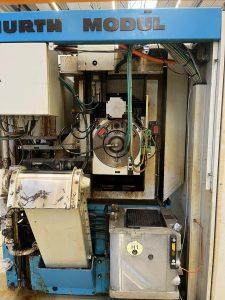

Insider Advice: What Successful Manufacturers Consider Before Buying a Used, Second-Hand, Pre-Owned, Surplus Deckel FP4M Milling Machine made in Germany
If you’re a manufacturer considering acquiring a used / surplus / second-hand Deckel FP4M (or variant thereof) milling machine (German origin), you’ll want more than a cursory walk-around. The FP4M is a precision universal mill (vertical / horizontal / tilt / swivel etc.), and many latent defects or mismatches can kill its ROI. Below is an “insider’s checklist & advice” — what successful manufacturers focus on (beyond the obvious) — to avoid common pitfalls and get true value.
What the Deckel FP4M should be (Reference Benchmarks)
First, know the expected specifications and capabilities, so deviations raise red flags:
- Typical travels: X ≈ 500 mm, Y ≈ 400 mm, Z ≈ 400 mm
- Spindle speed range: ~ 50 to 2,500 rpm
- Spindle drive power: ~ 3.7 / 4.4 kW (depending on version)
- Table / work surface: 800 × 460 mm often listed for the table size
- Quill / vertical head movement & horizontal quill options, variable speed gears, head tilt / swivel capability (universal milling features)
- Machine weight and footprint: several tons (often ~1,500 kg or more)
If a candidate machine deviates significantly from these, you must question whether it is a downgraded version, has had heavy modifications, or is poorly maintained.
Key Considerations Successful Manufacturers Emphasize
Manufacturers aiming for uptime, precision, and long lifecycle look beyond “just works now.” Below are the strategic concerns you should internalize as a buyer.
| Domain | What Smart Buyers Focus On | Why It Matters |
|---|---|---|
| Precision baseline & “true geometry” | Find out whether the machine has had any geometry calibration or re-certification (e.g. in a metrology lab). Ask for a test report or tolerance certificate (flatness, parallelism, squareness). | If the baseline geometry is compromised, you’ll fight alignment issues forever. Even a cosmetically good machine may produce parts out of tolerance due to drift. |
| Wear & tear vs. rebuild feasibility | Evaluate how much of the major wear parts are near end-of-life (guides, leadscrews, quill slides, head tilt trunnions). Estimate the cost to regrind or replace. | Sometimes the “cheap” used price hides that you have to invest heavily just to bring it back into spec. |
| Parts / spares ecosystem | For Deckel / Maho legacy machines, parts availability (gears, spindle bearings, head parts, control boards) is critical. Check local / regional supply, remanufacturers, and aftermarket suppliers. | A stagnated support ecosystem makes extended ownership expensive or impractical. |
| Control / electronics condition and upgrade path | Many FP4Ms are retrofitted with DROs or CNC controls (e.g. Heidenhain readouts). Check control module health, spare parts, firmware backups, interface compatibility, and upgrade potential. | Even if the mechanical parts are perfect, a dead or obsolete control makes the machine useless or expensive to retrofit. |
| Tooling & accessories compatibility | FP4M tooling (arbors, fixtures, dividing heads, tilting tables) may be specialized; ensure that what you’ll need is compatible or available. | A perfect machine is useless if you can’t mount your fixtures or get the correct tooling. |
| Environmental & foundation context | Check how the seller’s factory floor environment was (temperature swings, dust, coolant / coolant contaminant exposure, vibrations). Also check whether the machine base was rigid, well-anchored, and whether it has been re-levelled often. | The environment the machine ran in affects hidden wear (especially in bearings, slides, screws). A shaky or misleveled base can warp tolerances. |
| Legacy modifications / repair history | Ask for a full repair / modifications history. Some FP4Ms may have been “worked over” badly in the past (weld repairs, re-machining, parts from other models). Inspect for non-OEM parts or patchwork. | A “Franken-Deckel” could mask serious geometry or mechanical compromises. |
| Inspection under power & test cuts before purchase | Don’t accept a “power-off” inspection only. Insist on running the machine under real tool cuts (ideally with your sample workpiece), measuring output geometry, and looking for noise, drifting, or vibration. | Many defects only show up under load: spindle chatter, belt stretch, backlash under torque, thermal drift. |
| Economic model / ROI horizon | Model not just purchase price, but cost to refurbish, parts + consumables, downtime, expected life, and residual value. Successful manufacturers ensure the total cost of ownership remains acceptable. | A cheap purchase with high refurbishment or downtime cost may beat buying a newer machine. |
| Disassembly & reassembly risk | The FP4M may need to be moved, disassembled, reassembled, re-aligned. Smart buyers check how modular the machine is, whether guides and reference surfaces can be protected, and whether all alignment marks / reference datums are intact. | A poorly rigged move can damage precision surfaces or misalign the machine irrecoverably. |
| Acceptance period & guarantee clause | Negotiate a period (e.g. 30–90 days) during which you test the machine under load in your shop, with clause for return or repair if it fails to meet promised tolerances. | It gives you protection in case hidden defects surface after installation. |
Tactical Walk-Around & Inspection Checklist (What to Physically Check)
While high-level strategy is important, successful buyers also carry a systematic inspection list. Below are things you must verify on the shop floor.
- Documentation & machine identity
- Ask for serial number, build year, OEM drawings, parts lists.
- Confirm the model (FP4M or variant) really matches what is claimed (don’t trust seller titles alone).
- Request maintenance and overhaul logs; see which parts have been replaced or refurbished.
- Visual Inspection
- Frame, column, headstock: check for crack repairs, welds, distortions.
- Way covers, bellows, wipers: are they intact, not torn, protective.
- Surface cleanliness: significant corrosion, rust, pitting is a red flag.
- Spindle nose, taper, face: check for nicks, wear, damage.
- Axis handwheels (if still present): check for backlash or slop.
- Enclosure, guards, panel doors: missing or bent covers suggest abuse.
- Sliding / Guideway Condition
- Remove or partially retract covers (if safe) to inspect ways for grooves, scoring, pitting.
- Check quill slide, head tilt trunnions, swivel joints for smoothness, play, and wear.
- Confirm lubrication / grease / oil flow systems are present and not blocked.
- Spindle & geometry checks
- Rotate spindle by hand (if possible) and feel for roughness or binding.
- Use a dial indicator or test bar to measure radial & axial runout.
- Test spindle speeds under power: listen for hum, chatter, bearing noise.
- Check consistency of speed across whole range (gear/step transitions or stepless).
- Axis motion & backlash
- Command axis travels; reverse direction; measure backlash / deadband.
- Jog at low and higher speed: feeling of smoothness, no stick/slip.
- Test repeatability: return to same point multiple times and measure error.
- Command rapid moves (if safe) to stress axes.
- Test machining / cut test
- Run a simple machining operation on a test block; measure flatness, taper, dimensions.
- Use different parts of travel envelope (center, extremes) to detect drift or nonuniformity.
- Monitor for vibrations, heating, or deviation during sustained cuts.
- Control / electronics / wiring
- Open control cabinets and inspect wiring for burns, discoloration, patched splices.
- Check I/O boards, power modules, fuses, relays, connectors.
- Power up the control, check error logs, I/O status, smoothness of response.
- Verify that limit switches, home / reference sensors, feedback encoders are present and functional.
- Tooling interface & compatibility
- Check spindle taper (SK-40 or whatever variant) integrity, drawbar operation.
- Inspect toolholder mounting surfaces, drawbar threads, collet condition.
- Confirm machine table and you can mount your fixtures / parts with minimal adaptors.
- Auxiliary systems
- Coolant system: pumps, hoses, pipes, nozzles, filtration.
- Chip removal / swarf management: trays, conveyors, evacuation routes.
- Lubrication / grease system: pumps, lines, grease cartridges, reservoirs.
- Any orientation / tilt tables, dividing heads, swivel heads: check their precision and mechanical state.
- Wear estimation & remaining life
- Measure how far wear has gone (liner thickness, guide wear, backlash drift) and estimate margin left.
- Compare replacement cost of wear parts vs machine value.
Negotiation & Risk Mitigation Tips
- Base your offer on defects — subtract repair, parts, and drift risk from asking price.
- Demand written guarantees / acceptance window — e.g. guarantee geometrical accuracy for a few weeks.
- Include spare parts, tooling, consumables in the deal (e.g. toolholders, collets, liners).
- Transport & reinstallation risk accounting — factor costs for lift, rigging, alignment, re-leveling, calibration.
- Negotiate seller to perform baseline calibration or test cuts pre-shipment — get measurement reports in writing.
- Plan for recapitalization / refurbishment budget — even good used machines often need some rework (ways, spindle, calibration).
- If possible, bring a specialist or metrology expert on inspection — they’ll spot defects you might miss.
Why Many Manufacturers Still Choose FP4M (But With Caution)
Manufacturers who succeed with used Deckel FP4Ms often cite:
- Precision & versatility: As a universal / toolmaker milling machine, it combines vertical, horizontal, tilting capabilities in one machine.
- Low-speed torque & rigidity: Its mechanical design suits tough cuts at low rpm better than many modern high-speed mills.
- Longevity: When properly refurbished and maintained, Deckel machines can last decades — the trick is doing the “refurb” right.
- Niche / specialty machining fit: For toolroom, mold, die, small-volume high-precision parts, FP4M often outclasses generic VMCs — but only if accurately aligned.
- Capital efficiency: You can sometimes buy an FP4M at a fraction of a new universal mill cost — with trade-off in commissioning and up-front work.
The downside: tooling and consumables (especially European vintage parts) can be more expensive; control electronics may be harder to source; refurbishment costs are real. Several machinists in forums caution that while FP4M is “in a different league” vs a Bridgeport, tooling up is more expensive.