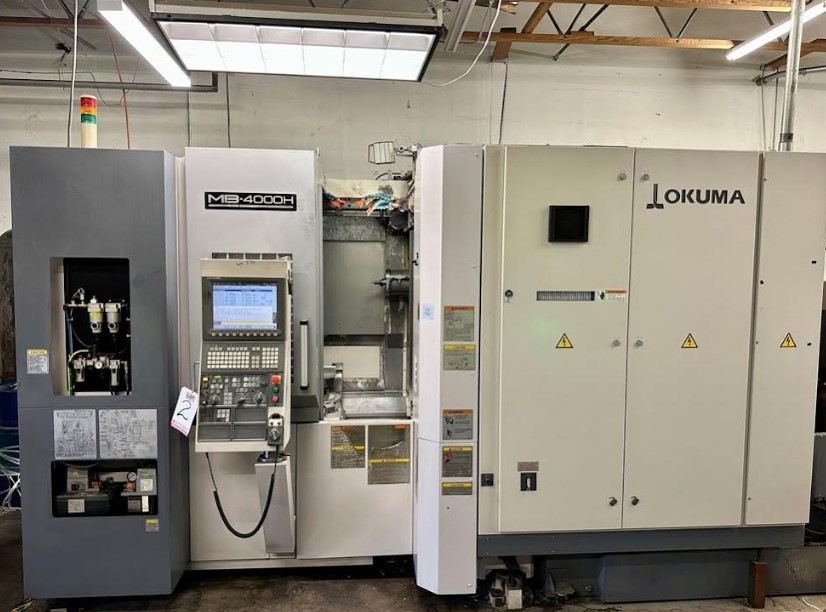
How Smart Engineers Assess a Pre-Owned, Used, Second-Hand, Surplus Okuma MB-4000H made in Japan Before Purchase
If you’re evaluating a used or surplus **Okuma MB‑4000H Horizontal Machining Centre (HMC) made in Japan, here’s a comprehensive checklist that smart engineers follow. It helps you go beyond the marketing, identify hidden issues, and assess if the machine is a good investment.
Why this machine warrants thorough due-diligence
- The MB-4000H from Okuma is a high-speed, horizontal machining centre with a 400 mm × 400 mm pallet size and X/Y/Z travels of about 560 × 560 × 625 mm.
- It features a 15,000 rpm (and optionally 20,000 rpm) spindle with rapid traverse up to ~60 m/min and high tool-magazine capacity.
- Because of its precision, spindle speeds, pallet change integration (for automation) and thermal-stability design (Okuma’s “Thermo-Friendly Concept”), any wear or misalignment has major cost and downtime implications.
- Being used, you are buying risk: unknown hours, unknown tooling/use pattern, possible hidden damage, spares availability, etc. So serious inspection is required.
Pre-Purchase Assessment Checklist
Here’s what to check when you inspect the machine, talk to the seller, or plan transport/installation.
1. Specification & Fit for Purpose
- Confirm the exact model: “MB-4000H” and note the build year, spindle version (15 k vs 20 k rpm) and pallet/ATC configuration.
- Ensure the machine’s capacity matches your parts:
- Pallet size: 400 × 400 mm (15.75″ × 15.75″) typical.
- Travels: X/Y ≈ 560 mm; Z ≈ 625 mm.
- Spindle speed: 15,000 rpm standard (20,000 optional) – for your material/part size check compatibility.
- Tool magazine capacity and pallet system: verify how many tools, how many pallets, is APC included.
- Check suitability of tooling, fixtures and automation: For your volume, ensure the machine’s automation options (pallet changer, ATC) match your workflow.
2. Mechanical & Structural Condition
- Base/structure integrity: Inspect casting for cracks, distortions, weld repairs. Rigidity is key for precision.
- Pallet table indexing and rotation: Verify pallet loads smoothly, indexes accurately, no excessive backlash or wobble. Some specs mention 0.001° index accuracy.
- Spindle condition: Check for noise, run-out, vibration when running at various speeds.
- Guideways & ball screws: Check axes movement (X/Y/Z) for smooth travel, backlash, scored ways or evident wear.
- Pallet changer / automation: Test pallet change cycle, locking/unlocking, repeat accuracy. Because this machine may have multiple pallets.
- Tool magazine & ATC: Ensure reliable tool change, no tool drop, correct magazine indexing, low tool change time as advertised (Okuma spec shows very fast tool change).
- Chip & coolant system: Since horizontal machines produce chips that fall differently, inspect chip conveyor, coolant filtration, cleanliness of sump and general housekeeping.
- Wear history: Ask for service records: how many hours machine has, how many spindle hours, has any major refurbishment been done (spindle bearings, pallet table bearing, guideway re-scrape etc).
- Thermal compensation: Okuma design emphasises “Thermo-Friendly Concept” to maintain accuracy under thermal load. Inspect whether the machine has this feature and if it appears to have been well maintained.
3. Electrical / Control / Software Condition
- CNC control condition: Which OSP version or other? Are there error logs? Has the control been updated/supported?
- Drives and servo motors: Check for alarms, overheated components, dust in cabinets, cable chain wear.
- Safety interlocks, sensors: Pallet table interlock, door interlocks, coolant safety, other sensors must work.
- Wiring & cabinet condition: Inspect visually for burned wires, excessive dust, signs of overheating or modifications.
- Spare parts and service support: Since machine is used, verify that key components (spindle bearings, pallet drive, replacements) are still available for this model.
- Automation interface readiness: If you plan to integrate with robots/pallet pool, verify the machine has suitable interface and that existing wiring or communications are intact.
4. Operational / Accuracy Testing
- Live run under power: Insist on seeing the machine powered up, axes jogging, spindle running, maybe a test cut if possible.
- Axis travel tests: Move each axis full travel; verify no jerky motion, listen for abnormal sound, use dial indicator or laser where possible to measure.
- Spindle performance test: Run at different speeds (e.g., 4,000 rpm, 10,000 rpm, 15,000 rpm), monitor vibration, heat rise, noise.
- Pallet/ATC test: Cycle the pallet change, check time, indexing accuracy of pallets, tool change reliability.
- Accuracy measurement: Do a sample job or fixture a test plate and measure: flatness, repeatability, positioning retention after pallet change, spindle to pallet top variation. Okuma lists tool change times: e.g., T-T 1.0s, C-C 2.6s for MB-4000H.
- Thermal drift check: Run the machine for some time (30-60 min) then measure if parts shift due to thermal expansion, see if machine still holds accuracy.
- Cutting test: If possible, cut a part similar to your production and inspect finish, dimensional accuracy, part load handling, cycle time.
5. Commercial & Logistical Evaluation
- Price vs condition: Compare asking price with similar used MB-4000H units (spec year, hours, features) and factor condition, tooling, pallet/ATC options.
- Installation/transport cost: These machines are heavy and require proper foundation, leveling, rigging, power supply. Budget these costs.
- Refurbishment cost: If you find wear on spindle bearings, pallet table, guideways, you should get quotes for refurbishment before purchase.
- Downtime risk: Used machines with automation/pallet systems have higher risk of hidden issues that can cause downtime. Factor in risk for your ROI.
- Spare parts/ support availability: Okuma is major brand, but older machine parts may be slowed or expensive. Confirm from your region.
- Resale value & future proofing: Consider how long you’ll use the machine, whether your part mix will still suit the machine, and what the future market is.
- Tooling/fixtures cost: If the machine includes tooling, pallets, tombstones, fixtures – great. If not, additional investment will be required.
On-site Quick Inspection Worksheet
Here’s a handy table you can print/use when visiting:
| Inspection Item | Acceptable Condition / Target | Notes & Observations |
|---|---|---|
| Model & serial number | Matches documentation | |
| Build year & hours | Hours reasonable given age | |
| Structural integrity (base/column) | No major cracks, repairs, distortion | |
| Pallet table indexing & accuracy | Indexing ≤ 0.001°, smooth swap | |
| Spindle run-out / vibration | Minimal noise, run-out within spec | |
| Axis travel smoothness & backlash | Minimal backlash, smooth travel | |
| Tool magazine/ATC performance | Reliable tool change times, no tool drops | |
| Pallet changer cycle & repeatability | Fast change, accurate repeat position | |
| Chip/conveyor/coolant system | Well-maintained, filters clean | |
| Control & electrical cabinet | No burnt components, error history clean | |
| Live demo execution | Good cycle time, good finish, accurate | |
| Thermal drift after warm-up | Minimal dimensional shift | |
| Service/maintenance history | Full records, major refurbishments noted | |
| Spare parts availability | Key parts supported in region |
Final Recommendation
If the machine passes most of these checks and especially if you can observe it running with good accuracy and reliability, then the MB-4000H can be a strong asset. On the other hand, if you uncover issues—major structural repair, high spindle hours, missing automation, no service history—you’ll either want a substantial price discount or consider a newer machine.
Before finalizing purchase:
- Get a written condition report (with measured run-out, table flatness, etc).
- Include a clause “inspection under power” or “rights to cancel if major defects found”.
- Budget for installation, training, tooling/spare-parts, and possible refurbishment.