18/10/2025
How Smart Engineers Assess a Pre-Owned, Used, Second-Hand, Surplus Heller HF-500 CNC 5 Axis Horizontal Machining Center with Pallet made in Germany Before Purchase
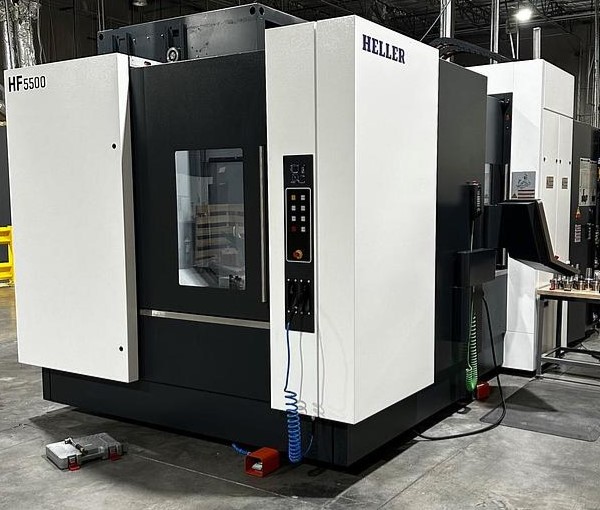
Here’s a detailed pre-purchase assessment guide for a used or surplus HELLER HF-series (e.g., HF-500 or HF-5500) 5-Axis Horizontal Machining Centre with pallet changer — essentially a machine with high capability made in Germany. Smart engineers use a structured checklist to evaluate such high-end equipment before purchase. (You specified “HF-500”, though most public specs are for HF-3500/HF-5500; the same principles apply.)
Why this machine demands a thorough evaluation
- The HF series are premium horizontal-5-axis machines with pallet changers or automatic loading, capable of simultaneous 5-axis machining and turning/mill-turn options.
- Because of their complexity (rotary/trunnion tables, direct-drive A/B axes, high speed spindles, tool magazines, automation), hidden wear or misalignment will significantly affect performance and return on investment.
- A used machine of this type can be a major asset if condition and support are good — but a poor condition unit may cost as much in retrofit/time as a newer model.
Pre-Purchase Assessment Checklist
Below is a detailed checklist organized in categories. Use it on-site with meter/dial gauge/inspection tools.
1. Specification & Fit for Your Needs
- Verify the exact model: HF-500 (or whichever HF variant) and any suffix (e.g., HF-5500). Confirm build year, serial number, and configuration.
- Match machine capacity to your production: table/pallet size, Z-travel, load capacity, tool magazine size, spindle speed/taper, pallet changer speed. For example HF series specs: typical pallet clamping surface 400×500 mm or Ø630 etc for HF models.
- Check whether the machine has pallet changer rather than only table loading — for series production this is key. HF specs show pallet changer variant.
- Tool-holder and spindle interface: HSK-A63 or HSK-A100 (depending on tooling) for HF series.
- Control system and software version: Ensure it supports 5-axis, has automation interface, is still supported for service/spares.
- Automation and accessories: pallet changer, twin pallets, tool magazine capacity, chip conveyor, through-spindle coolant, etc. Confirm what comes with the used machine.
2. Mechanical & Structural Condition
- Machine base and structure: Inspect casting for cracks, weld repairs or distortions — rigidity is crucial for accuracy.
- Rotary/trunnion table: Check for backlash, freedom of motion, smooth indexing, wear on swivel bearings. Because the HF series uses direct-drive A/B axes with large YRT bearings.
- Spindle condition: Horizontal spindle (typical of HF) is critical — check for unusual noise, vibration, run-out at tool taper.
- Guideways / ball screws / linear axes: Check X/Y/Z movement for backlash, smooth motion, table sag, wear marks. Use a dial indicator or laser measurement if possible.
- Pallet system & changer: Since pallet changer is key for rapid production, check indexing, clamp force, switching between pallets, lift/swivel mechanism. HF series spec emphasises “lift/swivel principle … robust HF pallet interface”
- Tool magazine & ATC: Verify magazine movement is smooth, tool grippers hold correctly, no mis-indexing or tool drop. Tool magazine wear often underestimated.
- Chip evacuation / coolant system: For HMCs, chip fall and coolant flow significantly impact performance — HF specs mention horizontal spindle for optimum chip fall.
- Hydraulic/pneumatic systems: Check for leaks, oil cleanliness, condition of seals/clamps.
- Service history: Review maintenance logs: spindle rebuilds, table bearing replacements, major retrofits. Some issues only show with a full production run.
3. Electrical / Control / Software Condition
- CNC controller: Check years of software, any legacy/hardware obsolescence risk. On HF series, Siemens SINUMERIK ONE or similar is typical.
- Drives and motors: Check servo motor hours, fan/filter condition, error logs.
- Wiring and cabinets: Inspect for burnt wires, connectors, dust build-up, cable chains wear.
- Safety systems: E-stop, door interlocks, pallet detection sensors — must be functional.
- Automation integration readiness: If you plan to add robots/pallet systems, verify interface ports, protocols, existing wiring.
- Spare parts / support: Since machine is used, check spare parts availability (especially rotary table bearings, direct drive motors, control boards).
4. Operational / Accuracy Testing
- Live demonstration: Insist on seeing the machine under load, ideally cutting a real work-piece or similar material/challenge.
- Jog motion test: Move each axis full travel (X, Y, Z, A, B if present) and check for smoothness, no vibration or chatter.
- Runtime test: Run a short cycle: e.g., tool change + pallet swap + first cut — measure times vs spec.
- Accuracy test: Use a dial indicator or laser to measure:
- Table flatness
- Repeatability of X/Y/Z
- Rotary table indexing accuracy (A/B axes) — HF spec sheet gives positional tolerance ~4-5 µm for linear axes and ~7 arcsec for rotary axes.
- Spindle test: At multiple speeds, see run-out and listen for bearing noise.
- Pallet changer test: Cycle pallet swap, measure time, check for positioning repeatability, no jamming.
- Cutting test: Perform a sample cut and inspect surface finish, measure parts to ensure machine still meets spec.
- Thermal drift test: After 30-60 minutes of continuous machining, check whether dimension accuracy shifts noticeably (which suggests cooling/thermal compensation issues).
5. Commercial & Logistical Evaluation
- Purchase price vs market value: Compare used machine price to new or similarly spec’d machines; evaluate condition, hours, service history.
- Installation/transport cost: These large systems require reinforced foundations, correct power supply, chip / coolant disposal, often crane & rigging — budget for these costs.
- Refurbishment cost: If mechanical wear or control upgrade is required, get quotes for spindle rebuild, table bearing replacement, control retrofit.
- Downtime risk: Because of complexity (5-axis, pallet changer, large parts) any hidden issues (rotary table wear, spindle failure) can lead to days/weeks downtime.
- Spare parts & service support: HELLER is German, global support is good, but older machines may face parts obsolescence.
- Resale value and future proofing: If your production needs change, will this machine still be viable? Consider investment horizon.
- Tooling, fixtures & automation cost: Large machines often need heavy fixtures, cast pallets, robotic loaders which add to total cost of ownership.
Practical On-Site Inspection Worksheet
Use this table during inspection:
| Item | Acceptable Condition | Notes / Observations |
|---|---|---|
| Machine model & serial | Matches spec sheets | |
| Build year & hours | Reasonable hours for age | |
| Base & structural integrity | No cracks, distortions, major repairs | |
| Rotary/trunnion table operation | Smooth, no backlash, indexing accurate | |
| Spindle run-out | ≤ 0.01–0.02 mm (or manufacturer spec) | |
| Guideways / ball screws | Minimal wear/backlash | |
| Pallet changer cycling | Smooth, repeatable positioning | |
| Tool magazine & ATC | All tools change reliably, no misloads | |
| CNC control & drives | No alarms, software version documented | |
| Electrical cabinet condition | Clean, no overheating, cable chain good | |
| Chip conveyor & coolant system | Good condition, no excessive chips/coolant issues | |
| Accuracy test result | Within spec (e.g., ±5 µm linear) | |
| Live machining test | Meets finish & cycle time expectations | |
| Documentation & manuals | All present and complete | |
| Included accessories | Pallets, fixtures, tool set, sensors |
Final Recommendation
- If the machine checks out (good structural condition, accurate, drives/control healthy, accessories included), then the HF-series unit can be a very strong investment for high-precision, high-mix large workpieces.
- If you find significant wear (rotary table backlash, spindle noise, control obsolescence, missing automation), negotiate strongly or consider a newer alternative.
- Ensure you include in your purchase contract a clause for “inspection under power” and if possible a short warranty/return window for major subsystems (spindle, rotary axes).
- Budget realistically: many buyers underestimate installation, commissioning, tooling, fixture cost.
- Consider that high-end machines like HELLER may already be fully depreciated, so long-term maintenance/parts supply becomes more critical than new machines.