19/10/2025
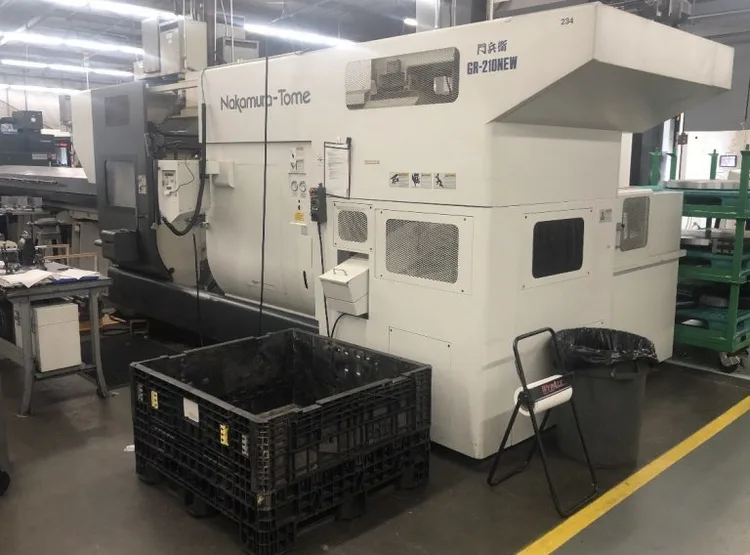
How Smart Engineers Assess a Pre-Owned, Used, Second-Hand, Surplus NAKAMURA-TOME WT-300 + GR-210 NEW Gantry Loader made in Japan Before Purchase
When evaluating a pre-owned / second-hand / surplus machine such as a Nakamura‑Tome WT-300 + GR-210 gantry loader (Japan-made), smart engineers will use a structured checklist to minimize risk and ensure you know what you’re buying. Below is a detailed guide of what to inspect, ask, and document — tailored to this twin spindle multitasking lathe + loader setup.
1. Machine identity & history
- Confirm the exact model: WT-300 (versus WT-250, WT-150 etc.). As pointed out by users, there are significant differences.
- Check the serial number, year of manufacture, machine hours or cycles.
- Ask for maintenance/service records: turrets, spindles, loaders, linear guides.
- Ask about original control type (e.g., Fanuc 18i-TB) and any upgrades.
- Ask if the machine has been relocated, how often, and if any major rebuilds were done (spindle bearings, turrets, loader mechanism).
2. Physical condition & alignment
- Inspect spindle nose(s) for wear, marks, chatter damage, collet condition.
- Check turrets (both upper and lower) for indexing accuracy, backlash, tool holder fit-up. As one user warned: “I used to run a 300, accurate and repeatable all day every day… but finicky had the turrets touch in slow motion and it knocked it out of spec.”
- Check ways, slides, linear rails (if applicable) for excessive wear, rust, damage.
- Inspect gantry loader (GR-210) for alignment, repeatability, servo/PLC logs. Ensure loader condition and reliability of pallet handling.
- Check lubrication systems, coolant systems, chip conveyors – often neglected on surplus machines.
- Ensure that all covers / guards were maintained, chips are not accumulating in hidden areas (one user noted chip accumulation behind turrets causing way wiper issues).
3. Functional test / controls & axis performance
- Power up the machine (if possible) and cycle all axes: X, Y, Z, A/B (if fitted) and ensure smooth travel, no unusual noises or stiction.
- Check spindle speeds and both main & sub-spindle operations. Confirm whether the max rpm / torque spec still meets your parts. For example, listings show spindle speed in older WT-300s at ~4 500 rpm and bar capacity ~65 mm in certain units.
- Test turret indexing: accuracy, repeatability, engagement firmness.
- Check live tooling / driven tools (if present) for speed, balance, tool holder integrity.
- Test gantry loader operations: pallet change, part transfers, sensor alignment. Verify the loader doesn’t introduce excessive vibration or misalignment.
- Watch the control interface: what control version (Fanuc, Siemens etc). Ensure parts-programming and cycles were properly used and that backup of programs exists.
4. Accuracy & repeatability
- Perform a test cut, measurement of a known sample part or reference block. Measure size, surface finish, repeatability of turret positioning, spindle run-out etc.
- Conduct spindle run-out check using a dial indicator (< 0.01 mm is desirable, but depends on job tolerance).
- Turret indexing check: tool-to-tool repeatability, tool holder repeatability.
- Gantry loader repeatability: ensure part placement doesn’t shift and that pallet exchange doesn’t introduce misalignment.
5. Consumables, tooling & spare parts status
- Check condition and availability of major wear items: spindle bearings, turret couplings, spindle drive belts (or direct drive), linear guide blocks, ball screws.
- Ask for the tooling set: are the collet chucks, tool holders, live tool modules original, or replacements?
- Confirm availability of spare parts for WT-300 and GR-210: although Nakamura-Tome machines have good reputation, older models may face parts issues. One forum user said “They are fantastic machines!”
- Verify whether the loader system is OEM or added later — check maintenance history for loader.
6. Utilities, environment & installation requirements
- Check electrical requirements: voltage, phase, power draw, whether any rewiring was done for export.
- Check foundation / anchoring: has the machine been relocated? Any damage to base or way alignment from transport?
- Check coolant system, chip removal, disposal for the particular job environment.
- Check safety features: guards, load/unload safety, gantry sensors.
7. Future maintenance & upgrade potential
- Ask whether major components (spindles, turrets, servos) have life left, or whether a rebuild might be required soon.
- Check firmware/controller version: ability to upgrade control (Fanuc/Siemens) for future compatibility.
- Assess machine’s current fit for your production: can it handle your parts dimensions, cycle times, tooling demands?
- Consider cost of integration: if the GR-210 gantry loader has to fit your fixtures and flow, you need to budget for integration, tooling, programming.
8. Documentation & warranty / seller credibility
- Get machine manual, maintenance/service logs, original build sheet if possible.
- Confirm seller’s credibility: is it a surplus asset from a reputable company? Reason for sale: relocation, job change, end-of-line?
- If possible, include a short acceptance test or performance guarantee if buying via dealer.
- Document any repairs needed or future planned maintenance costs.
Risk Areas Specific to WT-300 + Gantry Loader Setup
- Twin spindle + twin turret configuration is complex: more moving parts means more potential for misalignment, wear, tooling setup challenge.
- Gantry loader adds automation complexity: if the loader is mis-programmed or mis-aligned, it can slow cycle times or cause scrap.
- Older machines may have slower spindle speeds/torques compared to newer models: ensure your cycle times and material types match what this machine can deliver.
- Check turret bottom unit: forum users mention issues with bottom turret in twin-turret machines.
- Parts & service: older controls or unique options may lead to harder to find spares later.
Quick Pre-Purchase Scorecard
| Check | Good = Green | Warning = Yellow | Red Flag |
|---|---|---|---|
| Hours / usage history | < 20K hrs, full log | 20-40K hrs, partial log | > 40K hrs, no log |
| Spindle & turret wear | Minimal play, clean | Moderate wear/play | Excessive play, cracks, chatter |
| Turret indexing | ±0.005 mm repeat | ±0.02 mm repeat | > 0.05 mm error |
| Gantry loader operation | Smooth, fast, accurate | Some delays/mis-loads | Frequent failures/mis-loads |
| Spare parts availability | OEM parts available | Some parts require special order | Many parts obsolete |
| Control & software | Current Fanuc/Siemens version, good support | Older version, still supported | Rare control, unsupported |
| Tooling & consumables | Good set included | Basic set included | No tooling, unknown status |
| Installation/environment | Proper mounting, clean chips | Needs some clean-up | Poor foundation, heavy contamination |
Final Advice
- Don’t rush. Take time on-site.
- Bring a trusted technician familiar with multi-turret, twin spindle machines.
- Test parts: run a sample from your production portfolio if possible.
- Add margin in your budget for wear items, linear guide replacement, possible controls upgrades.
- Negotiate based on defects: If turret indexing is marginal or gantry loader needs service, factor that in.
- Plan installation & training: For a complex setup like WT-300 + GR-210, you’ll want time for setup, programming, loading/unloading integration.