26/10/2025
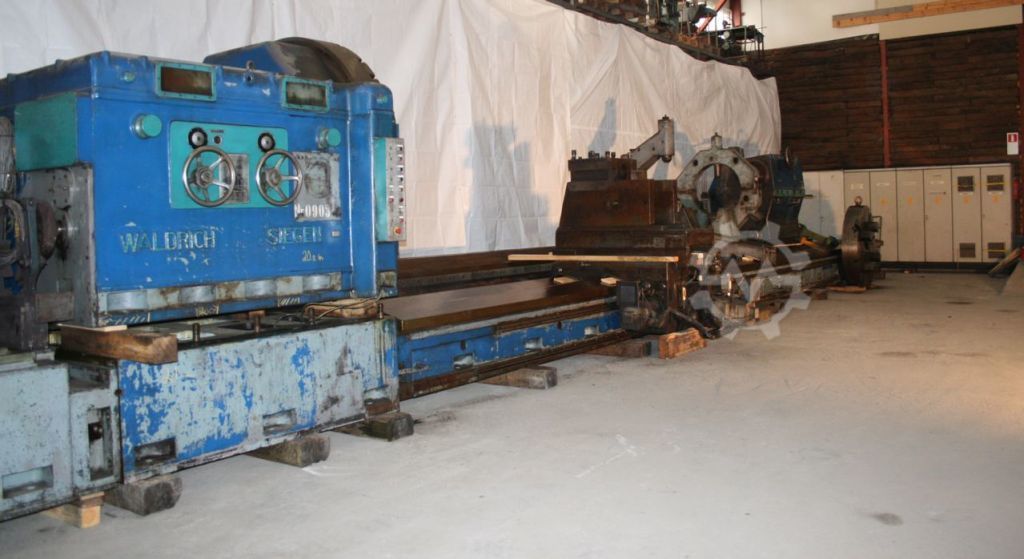
From Inspection to Installation: What to Verify Before Buying a Pre-Owned, Used, Secondhand, Surplus Waldrich Siegen Universal Heavy-Duty Lathe made in Germany
1 Pre-Inspection Phase: Documentation & History Review
Before traveling for physical inspection, request full documentation and gather technical background.
Documentation & Serial Validation
- Verify the model name, serial number, and production year directly from the Waldrich Siegen identification plate.
- Confirm that it is a universal heavy-duty lathe—these machines are usually part of Waldrich Siegen’s “Universal Turning Lathes” or “Portal Lathes” series designed for large, heavy-workpiece machining.
- Ask for maintenance logs, repair history, and spindle hours (if available from control or service notes).
- Request details of any retrofits such as control upgrades (Siemens, Heidenhain, or Fanuc), lubrication systems, or rebuilt slides.
- Identify original owner and working environment (single-shift or continuous production, indoor humidity conditions, oil mist exposure, etc.).
2 Visual & Structural Inspection On-Site
During the physical visit, visually and mechanically assess the machine’s structural integrity and alignment.
Bed, Headstock, and Tailstock
- Inspect the bedways for wear marks, scoring, or hand-scraped areas indicating re-grinding or rebuilding.
- Check that the headstock and tailstock centers align along the full travel length — misalignment may signal bed twisting or accident damage.
- Observe the gibs and slides for uneven backlash.
- Verify smooth travel of cross slide and carriage; excessive play can point to worn leadscrews or servo drive coupling issues.
Electrical, Hydraulic, and Lubrication Systems
- Examine the electrical cabinet for tidy wiring and signs of overheating.
- Inspect hydraulic units and lubrication manifolds for leaks or contamination.
- Ensure way lubrication system operates automatically — clogged oil lines can lead to severe wear.
- Check coolant pumps, chip conveyors, and guarding; replacement cost for large lathes can be substantial.
3 Functional Testing
If possible, request a powered demonstration.
Mechanical Operation
- Run the main spindle through full speed ranges; listen for bearing noise or vibration.
- Engage the feed axes (X/Z) to verify positional accuracy and consistent rapid traverse.
- Activate tailstock quill and steady rest (if equipped).
- Test spindle orientation and C-axis if the model includes contouring functions.
Measurement & Accuracy Verification
- Perform a test cut using a dial indicator or test bar.
- Check taper accuracy and concentricity at both ends.
- For very large machines, laser or ball-bar calibration data (if available) adds high confidence in geometry.
4 Control System & Drive Components
- Identify the CNC control type (Siemens 840D, Heidenhain TNC, or manual conventional system).
- Verify that all axes home correctly, limit switches function, and servo drives run quietly.
- Review drive modules and encoders for alarm histories.
- Inspect screen clarity and keyboard membrane on older controls.
5 Installation & Commissioning Considerations
- Review foundation drawings and anchoring requirements; Waldrich Siegen heavy-duty lathes require reinforced concrete bases.
- Confirm machine weight and transport dimensions — plan for special-permit trucking and lifting gear.
- Ensure three-phase electrical compatibility (400 V / 50 Hz typical in Europe).
- Align the machine precisely using a machinist’s level and re-verify geometric alignment after 48 hours of foundation settling.
6 Final Evaluation & Negotiation Tips
- Compare the offered machine’s price to similar Waldrich Siegen, WFL, or Niles-Simmons heavy-duty lathes in Europe to gauge fair value.
- Consider cost of dismantling, transport, re-commissioning, and possible retrofit (electrical and control upgrades).
- Always request a no-load and under-load video test before final payment.
- Draft a clear sales agreement defining: machine condition “as-is,” included tooling, and installation responsibilities.
Conclusion
A pre-owned Waldrich Siegen Universal Heavy-Duty Lathe is a highly precise, robust investment capable of decades of service — provided it passes thorough inspection. Ensuring bed accuracy, spindle health, and proper documentation is critical before shipping and installation.