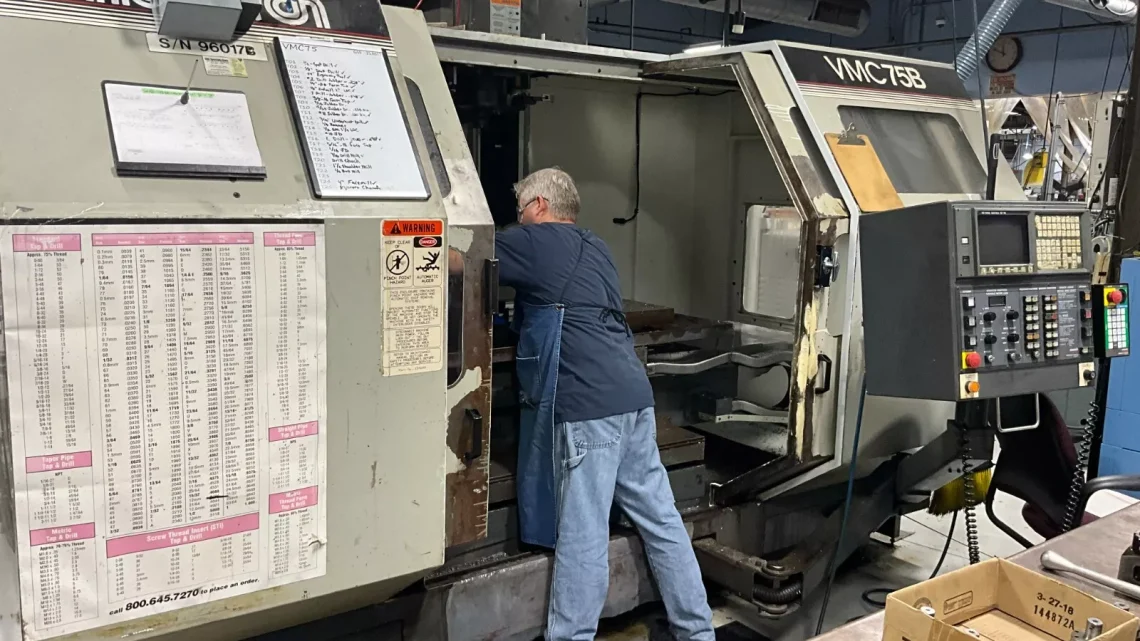
From Inspection to Installation: What to Verify Before Buying a Pre-Owned, Used, Secondhand, Surplus Monarch VMC75B CNC Vertical Milling Machine Cat 50 made in USA
Here’s a detailed guide—tailored to your second-hand machinery platform—on what to verify from inspection through installation when buying a pre-owned unit such as a Monarch VMC-75B (or similar) CNC vertical machining centre (Cat 50 taper in your case). I’ll include both general best-practices plus specifics relevant to the model. Since you specialise in second-hand machinery, these checks help you avoid hidden costs, downtime and transport surprises.
1. Machine identification & specification check
Before you commit, verify that the machine you’re looking at truly matches the spec you expect: model, taper, size, etc.
Key details to capture
- Model and serial number: for example the VMC-75B appears in listings with Model = VMC-75B.
- Taper/spindle specification: one listing shows “25 HP, 50 taper, Fanuc 15M control” for a VMC-75B.
- Travel and table size: for example X = 40″, Y = 20″, Z = 24″ in one listing.
- Control system: What CNC control is fitted (Fanuc, Siemens, others) – this has huge implications for parts/spares and compatibility with your work-flow.
- Accessories/optionals: Tool changer, pallet loader, coolant-through-spindle, etc. Example: one listing shows dual pallet loader on a VMC-75B variant.
- Taper vs what you need: You mention Cat 50. Some listings show CAT 45 (see turn0search0) and others show CAT 50 (turn0search10). So confirm which one is fitted.
Why this matters
If the machine is mis-specified (e.g., has CAT 45 instead of CAT 50), you may face tooling incompatibility, reduced resale value, or need adaptation. Also ensures your buyers on your platform know exactly what they’re getting.
What to ask/survey
- Ask the seller for the nameplate photo (shows model, serial, date, spec).
- Ask for original manuals (especially if control and taper are older).
- Confirm the control version (software version, last serviced) – older controls may be hard to support.
- Confirm power requirement (voltage, phase) and shipping weight (for logistics).
- Ask for machine history: how many shifts, what type of work, major repairs/upgrades.
2. Visual & mechanical inspection on-site
Once identification is good, you need a thorough inspection of machine condition. Many sources summarise what to check.
Exterior & general state
- Look for rust, corrosion, missing panels, broken covers. If way covers are torn or missing, that’s a warning sign.
- Check the general cleanliness: a well-maintained machine tends to have less hidden wear.
- Inspect for oil leaks or coolant leaks: especially around spindle, base, saddle, ball screws. Leaks may indicate poor maintenance.
Spindle, bearings & taper
- Run the spindle at full speed (if safe) and listen for unusual noises (grinding, vibration).
- Check spindle run-out: place an indicator on the taper or an inserted test bar to check for wobble.
- Examine the tool-holder taper and look for wear, chattering marks, burnt tooling.
- Inspect draw-bar and tool-changer engagement (if equipped) for signs of slop, mis-alignment.
- On large machines like this VMC-75B, replacing spindle bearings is costly — if it’s worn, discount accordingly.
Ways, ball screws, axis movement
- Check each axis for backlash: move the table/saddle then reverse and measure movement.
- Feel for smooth travel: when you manually jog, you shouldn’t feel binding or “notchy” motion.
- Check way covers: are they intact, sliding freely, sealing chips away? If way covers are damaged, chips can damage ways and ball screws.
- Inspect ball screws: If possible, remove guard and look for scoring, play in end bearings, signs of oil/grease starvation.
- Check rapid traverse rates (if possible): is the machine still achieving the rapid rates claimed?
Tool-changer / magazine / automatic features
- If the machine has an ATC (automatic tool changer) or pallets, test that it cycles correctly: tools pick up and drop reliably, no mis-loads. Example listing: 42 ATC for VMC-75B.
- Check sensors, interlocks, switches: Are tool change arms damaged? Are magazine slots worn?
- If pallets are present, check alignment of pallet load/unload station, look for wear at pallet locators.
Electrical / control cabinet
- Inspect the electrical cabinet: Is it clean? Free of dust/chips? Are cables well-clamped, no exposed wiring?
- Ask for power-on history: Are there alarms logged? How many hours?
- Check the condition of the control panel: key switches functioning, display clear, no missing buttons.
- Confirm the control system (e.g., Fanuc 15M) is supported, spare parts available. A listing had Fanuc 15M.
- If machine uses older PLC/drive systems, verify maintenance/support history.
Cutting test / accuracy test
If you can, perform a test cut: e.g., mill a simple block, inspect finish, dimensional accuracy, chatter, tool wear. Many experienced buyers advise this.
- Measure test part: Are tolerances within expectations?
- Check surface finish: any chatter marks, tool engagement marks, etc.
- Observe machine behaviour under load: spindle load, axis acceleration, any temperature rise in bearings or drives.
- Run the machine through a full cycle including tool change, rapid motion, feed motion. Listen and watch for abnormalities.
Service history & hours
- Ask for total operating hours and cutting hours (not just power-on). Machines may have many idle hours which is better than heavy cutting hours. Source highlights the importance of usage.
- Ask for maintenance records: lubrication schedule followed? Way-lubrication and ball screw lubrication systems maintained?
- Ask whether machine has had major rebuilds (spindle replacement, ball screw replacement, control upgrade).
- For your platform, you may want to log this info in a structured form so that your buyers can compare machines on your listing.
3. Transport & installation pre-checks
Since you operate an international second-hand machinery platform (your site cncbul.com), it’s critical to plan for shipping, installed footprint, utilities and post-installation setup.
Shipping / logistics
- Confirm machine weight and dimensions: one listing shows 24,000 lbs (~10,900 kg) for a VMC-75B DPL.
- Confirm whether the machine has been de-installed and crated or whether you must organise that.
- Check for heavy-lifting requirements, transit route access, forklift/truck capability at pickup and destination.
- Consider special permits: oversized load, customs for import/export (especially your country).
- Check whether the machine has been cleaned of coolant/oil for shipping; sometimes extra costs to de-contaminate.
Site preparation
- Floor load capacity: These machines are heavy and require a concrete floor with sufficient load-bearing capacity and minimal vibration.
- Utilities: voltages, phase (likely 3-phase), compressed air, coolant supply, chip conveyor, power drawbar, motor amps, etc.
- Space around the machine: allow for maintenance access, tool change access, chip removal, operator access.
- Foundation & anchoring: some large machines require anchor bolts or even a concrete pad with vibration isolation.
- Environmental considerations: adequate ventilation, chip collection, coolant disposal.
- Utilities connection: ensure supply matches machine specification (voltage/frequency), any step-up transformer needed (one spec example shows 440/3/60).
Installation & alignment
- Once installed, you’ll need to level the machine. Check the foundation/plate.
- Align the machine axes and check the spindle-to-table perpendicularity; often done using an indicator or laser.
- Check that the machine’s origin/reference is correctly set (for your existing tooling/work-flow).
- Verify chip conveyor and coolant system operate correctly (if present).
- Run an initial break-in sequence under light load to check for vibration, noise, heating, sign of instability.
- Calibrate the machine: ballbar test, geometry check, repeatability check. You might offer this as a value-add to your buyers or require it in your listing.
4. Financial & risk assessment
Because you’ll list this machine on your platform, you’ll want to communicate risk factors clearly to buyers.
Hidden costs to consider
- Parts availability: Older controls/spindles may mean long lead times or expensive replacements.
- Future maintenance: A spindle bearing replacement can cost tens of thousands of USD (or equivalent).
- Downtime risk: If the machine breaks down soon after installation, costs cascade.
- Transport & installation cost: Not just the purchase price—shipping, customs/import duties (in your country), installation and alignment.
- Depreciation and resale value: Some brands/models hold value better than others, but maintenance history affects this.
- Integration with buyer’s tooling, workflow and control system: E.g., if buyer’s tooling is CAT 50 and machine is CAT 45, extra cost for adaptor/spindle conversion.
Return on investment (ROI) considerations
- Can the machine support the expected workload, part size and cycle times your buyers anticipate?
- If your buyers need high precision or high speed, an older machine may fall short and reduce ROI. Source emphasises capacity and travel is key when buying used.
- Consider write-off/asset life: If machine is very old, sooner it may need major overhaul.
Platform listing advice
- Provide full spec sheet (model, serial, year, travel, taper, control, ATC, hours) in your listing.
- Provide inspection report/photos/videos of key areas (spindle taper, way covers, tool changer, electrical cabinet).
- Provide transport & installation cost estimate or guidelines for buyers.
- Provide “condition grade” (e.g., excellent, good, fair) based on your inspection checklist.
- Disclose any known issues or upcoming maintenance (e.g., “spindle bearings likely due for replacement within next 2,000 hours”).
- Offer or coordinate post-installation alignment/commissioning service (this can be a premium service you provide on your portal).
- Provide guidance on tooling compatibility (CAT 50 vs CAT 45) so buyers see clearly what they will need.
5. Tailored checklist for the Monarch VMC-75B (and similar Cat 50 taper machines)
Here’s a ready-to-use checklist you (or a buyer) can run through when inspecting a VMC-75B style machine. You can integrate this into your platform’s “machine listing form” or “dealer inspection protocol”.
| Item | What to check | Pass/fail notes |
|---|---|---|
| Model/serial | Confirm VMC-75B / serial number / year | |
| Taper | CAT 50 (or if CAT 45, note and tool-holder implications) | |
| Control type | e.g., Fanuc 15M or whichever version; software version | |
| Table size & travel | X ~40″, Y ~20″, Z ~24″ (verify) | |
| Table load capacity | Verify capacity (example: one listing 3,000 lbs) | |
| Spindle speed & power | e.g., 30-6000 rpm, 17 HP in one listing | |
| Spindle condition | Run at full speed, check noise, run-out, taper wear | |
| Tool changer / ATC | Check tool count, magazine condition, cycle time, tool change reliability | |
| Pallet changer (if present) | Check alignment, pallet interface, wear | |
| Ball screws & axes | Check backlash, smooth motion, wear marks, lubrication | |
| Way covers / seals | Check for damage, missing panels, chip ingress | |
| Electrical cabinet | Cleanliness, wiring, drives condition, control panel | |
| Hours / usage history | Cutting hours, machine hours, types of work done | |
| Service history | Lubrication schedule, major rebuilds, spindle changes | |
| Test cut | Mill a part, check finish, measure accuracy | |
| Utilities / power | Verify power spec, voltage/phase; check transformer if needed | |
| Transport readiness | Confirm machine is crated/disassembled, weight/dimensions, shipping access | |
| Site installation check | Floor load, anchoring, utilities, coolant/chip systems |
6. Installation & commissioning plan
After purchase, ensure a clean plan for installation and bringing the machine into production. Since you serve an international market, you might also offer a checklist or service to buyers.
Steps
- Receive machine/shipping: check for damage in transit, crate condition, components missing.
- Move machine into position: heavy-lift, forklift/truck, forklift clearance, rigging.
- Leveling & anchoring: use precision level, shim as required, bolt down if necessary.
- Electrical connection: ensure correct voltage, phase converter if required, check grounding, safety interlocks.
- Coolant/chip system setup: connect chip conveyor, coolant pump, filters, mist/flood systems (depending on machine).
- Control and drive warm-up: power up, let the machine idle, warm bearings, check for unusual heat or noise.
- Alignment & calibration: use test bar/indicators/ballbar to check geometry, repeatability. Set reference points.
- Test run: perform no-load cycle, tool change cycle, then light-load cut, increasing to full load while monitoring performance.
- Documentation handed over: machine manuals, wiring diagrams, maintenance logs, control manuals.
- Operator training (optional): ensure operator knows the control, machine idiosyncrasies, maintenance points.
Maintenance plan for first 100-200 hours
- Monitor spindle temperature and bearing behaviour.
- Monitor axis backlash, re-check every 50 hours.
- Check coolant levels, filtration, chip removal.
- Check way-lubrication feeds, inspect way covers for chip accumulation.
- Keep a log of run-hours, maintenance events — this adds value to the machine’s future resale.
7. Summary: Why this matters for your platform
Since you run a second-hand machinery portal (for example your site cncbul.com), applying this level of diligence adds credibility to your listings and helps your buyers make informed decisions. Machines like the Monarch VMC-75B are large CNC machining centres—the stakes (cost, logistics, downtime risks) are significantly higher than smaller used machines. By documenting and disclosing condition, specifying exact tooling/taper/control details, and offering installation guidance, you build trust and reduce buyer-risk.