25/10/2025
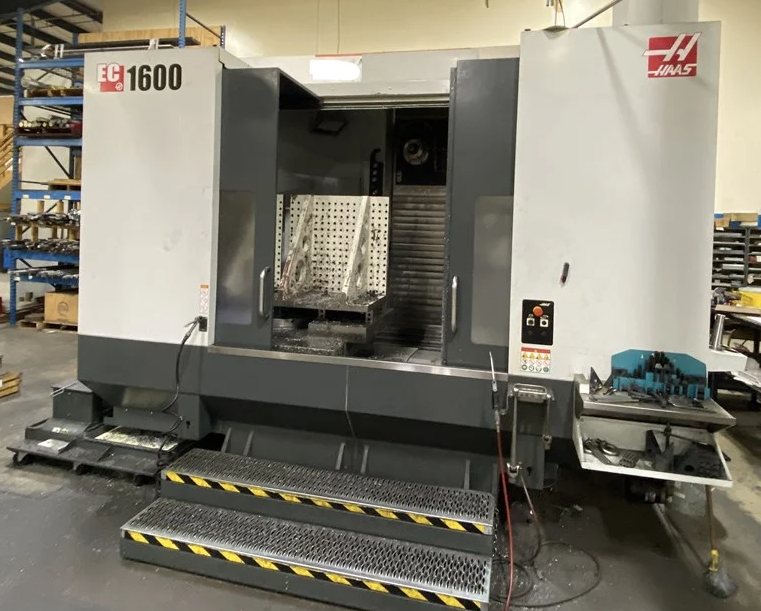
From Inspection to Installation: What to Verify Before Buying a Pre-Owned, Used, Secondhand, Surplus Haas EC-1600 CNC Horizontal Machining Center made in USA
When evaluating a pre-owned or surplus Haas EC-1600 CNC Horizontal Machining Center (USA-made) for purchase, you’ll want a thorough inspection and installation verification checklist covering physical condition, functionality, service history, and site-readiness. Below is a detailed guide of what to verify—from inspection to installation.
Pre-Purchase & Inspection Checklist
1. Physical & Structural Condition
- Inspect the machine bed, column, and base for cracks, weld repairs, corrosion or indications of past accidents.
- Check for wear on ways, rails or guides: look for polished areas, rust pitting, or inconsistent lubrication.
- Verify the spindle nose, taper and tool-holding interface for damage, rust, or mis-alignment.
- Inspect the pallet/table surface: check for flatness, wear, damage to mounting holes and clamping surfaces.
- Examine guards, covers and door hardware: they should operate smoothly and safely.
2. Spindle, Axis & Drive Systems
- Confirm spindle run-out, taper integrity and bearing noise. Review the machine’s service history for spindle rebuilds.
- Jog each axis (X, Y, Z) through full travel and test for binding, missing steps, grit, backlash or unusual noise.
- Inspect ball screws or linear drives for backlash, missing bellows or signs of contamination.
- Review drive motors, gears and transmissions—check for oil leaks, worn belts/chains and service records.
- Review the machine’s usage hours, cycle count (if available) and history of heavy cuts or abuse.
3. Control & Electronics
- Power up the control cabinet, check for clean wiring, burnt components or smell of overheating.
- Verify the control version, axis parameters and diagnostics. The EC-1600 supports process parameters designed for installation.
- Confirm preventive maintenance records: Haas has a published maintenance schedule covering lubrication, filters, axis backlash, spindle taper, etc.
- Check alarm history, servo errors, spindle fault codes and whether the machine has any locked features or expired licences.
4. Options, Accessories & Work-Holding
- Verify all installed options (pallet changer, rotary table, tool magazine, coolant system) match the listing and are operational.
- Inspect tooling interfaces, chucks, fixtures, adapters and how much repro tooling will be required.
- Confirm whether the machine includes the correct tool changer, ATS, or accessory systems for your production needs.
5. Foundation & Installation Readiness
- Confirm the machine was properly installed on recommended foundation. For EC-1600, a 12″ (300 mm) reinforced concrete slab is required.
- Check input power (voltage, phase), air supply, coolant system, machine anchor kit and environment readiness (vibration, floor level, space).
- Verify that the machine’s relocation history is documented: was it moved, re-leveled, re-calibrated? Reinstalling can cause misalignment.
Installation & Commissioning Checklist
Once you’ve purchased the machine, ensure the following before full production:
- Level the machine according to the manufacturer’s specification (check bed straightness, column plumb, table alignment).
- Complete axis calibration: backlash/ball-screw tuning for X/Y/Z axes; spindle orientation check.
- Run a ball-bar test or laser-interferometer alignment to verify volumetric accuracy.
- Flush and replace lubricants, filters, coolant as needed (especially for used machines).
- Confirm that all safety features, interlocks, guards and emergency stops function correctly.
- Test full production cycle with a realistic job: tool change, pallet change, traverse feeds, engage spindle feeds, coolant/nav-trash removal, etc.
- Document baseline performance: cycle times, surface finish, tool wear, accuracy. Keep record for future comparison.
Key Red Flags to Watch For
- Unexplained gearbox/drive rebuilds or spindle bearing replacements (may indicate hard usage).
- Excessive axis backlash or inconsistency across the travel range.
- Control or servo errors that recur often.
- Machine previously rigged improperly or moved multiple times without professional service.
- Missing or inadequate documentation of machine hours, service history or original installation specs.
Summary Table
| Item | Status to Verify |
|---|---|
| Structural condition | Free of cracks, welds, heavy wear |
| Axis motion smoothness | No jerkiness, binding or drift |
| Spindle condition | Run-out within specs, no damage |
| Control & electronics | Clean cabinet, logs & version check |
| Foundation & installation | Proper slab, anchoring, teaming |
| Options & accessories | Match listing, full functionality |
| Service history & hours | Documented, logical maintenance |
| Production test | Actual part machining verification |
Purchasing a used Haas EC-1600 can be a very smart investment if you do your homework. By systematically checking each of the above items, you’ll minimise risk, secure better pricing leverage, and be confident that the machine is ready to deliver reliable production performance.