24/10/2025
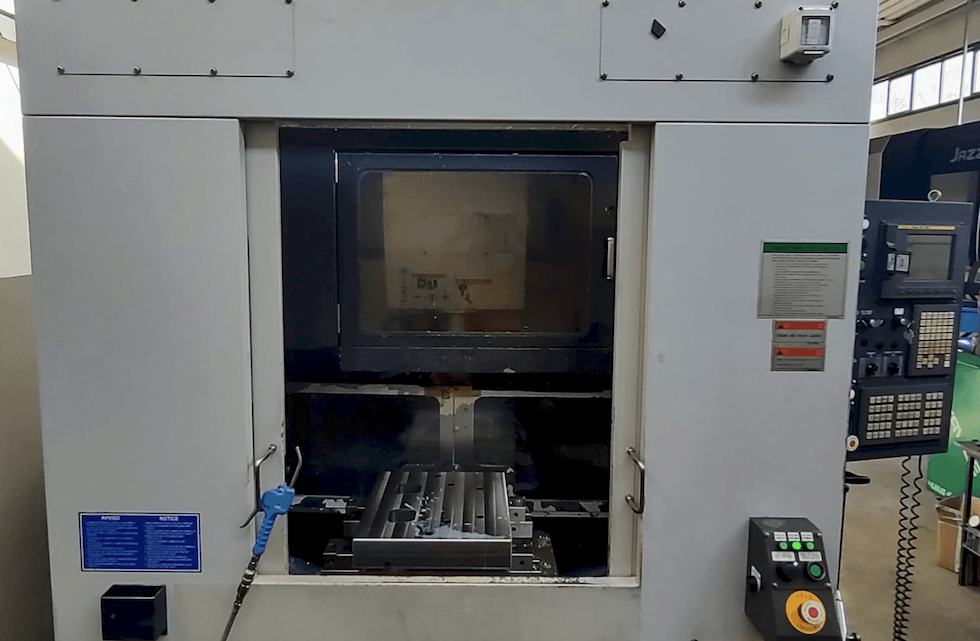
From Inspection to Installation: What to Verify Before Buying a Pre-Owned, Used, Secondhand, Surplus Enshu ES450 CNC Vertical Machining Center made in Japan
Here’s a comprehensive checklist you can use when inspecting and preparing to purchase a Enshu ES450 CNC Vertical Machining Centre (Japan-made) — covering pre-purchase inspection, logistics & delivery, and installation & commissioning.
1. Pre-Purchase Inspection
1.1 Verify Model, Specifications & Documentation
- Confirm that the machine is Enshu ES450, manufactured in Japan.
- Typical specifications:
- Travel (X/Y/Z): 650 × 450 × 460 mm
- Table size: 800 × 450 mm
- Spindle speed: up to 12,000 rpm
- Tool magazine: 20 tools (standard)
- Machine weight: approx. 7,000 kg
- Record serial number, year of manufacture, control unit model (often FANUC 18i-MB or Oi-MB), and total spindle hours.
- Request service history and maintenance logs. Machines with consistent lubrication and scheduled ball-screw inspections have significantly longer life spans.
1.2 Structural & Mechanical Condition
- Inspect table surface and T-slots for dents, corrosion, or deep scratches.
- Move X/Y/Z axes across full travel range; listen for irregular sounds, check backlash or step errors.
- Examine guideways and ball screws for wear or pitting — ES450 uses LM linear guideways, which require smooth, consistent motion.
- Check spindle run-out using a test bar; any noticeable vibration or noise may indicate bearing fatigue.
- Inspect ATC (Automatic Tool Changer):
- Check arm alignment, carousel indexing, and smooth tool change cycles.
- Verify the number of stations (20/30 tools).
- Evaluate auxiliary systems: coolant pumps, chip conveyors, hydraulic clamps, lubrication lines.
1.3 Performance & Accuracy
- Request a test cut: observe surface finish, dimensional accuracy, and cycle stability.
- Measure positioning and repeatability according to ISO 230-2 (or use a laser interferometer).
- Check rapid traverse rates: around 48 m/min (X/Y) and 36 m/min (Z) should be normal.
- Inspect for signs of previous crashes or column misalignment.
- Review controller logs for alarms or axis errors.
1.4 Electrical, Control & Software
- Verify voltage and phase: usually 200–220 V, 3-phase, 50/60 Hz.
- Open the electrical cabinet: check for burnt connectors, modified cables, or retrofitted drives.
- Confirm controller functionality (FANUC, Mitsubishi, etc.): monitor responsiveness, alarm history, and available spare ports.
- Check if optional upgrades exist: through-spindle coolant, 4th axis interface, spindle chiller, or tool load monitoring.
1.5 Ownership & Documentation
- Ensure legal ownership and serial number match invoices and nameplates.
- Ask for a parts list, electrical diagram, and parameter backup file.
- Confirm that the machine was properly decommissioned — spindle and ATC should be locked, axes in home position.
2. Logistics, Transport & Delivery
- Machine weight: approximately 7.0 t — confirm your transport capacity.
- Lock the spindle and ATC arm before loading.
- Secure all moving parts with mechanical locks or foam blocks.
- Use moisture-proof wrapping and rust-preventive spray for overseas shipping.
- Verify access width and floor load rating at your installation site.
- Arrange rigging, forklifts, and cranes suitable for the machine’s footprint (~2.6 × 2.8 m).
- Prepare foundation drawings and ensure flatness within ±0.02 mm/m.
Electrical preparation:
- 200–220 V AC, 3 phase, 40 A circuit recommended.
- Stable air pressure 0.5–0.6 MPa for tool clamp/hydraulic systems.
- Install power stabilizer and surge protection to protect the controller.
3. Installation & Commissioning
Step 1 — Leveling and Anchoring
- Level the base using precision spirit level (0.02 mm/m).
- Secure anchor bolts once the bubble stays centered in all axis directions.
Step 2 — Axis Alignment
- Check squareness between X/Y axes and perpendicularity of spindle to table.
- Verify backlash values are within 0.005 mm tolerance.
Step 3 — System Setup
- Reconnect lubrication lines and verify oil flow to guideways.
- Fill coolant tank and check coolant return lines for leaks.
- Power up controller and confirm parameter loading.
Step 4 — Functional Testing
- Home all axes and test soft limit operation.
- Run warm-up cycles: 30 min at incremental spindle speeds (1,500 → 6,000 → 12,000 rpm).
- Test ATC change cycle, coolant on/off, and emergency stop functionality.
- Perform a cutting test to confirm dimensional accuracy and chatter-free operation.
4. Value, Risks & Commercial Factors
| Evaluation Area | Key Considerations |
|---|---|
| Spindle Health | Check vibration spectrum, noise, heat after 15 min idle run. |
| Guideways & Screws | Replace lubrication oil and clean LM rails before use. |
| Controller Age | FANUC 18i-MB units are serviceable; older versions may lack parts. |
| Tool Magazine | Inspect ATC arm claws and Geneva indexing cam. |
| Electrical Components | Check Yaskawa/Servo drives for overheating or replaced boards. |
| Market Value | Typical resale value (2025): USD 20 000–35 000 depending on hours and condition. |
| Support | Enshu Japan still provides documentation and limited parts support for ES-series models. |
5. Final Checklist Before Purchase
- Verify model, serial number, YOM, control system.
- Inspect table, guideways, and spindle taper.
- Test axes travel, backlash, and noise.
- Run spindle and ATC cycles.
- Review service records and control logs.
- Confirm voltage and air supply compatibility.
- Inspect coolant and lubrication systems.
- Verify transport and installation readiness.
- Perform leveling and accuracy test after setup.
- Define maintenance intervals and backup parameters.