24/10/2025
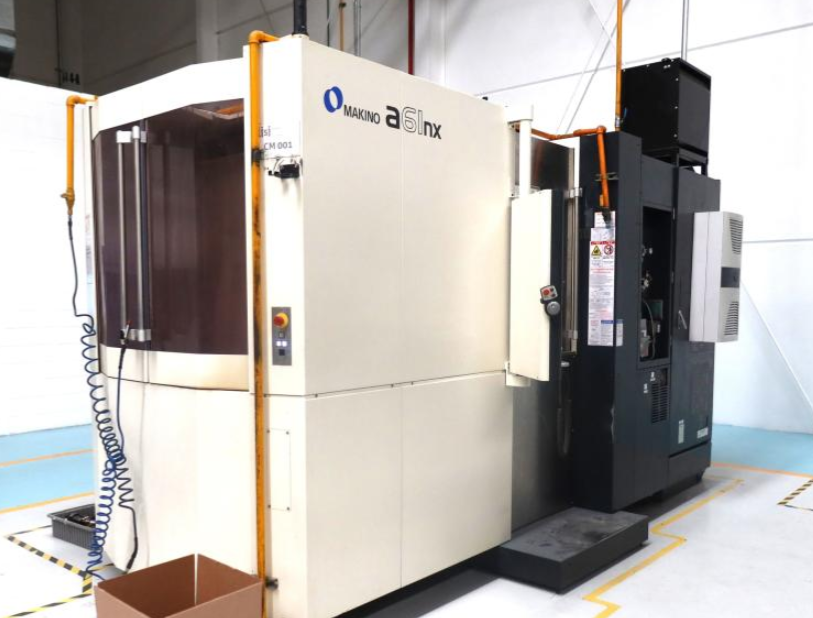
From Inspection to Installation: What to Verify Before Buying a Pre-Owned, Used, Secondhand, Surplus Makino A61NX CNC Horizontal Machining Center made in Japan
1. Machine Overview & Key Specs
Having a solid grasp of the machine’s baseline specs helps in assessing condition and suitability.
- The Makino a61NX is a 4-axis horizontal machining centre (HMC) with dual-pallet (500 × 500 mm) configuration standard.
- X/Y/Z travels: X ≈ 730 mm, Y ≈ 650 mm (optionally 730 mm tall-column), Z ≈ 800 mm.
- Spindle: 14,000 rpm standard (option up to 20,000 rpm), CAT/BT-40 (or HSK-A63 optionally) taper.
- Pallet load: around 500 kg standard, option up to ~700 kg.
- Tool magazine: 60 pockets standard (optional 133, 218, 313).
Knowing these means you can benchmark what you’re buying against original spec and identify deviations.
2. Pre-Purchase & On-Site Inspection Checklist
Here are what you should check before committing — mechanical, electrical, software, and general condition.
A. Visual / Structural Condition
- Inspect base, columns, machine frame: any cracks, repair welds, corrosion? The machine must maintain rigidity for precision.
- Check way covers, guards, enclosures: missing covers or heavy damage may indicate collisions or neglected maintenance.
- Inspect pallets for wear: check pallet surface flatness, clamp points, indexing integrity.
- Look at the spindle nose and tool-changer area: are there signs of abuse, worn surfaces, broken keys?
- Review environment where machine was used: heavy brownfield factory vs clean tool-room? A harsher environment increases wear.
B. Usage & Maintenance History
- Ask for running hours (spindle hours, axis hours) if available. Some listings show ~9,800 hours.
- Request maintenance logs: when were spindle bearings changed, major drives replaced, linear guides serviced?
- Confirm prior application: Was this machine used for abrasive steel, aerospace aluminium, or lighter duties? The duty influences wear.
- Ask what the reason for selling is: When a machine is retired only due to capacity, that’s better than when due to breakdown or unreliability.
C. Control System & Software
- Confirm the control version (Makino Professional 5/6 or Fanuc, etc). Ensure the operator panel, buttons, touchscreen are intact.
- Check program libraries, tool offset backups, CNC parameters. Are there backups? Is the software up to date?
- Check alarm history: see if there are frequent servo faults, spindle overloads, or other recurring errors.
- Ensure compatibility of control language, network interface, and your shop’s IT infrastructure.
D. Mechanical Axes & Spindle/Tool Systems
- Move X, Y, Z axes manually: listen/feel for backlash, roughness, jerkiness, unusual noise.
- Use a dial indicator (if possible) to check linear axis backlash or play.
- Run the spindle (if permitted) at low speed: listen for bearing noise, monitor temperature rise, check run-out.
- Inspect tool changer: Does it index cleanly? Has there been tool-changer repairs? Tool to tool time is ~0.9 s for this machine.
- Check pallet changer (if equipped): Cycle rate, indexing accuracy, clamp integrity.
E. Automation, Workholding & Auxiliary Systems
- Confirm pallet changer and work-handling: Does it function reliably? Are clamp pistons/hydraulics okay?
- Inspect coolant system: coolant filtration, chip conveyor, coolant tank cleanliness.
- Check through-spindle coolant (if applicable): pressure, seals, functionality.
- Ensure work-holding fixtures (pallets, vises, chucks) are included or available and in good condition.
F. Electrical, Safety & Environment
- Open electrical cabinet: check for burnt components, proper labeling, dust/coolant ingress, corrosion.
- Verify power supply compatibility: voltage, phase, breaker size — ensure your site matches.
- Verify safety interlocks, emergency stop, door sensors work properly.
- Check floor vibration, ambient environment, dust and coolant exposure.
G. Accuracy, Calibration & Test Part
- Ask for calibration reports: for example straightness of axes, spindle run-out, rotary table accuracy.
- If possible, run a test part: machine a part and measure key dimensions, surface finish, repeatability.
- Compare actual performance vs original spec: This machine expects high precision given its design.
- Check for previous relocations: moving large HMCs can misalign axes and increase wear.
3. Commercial & Contractual Considerations
- Confirm machine’s serial number, year of manufacture, and any retrofits that have been applied.
- Clarify what is included: machine only, pallets, vises, toolings, software licences, point-probes, conveyors.
- Determine transport & installation responsibility: who pays for shipping, rigging, alignment, calibration.
- Discuss warranty or acceptance period: For used machines, having a short test period post-install is beneficial.
- Check spare parts availability for this model in Türkiye/Europe: Understand cost and lead times.
- Negotiate payment terms: Consider paying part only after acceptance test.
4. Site Preparation & Installation Readiness
- Ensure your facility meets requirements: floor load capacity, vibration isolation, foundation rigidity, coolant/air supply.
- Prepare power supply: match machine specifications (voltage, phase, amperage, stable feed).
- Ensure chip removal, coolant filtration, ventilation are set up ahead of arrival.
- Plan rigging: machine weight may be ~10–12 tons or more, depending on configuration; ensure crane/transport access.
- Plan for alignment and calibration: after placement, you’ll need to level, align pallets, check spindle and axes accuracy.
5. Decision Criteria & Fit to Your Use Case
- Fit to Part: Does the a61NX’s work envelope (X/Y/Z) and pallet size match your parts? E.g., for Ø800 mm × 1,000 mm max workpiece.
- Condition vs Price: A low asking price is good only if machine condition and refurb costs are low.
- Support & Parts: Makino parts and local service availability should be checked.
- Risk vs Reward: A well-used but well-maintained a61NX can be a great production machine; a neglected one may cost more in downtime and rebuilds.
Summary
The Makino a61NX horizontal machining centre is a high-precision, high-productivity machine suited for demanding work. Buying one used requires thorough inspection of mechanical condition, control/electrical health, tooling and automation systems, and readiness of your site for installation.