27/10/2025
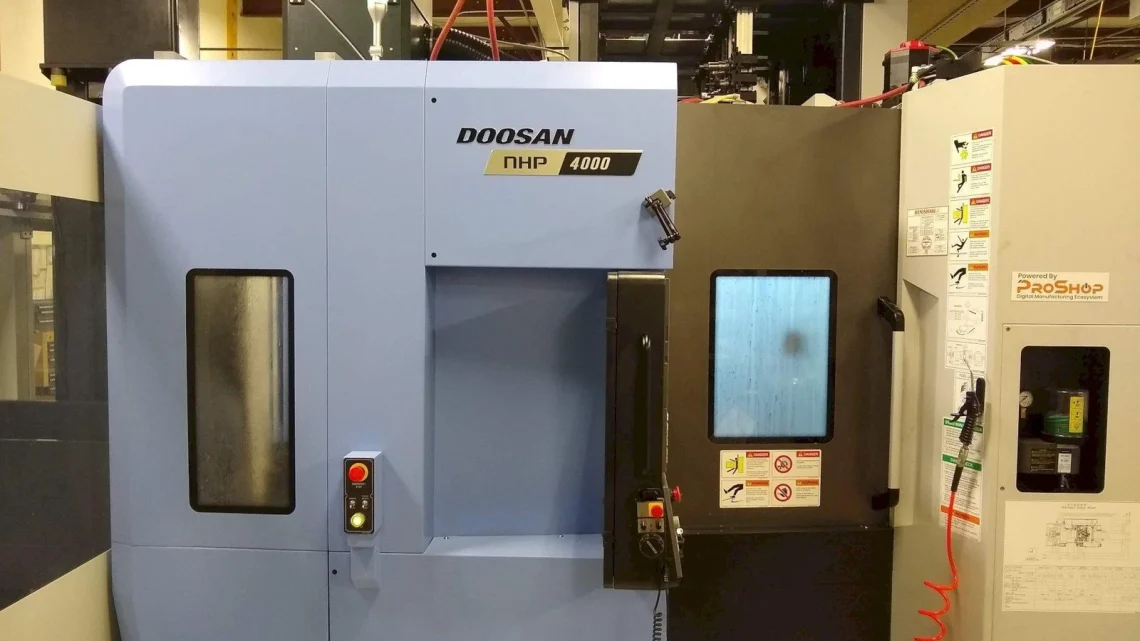
From Inspection to Installation: What to Verify Before Buying a Pre-Owned, Used, Secondhand, Surplus Doosan NHP 4000 CNC Horizontal Machining Center made in South Korea
f you’re considering acquiring a pre-owned or surplus Doosan NHP 4000 horizontal machining center (HMC) made in South Korea, it’s wise to perform a complete inspection through to installation. Below is a comprehensive checklist broken down by stage, with specific items relevant to this machine series, along with some caution flags and installation tips.
1. Pre-Purchase / Inspection Stage
What to verify
- Machine identification & history
- Confirm the exact model (NHP 4000) and verify the serial number and manufacturing origin (South Korea).
- Ask for machine history: original owner, usage (material processed, number of shifts, types of parts), maintenance records.
- Check how many hours of cutting time (not just spindle hours) and how many total hours on the machine.
- Ask whether any major repairs or rebuilds have been done (spindle rebuild, guide replacement, control upgrade, etc.).
- Specification vs actual
- Confirm specifications for the NHP 4000: For example, spec sheet shows X travel ~ 560 mm (22″) ; Y ~ 640 mm (25.2″) ; Z ~ 660 mm (26″).
- Spindle speed: 15,000 rpm is standard for the series.
- Pallet size and payload capacity: e.g., 400 × 400 mm pallet, ~400 kg for NHP 4000.
- Machine footprint, weight, especially for transport planning.
- Mechanical condition
- Visually inspect the machine bed, column, guideways. For NHP series the step-guide bed structure and roller linear guideways are key features.
- Check the guideway wear, ball screws: look for backlash, play, unusual noise when moving axes manually.
- Spindle condition: check run-out (with a dial indicator or test bar), listen for unusual bearings noise, check for coolant leakage through spindle nose.
- Tool changer and pallet changer: verify they operate smoothly, indexing times, look for wear or damage. For NHP series very fast tool changes (0.9 s) and pallet changes are marketed.
- Chip conveyor, coolant tank, filters: check condition, cleanliness, whether the coolant system has been maintained, any signs of rust or contamination.
- Electrical cabinet: check wiring condition, cleanliness, evidence of dust ingress or coolant leaks.
- Control system: check the CNC (likely FANUC 31i-B on many NHP units) is functioning, screen is good, memory/back-up operations verified.
- Test-run / Cutting test
- If possible, run the machine under power: check axis motion (feed and rapid traverse), listen for unusual vibration/noise, check accuracy (perform test piece or calibration piece).
- Run a tool change and pallet change and time them; check if performance matches expectation.
- Measure part accuracy: for example repeatability, surface finish on test part.
- Check spindle thermal behaviour: does the machine require long warm-up? Are there variation issues? Since NHP machines include thermal compensation.
- Documentation & ownership / export aspects
- Ensure full documentation: manual, service logs, parts list, electrical drawings.
- Verify machine has no liens, is legally transferable.
- If importing into your country (or Europe), check export restrictions, duty/VAT implications, spares availability.
- Ask about spare parts status: how many hours remaining on consumables, spindle bearings, etc.
- Cost of ownership considerations
- What spares are expensive (spindle, tooling system, ATC carousel)?
- What tooling does the machine require (CAT 40 Big Plus shank, etc) – ensure compatibility with your tooling system.
- Energy consumption (machine weight ~21,000 lb for NHP 4000 listing)
- Consider relocation/shipping cost (weight + size), installation cost, labour cost for commissioning.
Red flags
- No or incomplete service/usage history.
- Excessive hours of cutting without major rebuilds.
- Large play or wear in axes/guides.
- Spindle run-out beyond tolerance, or vibration at high rpm.
- Tool change / pallet change failures or severe wear.
- Coolant or chip management system in poor condition (leakage, contamination).
- Electrical cabinet with signs of damage, corrosion, or unconventional wiring.
- Parts unavailable or very long lead times for key spares.
2. Pre-Relocation / Deinstallation
What to plan and verify
- Floor plan: Confirm machine footprint (length, width, height) and weight. For example one listing gives ~4950 × 2300 mm footprint and weight ~9,700 kg for NHP 4000.
- Ensure the destination floor can handle the weight and dynamic loads; also ensure proper foundation or leveling ability (many machines require stiff foundation or floor leveling).
- Utilities at destination: power (voltage, phases, amps), compressed air (if needed), coolant/filtration systems. Check what the machine requires (one listing shows 80 kVA / 210 A at 220V for NHP 4000).
- Removal and transport planning: De-rigging, packaging, transport protection (especially for spindle, guides), trucking from seller to your site in your country.
- Documentation for customs / import: shipping manifest, machine VIN/serial, certification or CE compliance if needed.
- Spare parts to bring: It’s wise to bring key spares (filters, seals, coolant, etc) with machine to avoid downtime upon installation.
Red flags
- Floor not rated for machine weight.
- Utilities not matching machine requirements or missing.
- Poor removal logic: machine not strapped, spindle not locked, guides exposed.
- Incomplete shipping paperwork, leading to customs delays.
3. Installation & Setup at Your Site
What to verify during installation
- Leveling & alignment: Use precision instruments to level the base, align axes (X/Y/Z) and verify table/pallet alignment with spindle.
- Spindle alignment & run-out: Measure with test bar, dial gauge to verify spindle nose run-out within specification.
- Axis backlash and resolution: Test for backlash in all axes and ensure acceptable play (refer to manufacturer’s spec).
- Tool changer / pallet changer: Test full cycle, verify indexing accuracy, repeatability of pallets, ensure no mechanical looseness.
- Coolant/chip management: Fill the coolant tank, test coolant delivery (through-spindle if equipped), test chip conveyor system, evacuation.
- CNC / control: Boot up machine, calibrate axes, run homing procedure, test M/G codes, tool offsets, probing functions (if equipped).
- Thermal stable state: Bring machine up to normal operating temperature, then run a test part to verify accuracy.
- Trial run with real material: Make sure machine performs under real application, produces acceptable parts, surface finish and accuracy meet your requirements.
- Safety / guarding / compliance: Ensure all emergency stops, safety guards, interlocks are operational and compliant with local regulation.
- Training & documentation: Ensure operator training is completed, manuals are present, and you have a maintenance plan in place.
Red flags
- After installation, accuracy drifts significantly as machine warms up.
- Tool/pallet changer jams or moves slowly.
- Spindle vibration at high rpm under load.
- Unusual noises during axis motion or tool changes.
- Chip evacuation is poor—chips accumulating in base or table causing possible recuts.
- Electrical or control faults (e.g., alarms, inconsistent axis homing).
4. Post-Installation Ongoing Checks & Considerations
- Establish periodic maintenance schedule: check lubrication, coolant quality, spindle belt/bearings, tool changer servicing.
- Monitor spindle hours and tool change cycles – set alerts for major maintenance intervals.
- Keep logs of machine performance (scrap rate, downtime) and compare to what you expected.
- Spare parts inventory: maintain a small stock of commonly used spares (filters, belts, seals) to minimise downtime.
- Align machine usage with what the NHP 4000 is capable of: It is designed for high productivity, high speed spindle, quick tool changes, etc. Ensure you are utilising those features to get the best ROI.
- Plan for eventual resale, keep machine in good condition, stain-free casting, logs, maintenance records — this will enhance future value.
5. Summary Tailored for the NHP 4000
- The NHP 4000 is part of Doosan’s high-productivity horizontal machining center line with features such as 15,000 rpm spindle, very rapid traverse rates and automation ready.
- Ensure that the pallet system, tool magazine, spindle condition and guideways are all in top shape. Because with a machine like this, non-cutting time (tool change/pallet change) is essential to ROI.
- Because you are buying used / second-hand / surplus, be especially vigilant about fatigue wear, maintenance history, and hidden damage (e.g., coolant leaks leading to corrosion, worn linear guides, spindle bearings near end of service life).
- Given you are in European area (importing from abroad might be relevant), include shipping, customs, installation and local service support in your cost calculation.
- And finally: run a real parts test or demo on your actual material if possible — helps verify that this machine will meet your production requirements and not just theoretical specs.