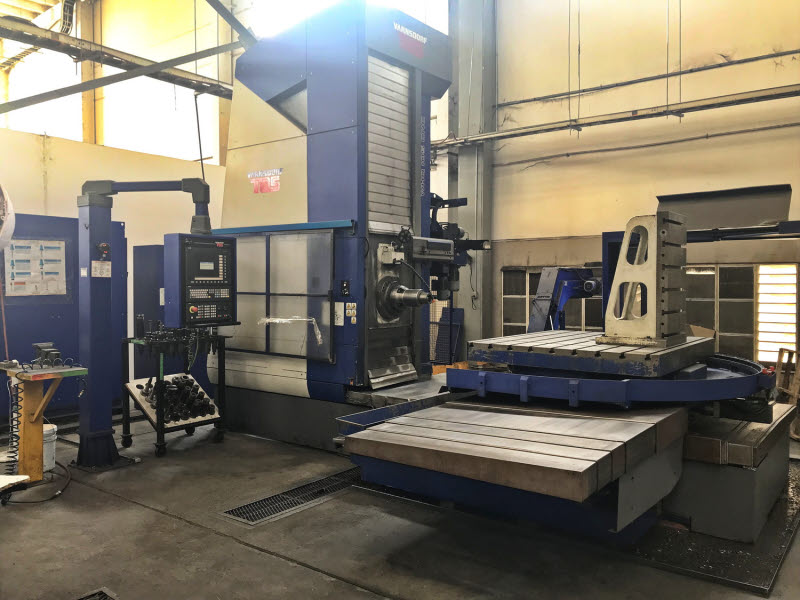
From Inspection to Installation: What to Verify Before Buying a Pre-Owned, Used, Secondhand, Surplus TOS VARNSDORF WHQ-105 CNC HBM CNC Horizontal Boring Machine made in Czech Republic
When you’re considering purchasing a used, second-hand or surplus machine tool like the TOS VARNSDORF WH(Q) 105 CNC (Czech-made horizontal/milling/boring machine), there are many critical checks from inspection through to installation. Given your portal focuses on second-hand machinery, here’s a detailed checklist (adapted to your market) including both general and machine-specific items.
1. Specification Verification & Matching to Needs
Before inspecting physically, ensure the machine offered meets the required spec for your usage (or the buyer’s usage). Key details for this model from the manufacturer:
- The WH(Q) 105 CNC is a “horizontal table-type boring machine … designed for precision machining of larger box-type parts and complex shape components up to ~5 tonnes.”
- Spindle diameter: 105 mm; spindle taper ISO 50.
- Spindle speed variants: 10-2,300 rpm (headstock “N”), up to 3,300 or even 4,000 rpm for high-speed headstocks (“R”, “R4”).
- Travels: X (table transverse) ~1,800 mm, Y (vertical headstock travel) ~1,250-1,600 mm, Z (table longitudinal) ~1,250 mm, W (spindle in feed) ~630 mm.
- Table dimensions about 1,400 × 1,400 mm or 1,400 × 1,600 mm; and max work-piece weight up to ~5,000 kg.
What you should check:
- Confirm the machine offered is indeed the WHQ 105 CNC (or WH 105 CNC) version with ATC (automatic tool changer) if advertised. Some listings mention “WH 105 CNC” basic version and “WHQ” version with ATC.
- Check the actual travel values (X, Y, Z, W) and table size; sometimes previous use or modifications may have altered them.
- Confirm spindle version: what headstock (N, R, R4) it has, what maximum rpm, what taper, what motor power. This will affect machining capability.
- Check control system: listings for this machine show e.g., Heidenhain TNC 530.
- Ensure the condition of auxiliary systems if required: e.g., ATC magazine, coolant system, tool changer, maybe auxiliary milling head.
2. Visual & Mechanical Inspection
Once spec is confirmed, you need to inspect the machine physically (preferably on site). Focus on wear, condition, service history, geometry, and hidden costs.
What to inspect:
- Machine frame & castings: verify no major cracks, repairs, or distortions in the main column, table, base. The WH(Q) 105’s frame is described as grey iron castings with ground/hardened slideways.
- Slideways / guideways / ball‐screws: Check for signs of wear on X, Y, Z, W axes. Look for uneven wear, play/backlash, scoring on surfaces.
- Table & rotary axis (B axis / C axis if included): Check the table surface for damage, flatness; check clamping mechanism; check rotary indexing for the table – whether it rotates smoothly, locks correctly.
- Spindle & headstock: Because spindle is the heart of the machine: check for spindle run-out, unusual noise, oil leakage, bearing play. Check the spindle taper (ISO 50) for wear. If the machine has high‐speed headstock (R or R4) check condition of bearings. The spec states “preloaded, multiple setup ball bearings” in the spindle.
- Tool magazine / ATC (if WHQ version): Check that the ATC works, tool changes correctly, magazine arms work without binding, sensor and indexing mechanism functional.
- Electrical panel & control system: Ensure the control (e.g., Heidenhain) is functional, operator screen works, emergency stop, interlocks, servo drives, power cables in good condition, no major modifications that might affect spare parts availability.
- Coolant & lubrication systems: Check coolant tank condition (cleanliness, rust, sludge), coolant pump, internal spindle cooling if included. The spec mentions optional through-spindle cooling up to e.g. 10-40 bar. Also check automatic lubrication of guideways and ball screws.
- Hydraulics & pneumatics: Table clamps, clamping of rotary axis, tool-holding device, chip conveyor if included, hydraulic systems for headstock counterweight (the spec mentions the headstock weight is compensated via a counterweight inside the column)
- Accessories & tooling: Check what’s included (angle heads, milling head attachments, probing system, fixtures) — these add value.
- Service & maintenance history: Ask for records of major overhauls: e.g., spindle overhaul, guideway adaptations, re-alignment, any crash history. If the machine has been used in multi-shift heavy duty, expect more wear.
3. Geometric Accuracy & Functional Testing
For a precision machine like this, seeing it running and verifying accuracy is crucial.
What to test:
- Run a test part / trial cycle: If possible, run a simple machining program to see axes move, check for smoothness, vibrations, error messages, overheated components, spindle noise.
- Check positioning accuracy / repeatability: Use dial indicators or laser measurement to check X, Y, Z axes for backlash or repetition error. Compare against spec; the manufacturer claims testing under ISO 3070-1,2,3, VDI/DGQ 3441 standards.
- Spindle run-out and surface finish: Cut a test piece and check surface finish and dimensional accuracy; measure spindle concentricity.
- Table flatness & squareness: Using straight edge/square, check table surface for sag or wear; check that table is square to axes, check rotary axis indexing accuracy.
- Check coolant flow, tool change cycle time (if ATC), axis rapid traverse speeds: The spec lists rapid traverse X/Y/Z = 10 000 mm/min, W axis 8 000 mm/min. If the machine cannot reach near these values, might indicate deterioration or adjustment needed.
- Thermal condition & stability: For heavy machines, verify how the machine behaves as it warms up; check if there’s visible change in accuracy after some runtime.
4. Spare Parts / Support / Documentation
Especially for second-hand machines, ensure you won’t get stuck without support.
- Check if machine has full documentation: user manual, wiring diagrams, spare parts list, program backups, maintenance log.
- Check availability of spare parts for the machine: given TOS VARNSDORF is Czech and global brand, parts for major components (spindle bearings, servo drives, control system boards) should still be available. The brochure says the company offers “spare parts, overhauls and modernisations”.
- Check condition / age of control system (e.g., Heidenhain, Siemens, etc). If the control is very old or proprietary, upgrades might be costly.
- Check if previous owner has done any retrofits or non-standard modifications (which could affect maintenance, calibration or resale).
- If importing into Turkey / Türkiye (as your business base is Bursa), check import duties, shipping logistics, local service/technician availability for TOS machines.
5. Logistics, Installation & Site Requirements
Once purchase decision is made, you must plan for transport, installation, commissioning, and once installed, validation in your environment.
- Weight & footprint: Determine machine weight (often ~ 13–18 t for these machines) and shipping size. For example one listing: “weight 13 400 kg” for WH 105 CNC. Ensure your floor can support the machine (load per m²), the crane capacity at your site, access for removal and installation.
- Foundation and leveling: Such heavy machines typically require a concrete foundation with floor anchors, leveling bolts, sometimes grouting. Check if the original machine had this and ensure you can replicate.
- Electrical supply & utilities: Check required power supply (voltage, phases, amps). Check cooling system, compressed air (if needed for ATC or chip conveyor), extraction/ventilation for coolant mist, chip conveyor output, space constraints.
- Site inspection: Ensure the machine will fit through doors, into the hall, with overhead crane if needed, that access to all sides is available for maintenance and chip removal.
- Installation & alignment: After installation, you’ll need to align axes, calibrate, verify accuracy once installed. Budget time and cost for that.
- Commissioning trial runs: On your site, run initial test parts, verify accuracy in situ, adjust as needed.
- Training & operator readiness: Ensure your operators are familiar with the control and machine functions, especially if ATC, advanced features (probing, automation) are present. The brochure mentions remote diagnostics and job-management features for this machine.
6. Risk Checklist / Warning Signs
Here are red flags you should watch out for:
- Lack of service history or proof of major maintenance — big wear machines may hide issues.
- Excessive spindle hours / high load history (multiple shifts, rough machining) with little maintenance.
- Obvious signs of abuse: spindle noise, cracked castings, damaged guideways, table surface pitting.
- Control system or servo drives obsolete or end-of-life — could lead to expensive upgrades.
- Non-standard modifications that may hinder spare parts or future resale.
- Poor condition of coolant/filtration system (rust, sludge) indicating neglected maintenance — can indicate internal corrosion, contamination.
- Inadequate foundation at previous site — if the machine was moved without proper rigging or foundation removal, can affect geometry.
- Missing accessories or attachments that were listed — these add value and if missing you must budget for replacements.
- Under-estimating transport, installation, alignment and commissioning costs — these can add significantly to purchase cost.
7. Context for Your Portal & Second-Hand Machinery Business
Since you run a second-hand machinery portal (for example your platform cncbul.com), you may want to incorporate the following into your listing process, and advise clients accordingly:
- For each machine listing (e.g., this WHQ 105 CNC), include a full machine specification against official brochure specs — travel values, headstock version, table size, spindle, control, accessories.
- Ask sellers for detailed service history, hours of use, last major overhaul, any crash/repair history.
- Encourage or require inspection photos/videos of key components (slideways, table, spindle taper, ATC magazine, electrical cabinet).
- Advise buyers to budget for transport, installation, alignment, commissioning — so that purchase price isn’t misleading.
- Provide a checklist (customised from above) that buyers can download/print when inspecting machines locally or overseas.
- Consider offering or partnering for inspection services (local technician to inspect machine, report wear, verify geometry) — this adds trust for your portal.
- Since your portal user base may include international buyers/sellers, include logistics advice for Türkiye (tariffs/duties, shipping to Bursa, installation costs, service network).
- Highlight when machines include premium features (ATC, high‐speed headstock, probing system, job management software) — these should command higher listing price.
- For older machines, emphasise expected remaining useful life, spare parts availability, control system upgrade path — so buyers understand the “cost of ownership” beyond purchase price.
8. Summary
Before buying the TOS VARNSDORF WH(Q) 105 CNC (or similar high‐value second-hand machine), it’s essential to:
- Verify the spec exactly matches your (or your buyer’s) needs.
- Perform a thorough visual/mechanical inspection and service history check.
- Run functional tests and verify geometric accuracy.
- Confirm spare parts availability, service support, documentation.
- Plan logistics, installation, commissioning realistically.
- Be alert for major risk factors / hidden costs.
By following this structured approach, you increase the likelihood of a successful purchase (and, for your portal, a satisfied buyer) and reduce the risk of buying a machine that will cost significantly more than expected to bring into full operational state.