23/10/2025
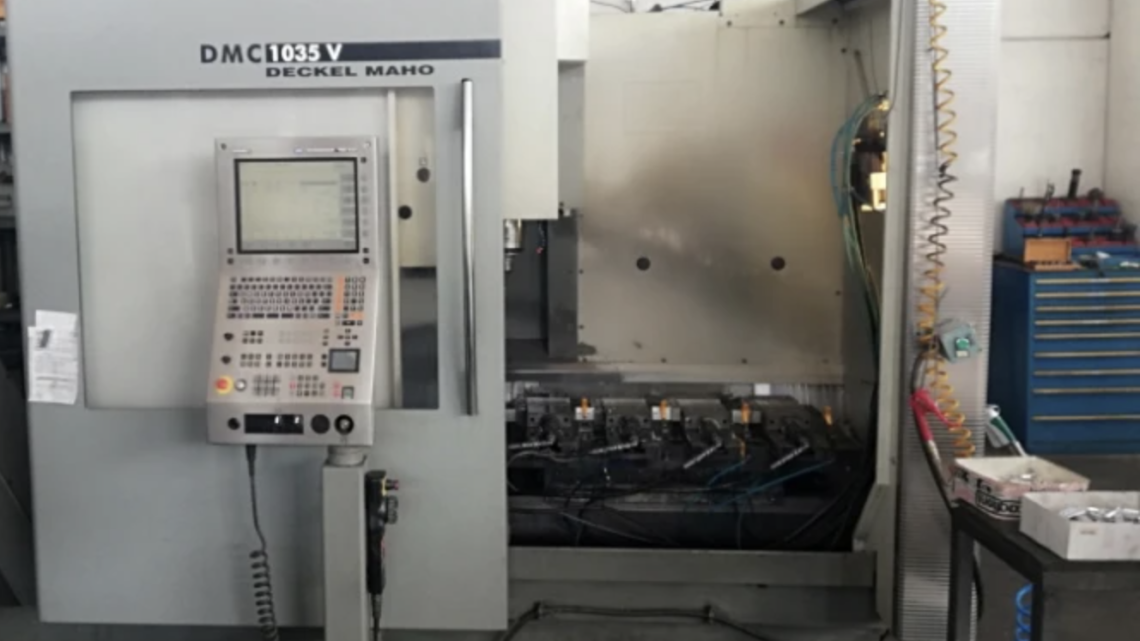
From Inspection to Installation: What to Verify Before Buying a Pre-Owned, Used, Secondhand, Surplus Deckel Maho DMC 1035 V CNC Vertical Machining Center made in Germany
Here is a detailed guide for what to check — from inspection through to installation — when buying a pre-owned/surplus Deckel Maho DMC 1035 V (Germany) vertical machining centre. Use it as a comprehensive checklist to avoid surprises and ensure you get a machine that will perform reliably in your shop (e.g., in your country).
(Note: some specs vary by configuration/age — so always verify the actual machine you are looking at.)
Key Specifications (for reference)
- X-axis travel approx. 1 035 mm (≈ 40.7″) for many units.
- Y-axis travel in the order of 500–600 mm (≈ 20–22″) for many machines.
- Z-axis travel approx. 510 mm (≈ 20.1″) in many examples.
- Table size examples: ~1 200 × 560 mm (≈ 47″ × 22″) in one listing.
- Spindle speed options: e.g., 8,000 rpm, 10,000 rpm or even 12,000 rpm in some units.
- Control systems: e.g., Siemens 840D in one unit.
Knowing these typical specs helps you confirm that a machine actually matches the claimed model and configuration.
Pre-Purchase / Inspection Checklist
1. Identity & Documentation
- Confirm the exact model number is “DMC 1035 V” (or variant), not a different size/model.
- Check serial number, year of manufacture, and original configuration sheet.
- Ensure documentation is complete: manuals (mechanical, electrical, control), wiring diagrams, parts lists.
- Ask for a maintenance/service history: hours of use, what types of work it did (heavy duty vs light duty).
- Check if any modifications or retrofits have been done (control upgrades, spindle change, automation).
- Verify the machine’s last operating environment: Was it used in clean environment? Was it idle for long time?
2. Structural & Mechanical Condition
- Bed/column/structure: Inspect the machine’s main frame for signs of damage/cracks/repair, check the geometry hasn’t been compromised.
- Guideways and ball screws: Check for wear, play, scoring, corrosion. On a machine like this that may have seen significant use, guideway condition is critical.
- Table: Inspect table surface, T-slots for wear or damage. Check flatness. The example listing shows table max part weight ~1,000 kg.
- Spindle assembly: Check for run-out, noise, vibration. Verify spindle bearings. If spindle speed is high (8,000–12,000 rpm) then condition is even more critical.
- Opening/Travel moves: Manually jog axes (X, Y, Z) if possible, check for smoothness, no binding, no unusual noise or vibration.
- Hydraulics/Pneumatics: If machine uses hydraulic systems (e.g., for tool clamps, coolant systems) check for leaks, fluid condition, maintenance.
- Electrical cabinet / wiring: Check for burnt wires, overheating signs, cleanliness. Exposure to coolant mist can degrade electronics.
- Tool magazine / ATC (Automatic Tool Changer): If equipped, inspect for wear, proper indexing, any missed tool changes or errors.
3. Operational & Accuracy Testing
- If possible, ask to run the machine with a test piece or witness it under power. Check actual machining performance: feed rates, cycle time, surface finish, accuracy.
- Check axis repeatability and backlash. On long travels (X ~1,000 mm) any wear will show up.
- Perform a spindle run-out test with a dial indicator if you have access.
- Check for thermal drift: run the machine for some time, then check accuracy again.
- Review tooling history: were high-speed cuttings, heavy cuts, or light finishing work the main use? The heavier usage leads to greater wear.
- Inspect chip conveyor/coolant condition: Build-up of chips or poor coolant cleanliness can signal neglected maintenance.
4. Spare Parts, Technical Support & Documentation
- Confirm availability of spare parts for the brand (Deckel Maho/DMG Mori) in Europe/ your country. Older machines may have parts with long lead times.
- Check if any major components have been replaced (e.g., spindle bearings, ball screws). If major components are near end-of-life you should factor in replacement cost.
- Ensure control system is supported (software updates, spare modules). If the machine has a rare old control version, support may be limited.
- Ask for tooling history and included accessories (are fixtures, tooling, probes included or not).
- Review compliance with local electrical/safety standards (e.g., CE marking). If the machine will be installed in your country, you may need to align with local requirements.
5. Usage History & Risk Factors
- How many hours has the machine been run? Are the hours verified? Idle machines may still require refurbishment (seals dried out, lubricant degraded).
- What type of work was it doing: heavy structural/mold work or light finishing? Heavy usage may mean greater wear.
- Has the machine ever been involved in a collision or accident (tool crash, spindle crash)? This may affect geometry.
- Check storage condition: If it has been idle for a long time, was it stored properly (protected from moisture, dust, etc.).
- Understand any retrofit or upgrade cost: If control is obsolete or parts rare, plan for upgrade/modernization.
Installation & Site Preparation Checklist
1. Site Readiness
- Foundation & Floor Load: Validate that your building floor in Bursa (or wherever installation) can support the machine weight (which may be several tonnes). For example one listing shows machine weight ~5,860 kg.
- Footprint & Clearance: Ensure you have enough space for the machine footprint + workpiece handling + tooling access + maintenance space. Example dimensions: ~4,600 mm × 3,600 mm × 2,500 mm.
- Power Supply: Confirm you have correct voltage, phase, kVA, frequency, and electrical infrastructure for the machine.
- Cooling / Chip Removal / Ventilation: Ensure you have proper coolant chiller or water supply if needed, chip conveyor / disposal, extraction of mist or coolant fumes if required.
- Access & Delivery: Check that you can deliver the machine physically: doorways, crane or forklift capacity, unloading area, rigging path.
- Environmental Conditions: Stable temperature, minimal vibration environment, level surface. Avoid areas with excessive humidity or dust.
- Safety & Guarding: Ensure you meet local safety regulations: guarding, emergency stop, interlocks, CE compliance if applicable.
2. Installation & Commissioning
- Machine Placement: Use precise levelling and alignment to ensure machine foundation and mounting bolts are correct.
- Anchor & Grouting: If required, anchor bolts + grout to secure machine base to foundation; helps in vibration damping and accuracy.
- Alignment Checks Post-Installation: Verify X/Y/Z axis alignment, table flatness, spindle nose to table parallelism, etc.
- Power-Up & Test Run: Run machine without load first; check all axes; then load a test piece and verify performance under operation.
- Coolant & Chip Systems: Test coolant flow, filtration, chip conveyor, waste disposal. Ensure no leaks, smooth operation.
- Safety Systems Test: Check guards, doors, interlocks, emergency stops, operator safety features.
- Training & Documentation Handover: Operators and maintenance staff should be trained; have updated documentation; create maintenance schedule.
3. Post-Installation Baseline & Maintenance
- Record baseline machine condition: table flatness, spindle run-out, axis backlash. These can be used as future comparison to monitor wear.
- Establish maintenance plan: regular lubrication, check ball screws, way wipers, coolant maintenance, filter changes.
- Ensure inventory of critical spares: e.g., way wipers, spindle seals, filters, ball screw glands.
- Monitor machine performance over first few weeks: check whether it meets production tolerances and cycle times.
Summary & Decision Checklist
Before committing to purchase, check and answer the following:
- ✅ Does the machine’s specification (travel, spindle speed, table size, tool capacity, control type) meet your production requirements?
- ✅ Has the machine’s condition (structural, spindle, guideways, control) been thoroughly verified?
- ✅ Are spare parts, support and documentation assured for the machine in your region?
- ✅ Is your installation site ready (floor, space, power, environment) to accept this machine without major modifications or hidden costs?
- ✅ Have you budgeted for transport/shipping, installation, alignment, and any refurbishment required?
- ✅ Do you understand the risk of purchasing a used machine (potential wear, unknown history) and accept the condition as is?
- ✅ Do you have a trial or inspection opportunity to witness the machine under power if possible?