23/10/2025
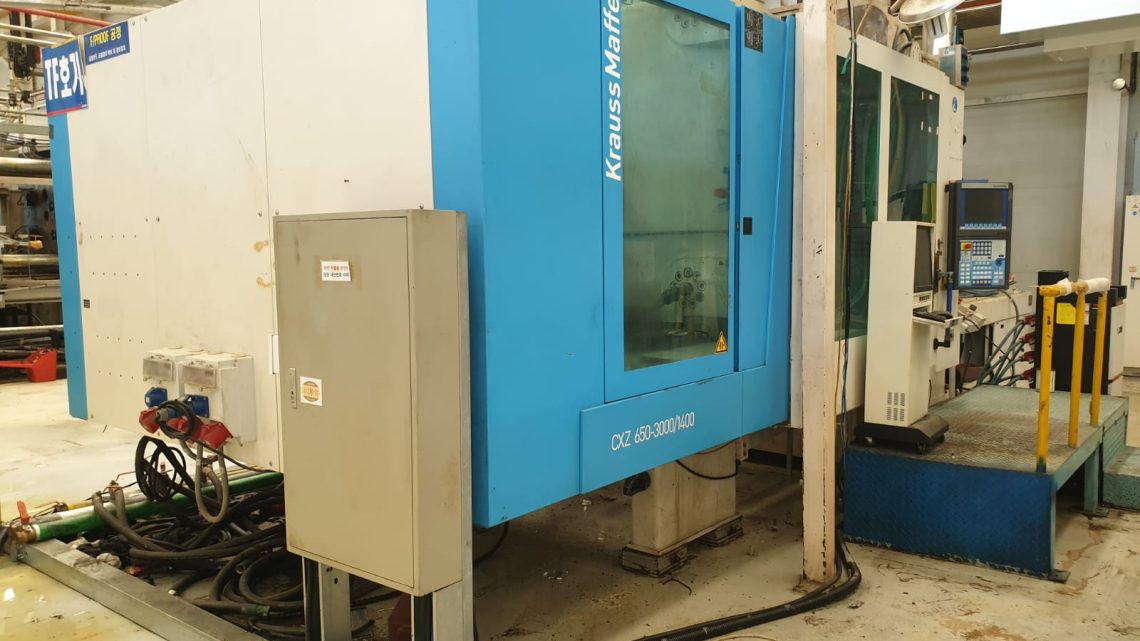
From Inspection to Installation: What to Verify Before Buying a Pre-Owned, Used, Secondhand, Surplus KRAUSS MAFFEI CXZ 650-3000/1400 Injection Moulding Machine made in Germany
If you’re considering buying a used (pre-owned, secondhand, surplus) Krauss Maffei CXZ 650-3000/1400 injection moulding machine, here is a comprehensive inspection-to-installation checklist tailored to this model. It covers everything from verifying specification, assessing condition, and preparing for site installation — especially useful if you’ll bring it into your country or a similar market.
1. Verify Machine Identity & Specification
- Confirm the machine is indeed model CXZ 650-3000/1400 (650 ton clamping force, injection unit designation “3000/1400”, etc). Listings show this model: “650-Ton, Krauss Maffei #650-3000/1400CXZ … Year: 2010”.
- Check manufacture year, serial number, original configuration (single-shot or 2-shot/multi-component version). For instance one listing notes “two shot (2k)” for this model.
- Confirm the build origin: Krauss Maffei is a German manufacturer; verify machine import documentation if applicable. As per product overview: CX series (500-4 200 kN) manufactured by Krauss Maffei in Germany.
- Review original spec sheet: platen size, tie-bar spacing, mould height capacity, injection screw diameter, injection pressure, shot size etc. For example: for a similar 650-ton model: screw diameter ~80 mm, shot weight ~1 170 g PS etc.
- Check if the machine includes auxiliary features: e.g., multi-component (2K) moulding, robot interface, automation integration. One listing mentions “Robot interface” for this model.
- Confirm whether it uses hydraulic, servo-hydraulic drive or hybrid, and check what version of control system is installed (Krauss Maffei’s smartControl MC6 etc).
2. Mechanical & Structural Condition Inspection
- Clamping unit: Check platen surfaces for wear, scratches, parallelism, tie-bar spacing (H × V), tie-bar condition (no bent or scored bars).
- Mould mounting surface: Check for damage, mounting holes integrity, platen flatness.
- Opening/closing mechanisms: Verify smooth operation of movable platen, no unusual noise, ensure the ejection stroke and mould opening stroke operate to spec.
- Injection unit: Check screw/barrel condition (wear, scoring, corrosion), injection pressure system (hydraulic pump, servo pump if present), injection check valves, nozzle alignment, and whether injection stroke is smooth.
- Hydraulic system & oil quality: Inspect hydraulic power pack, look for leaks, oil contamination, filter history, ensure hydraulic oil meets proper cleanliness level.
- Electrical & control cabinet: Check wiring for signs of overheating, burnt marks; inspect drives, motors, relays, control panel. Verify that the installed control system is functioning and up-to-date.
- Automation / robot interface: If machine was used with robotic pick-and-place or 2-shot, inspect robot interface points, safety interlocks, peripheral integration.
- Frame and foundation: Large 650 ton unit will have significant mass—inspect for frame distortions, cracks, or prior collision damage (especially relevant if it is a 2-shot machine with extra components).
- Shot count / hour meter: Ask for total operating hours, cycle counts, day/hour usage. Higher hours = more wear. Examine maintenance records: have major items (screw, barrel, hydraulic pump) been replaced?
- Check for retrofits / upgrades: Determine if machine has had past retrofits (e.g., control system, energy-saving servo drives) and document them.
3. Performance & Accuracy Testing
- Request a trial run if possible: eject a sample mould run, check cycle times, repeatability, part quality, shot weight consistency.
- Measure injection stroke consistency, check shot to shot variation.
- Check platen parallelism, opening/closing accuracy, mould height consistency.
- Evaluate hydraulic system response: closing/opening speed, secure clamping force hold.
- Monitor machine during operation: listen for abnormal noises, vibrations, overheating in motors or hydraulic components.
- If available, examine previously collected performance data: scrap rate, downtime reasons, maintenance logs.
- For 2-shot capability (if present), inspect additional injection unit, rotating mould support or indexing mechanism for wear.
4. Spare Parts / Support / Documentation
- Ensure you receive full documentation: manuals (mechanical, hydraulic, electrical), spare parts list, wiring diagrams, control software/user manuals.
- Check availability of spare parts: some large German machines may have long lead times or high cost—verify local support in your region or via European distributors.
- Ask if critical components (screw/barrel, clamping unit bearings, servo/hydraulic pumps) have been recently replaced or will need replacement soon.
- Review service history: how often service was done, major repairs, any collisions or mould crash incidents.
- Confirm machine compliance with electrical/safety standards relevant in your country (CE? local certification?). If machine is older, determine if safety guards/coverings meet your country’s regulations.
5. Site Preparation & Installation Considerations
- Floor & foundation: A machine of 650 ton clamping force is heavy and will exert high static and dynamic loads—check floor load capacity, plan for anchor bolts, possibly machine base/grouting.
- Power supply: Confirm your facility in your country supports required voltage, phase, frequency, and kVA rating. Large injection machines may require high peak power for hydraulic pumps.
- Cooling system: Ensure factory or site has adequate cooling/water supply for mould temperature control, machine oil coolers, chiller units.
- Access & transport: Ensure crane/hoist or forklift capacity for unloading, placement, handling of machine. Consider dimensions/clearance of machine into building, route must support safe delivery.
- Environmental conditions: Temperature control, ventilation, dust control—especially if moulding specialty polymers sensitive to environment.
- Installation alignment & commissioning: After placement, level machine, anchor, check platen alignment, tie-bar spacing, test hydraulics, control system, and run initial trial runs.
- Mould interface & tooling: Check that mould height, size, tonnage fit your production needs; prepare tooling fixtures, robot or automation interface if required.
- Safety & guarding: Ensure all safety guards, mould changing platforms, interlocks, emergency stops, doors are in place and compliant. If machine used previously in another jurisdiction, some guards may need updating for your country.
- Operator training & maintenance plan: Plan for training of operators and maintenance personnel, set up preventive maintenance schedule (hydraulic oil change, filters, check screws/barrel etc).
6. Cost-Breakdown & Risk Assessment
- Estimate transportation + installation cost (including overseas shipping if imported, customs, VAT, handling, alignment).
- Budget for refurbishment/overhaul—used machines may need screw/barrel replacement, hydraulic pump rebuilds, major service, updating control system.
- Evaluate downtime risk: How readily parts can be sourced, how easily support is available locally.
- Consider logistic delays: if part needs shipping international, machine downtime may impact production.
- Assess return on investment (ROI): Given age, condition, expected life remaining, does this machine meet your production requirements (cycle time, product quality, part size/weight, shots per hour).
- Understand the seller’s guarantee or “as-is” condition: Used machines often sold “as is,” so inspect thoroughly and negotiate price accordingly.
Summary: Decision Checklist
Before you commit to purchasing the used Krauss Maffei CXZ 650-3000/1400, ask yourself:
- Does the machine’s specification (650 ton, shot size, platen size, 2-shot capability if needed) align with your product/market requirements?
- Is the machine structurally in good condition (clamping unit, injection unit, hydraulics, tie‐bars) such that major rebuild costs are not imminent?
- Are spare parts, technical support and documentation accessible (especially for Germany-built Krauss Maffei machines) in your region?
- Is your site ready (floor, power, cooling, access) to take on this machine without major extra cost?
- Are you comfortable with the risk of used machine purchase (potential hidden wear, downtime, refurbishment) and have budgeted accordingly?
- Do you have a plan for installation, commissioning, testing and training ready?