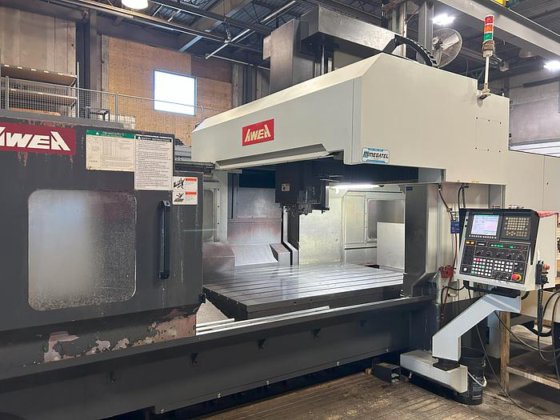
From Inspection to Installation: What to Verify Before Buying a Pre-Owned, Used, Secondhand, Surplus Awea SP-2016 CNC Bridge / Double-Column Vertical Machining Center made in Taiwan
Here is a comprehensive inspection-to-installation checklist in English, tailored specifically for the AWEA SP-2016 bridge (double-column) vertical machining centre (made in Taiwan). It guides you through what to verify before purchase, on-site inspection, transportation/logistics, installation/commissioning, and after-installation sustainability. This will help you minimise risk and ensure that the machine is a good fit for your business (such as your second-hand machinery portal/platform).
1. Pre-Purchase / Seller Due-Diligence
Before committing (visiting the machine or placing payment), gather and verify the following with the seller:
a. Machine identity & history
- Confirm exact model: SP-2016 (bridge/double-column type) and manufacturer AWEA. The spec sheet lists X-axis travel 2,100 mm, Y-axis 1,600 mm and Z-axis 760 mm.
- Serial number, year of manufacture (check for service life/hours used).
- Control system: which CNC (e.g., Fanuc, Mitsubishi) and version. For example listing: Fanuc 0i-MF.
- Spindle type and tool-holder interface: For example BT50 (ISO50) is standard in one spec.
- Table size, load capacity, distance between columns: For SP-2016: Table size approx 2,310 × 1,500 mm; load capacity approx 8,000 kg; distance between columns 1,700 mm.
- Documentation: electrical drawings, manuals, maintenance logs, spare-parts list.
- Check if there have been major modifications or repairs (e.g., head rebuild, column straightening, control retrofit).
- Verify export/import compatibility for your country : thinking about voltage, frequency, customs duties, shipping.
b. Suitability for your requirements
- Confirm the work envelope (X/Y/Z) suits your expected work-pieces. For example SP-2016 gives large capacity, suitable for heavy work.
- Ensure spindle speed, tool-changer capacity, and structural rigidity match your workload (moulds, large aerospace parts, etc).
- Check whether linear guideways, box ways or roller types are used for axes (impact on precision & wear). For example: “Super rigid roller type linear guide ways on X and Y; Z-axis is box way.”
- Spare-parts availability in your region , brand reputation and support for AWEA machines.
- Physical installation constraints: floor load capacity, ceiling height, electrical supply, crane access.
- If you plan to resell via your portal (like CNCBUL), check market demand for this model.
c. Request detailed photos/videos
- General exterior: columns, bridge/gantry, table, overall condition.
- Table top & T-slots: any gouges, corrosion, repairs.
- Spindle nose and tool interface: signs of wear, damage, tapered seat condition.
- Control panel and electronics cabinet: wiring, cleanliness, any burn marks.
- Chip conveyor / coolant tank / lubrication system: condition, presence of sludge or rust.
- Running demonstration video if possible: axes moving, tool change cycle, spindle running (listen for noise/vibration).
- Floor/installation area: is machine anchored, level, any signs of past lifting or relocation.
d. Ask key questions
- What material(s) was the machine used to work? (Steel, castings, aluminium, etc)
- Has the machine ever had any crash (table vs bridge, spindle head vs column)?
- When were spindle bearings last replaced (if at all)?
- Are any axes showing excessive backlash or play?
- Is the ATC (automatic tool-changer) functioning fully? How many tools?
- Are all accessories present: coolant system, chip conveyor, guarding, maintenance records?
- Why is the machine being sold (upgrade, plant shutdown, relocation)?
- Are there any unresolved electrical or mechanical faults?
2. On-Site Inspection & Functional Test
Once on-site with the machine, run through this structured checklist:
a. Visual / Structural inspection
- Table top: inspect for deep gouges, wear in T-slots, corrosion marks. Large repairs or welding on the table surface are red flags.
- Columns and bridge/gantry: look for straightness, bends, signs of repair, cracks.
- Distance between columns should match spec (approx 1,700 mm for SP-2016).
- Way covers: Are they intact? Worn or missing covers allow chip/coolant ingress leading to accelerated wear.
- Any hydraulic/pneumatic leakage around head, ATC, chip conveyor?
- Machine environment: is the floor level and sound? Is there evidence of machine being moved or lifted irregularly?
- Electrical cabinet: open door and inspect wiring, any burnt marks, cleanliness, labelling.
- Coolant system & tank: is there sludge, rust, missing cover or open reservoir?
b. Spindle & tool interface
- Insert a clean tool holder in the spindle taper. Check for proper contact, no chattering, no visible pitting in the taper.
- Run the spindle (if allowed): listen for unusual noise or vibration; check for heating.
- Tool-changer: pick tool and drop tool cycle. Check for missed picks, alignment issues, slow cycle.
- Spindle speed and motor specs vs spec sheet: SP-2016 lists spindle speed 6,000 rpm standard, BT50 taper.
- Check draw-bar, tool retention system for play or wear.
c. Axis movement, backlash & accuracy
- Move each axis (X, Y, Z) full travel. Feel for smoothness, any binding or jerky motion near limits.
- Check for axis backlash: e.g., move table forward/backward small amounts, see if there is measurable delay.
- If possible, run a test cycle: e.g., a simple face-milling or pocket and measure dimensions to assess real accuracy.
- Measure table travel: e.g., X ≈ 2,100 mm, Y ≈ 1,600 mm, Z ≈ 760 mm per spec.
- Check for uniform rapid traverse speed (e.g., rapid feedrates specified as 20,000 mm/min for X/Y).
- Check lubrication system: way lubrication, Z-axis box way lubrication, ensure wipers and seals are present.
d. Control system & electronics
- Power up the machine. Check CNC control (e.g., Fanuc), verify home/limit switch functionality.
- Ensure operator panel buttons, touchscreen (if any) are responsive and not worn out.
- Check servo drives and motors: look for overheating, error logs, history of faults (if accessible).
- Inspect electrical wiring condition inside cabinet: no melted insulation, dust build-up, rusted terminals.
- Coolant and chip management: check the pump runs, chip conveyor works, no unknown noises.
- Safety systems: emergency stop button works, guards interlocked, doors close properly.
e. Accessories, set-up & logistical readiness
- Verify presence and condition of chip conveyor, coolant system, guarding, fixtures, tooling (if included).
- Check table load specification: For SP-2016, table load capacity approx 8,000 kg.
- Assess physical installation readiness: check the footprint, access for rigging/crane, clearances for moving axes, overhead height.
- Check floor loading: machine weight for SP-2016 approx 19,000 kg.
- Ask for condition of relocation (if previously moved): Was the machine partially disassembled? Are parts missing?
- Negotiate documentation of how the machine will be shut down, cleaned, prepared for transport.
3. Logistics & Transport Planning
Once you decide to buy, plan the transport and installation as follows:
- Confirm machine location and transport method (domestic export/import). For Turkey, consider freight, customs, VAT, duties.
- Note machine weight and dimensions: e.g., for SP-2016 weight ~19,000 kg, footprint approximate length ~6,690 mm, width ~4,160 mm.
- Ensure the destination building floor capacity can support the machine (including dynamic load during operation).
- Plan rigging/disassembly: Often bridge-type machines need lifting of bridge or head for transport; machine must travel in safe configuration.
- Prepare for foundation/grouting: Bridge machines often require solid foundation, may need anchor bolts or concrete pad.
- Arrange electrical supply preparation: Check voltage, phase, frequency compatibility with Turkish supply (e.g., 380–400 V, 50 Hz).
- Plan for coolant/hydraulic fluid drain or flushing during transport to avoid leakage.
- Obtain transport insurance covering damage in transit.
- Schedule arrival, unloading, positioning and storage (if there is delay before installation).
4. Installation & Commissioning
After delivery, ensure properly setting up the machine so it performs as expected:
a. Foundation & alignment
- Set machine on level foundation/pad; perform grouting or bolting as required.
- Perform machine geometry checks: bed level, column perpendicular to table, bridge alignment.
- Verify spindle centre height, head tilt/rotation (if applicable) and table alignment.
- Run a set of test cuts to verify accuracy (dimensional consistency, repeatability).
- Establish baseline performance: For example, repeatability spec for SP-2016 is ± 0.003 mm.
- Install/verify ancillary services: air supply (5-8 kg/cm²), hydraulic unit (if applicable), coolant system (tank size 420 litres spec).
b. Conditioning & “run-in”
- Replace fluids: coolant, hydraulic oil, lubrication oil (used machines often benefit from fresh fluids).
- Clean way covers, wipe sliding surfaces, check lubrication paths.
- Run machine without load for several hours to verify smooth operation, heating/temperature rise, no abnormal noises.
- Gradually load machine with real cutting workload after initial checks, monitor performance.
- Calibrate measuring systems if machine has linear scales or sensors.
c. Control system & production readiness
- Load control program and test all axes, interlocks, ATC cycle, safety system.
- Train operators and maintenance staff on machine specifics, including maintenance schedule.
- Produce first parts, check tolerances, surface finish. If not meeting expected spec, adjust/troubleshoot.
- Establish operational procedures: tool magazine management, coolant replacement intervals, chip evacuation, preventive maintenance.
5. After-Installation Monitoring & Sustainability
To maximise value and longevity of your investment:
- Track machine utilisation: uptime vs downtime, scrap rate, operator setup time.
- Perform periodic checks on spindle vibration/temperature to detect bearing wear early.
- Maintain a documented maintenance log: lubrication schedule, way cover replacement, spindle inspection.
- Keep spare parts inventory for known wear-items: e.g., way wipers, coolant pump, tool-changer components.
- Review cost of consumables: coolant, tooling, electricity—compare expected vs actual.
- Consider future upgrades/retrofits: many older bridge machines can benefit from new control, automation, monitoring systems.
- Preserve machine condition: keep area clean, programme preventive shutdowns, maintain alignment and lubrication.
6. Summary Quick-Check Table
Here’s a quick summary you can use on-site or print out:
| Item | Acceptable / OK | Notes |
|---|---|---|
| Model & Serial check | SP-2016, AWEA, serial present | |
| Work envelope matches spec | ~X 2,100 mm / Y 1,600 mm / Z 760 mm | |
| Table size & capacity | ~2,310 × 1,500 mm / ~8,000 kg | |
| Distance between columns | ~1,700 mm | |
| Spindle taper & speed | BT50, ~6,000 rpm standard | |
| Table top condition | No deep gouges/corrosion | |
| Bridge/column structure | No major repairs/cracks | |
| Way covers condition | No missing covers or large openings | |
| Spindle/ATC operation | Smooth, no unusual noise, tool change works | |
| Axis movement & backlash | Smooth motion, minimal play | |
| Control & electronics condition | Clean wiring, control panel good | |
| Accessories present | Chip conveyor, coolant tank, fixtures | |
| Transport/installation readiness | Floor, crane access, power supply ok | |
| Foundation & alignment plan | Verified, pad prepped | |
| First parts test | Meets tolerances, surface quality ok |