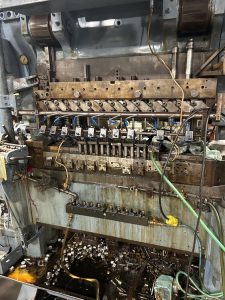
From Factory Floor to Your Workshop: Evaluating a Pre-Owned , Used , Secondhand, Surplus CNC Machines Before Purchase VDF BOEHRINGER DUS 560 made in Germany
Here’s a detailed, field-tested guide for evaluating a pre-owned / surplus VDF Boehringer DUS 560 (or DUS 560 Ti) universal / CNC turning center (Germany origin). Use this as your “from factory floor to workshop” inspection roadmap, combined with reference specs to benchmark claims and spot red flags.
1. Reference Specs & Model Context (What to Expect)
Before you walk into the shop, having an expected spec envelope helps you identify overclaims. Here’s what I found for the DUS 560 / DUS 560 Ti / DUS series units:
| Parameter | Typical / Published Value | Notes / Sources |
|---|---|---|
| Swing over bed | ~ 570 mm (22.4 in) | Multiple dealer listings: Swing over bed Ø 570 mm” for DUS 560 Ti units |
| Swing over cross slide | ~ 365 mm | Dealer listing: “Swing over cross slide Ø 365 mm |
| Turning length (DBC / between centers) | Typically 2,000 mm | Standard DUS 560 Ti listing shows “DBC Turning Length 2000 mm |
| Spindle bore | 62 mm | Many seller listings for DUS 560 use 62 mm bore specification |
| Spindle speed / range / gears | Up to ~ 2,500 rpm, with gearing steps | Multiple sources: “Total speed range (min-1) 5-2500, 2 gear steps” for standard versions DUS 560 Ti listing: speed up to 2,500 rpm |
| Spindle power / torque | ~ 25 kW, torque up to ~1,800 Nm (in some models) | Some DUS 560 Ti units list 25 kW power; older versions list drive power 25 kW, torque 1,800 Nm in spec sheets |
| Tool turret | 8-station, tool size compatible with DIN 69880 / Ø50 etc. | A listing for DUS 560 Ti shows an 8-station SAUTER turret, DIN 69880 tool holders Ø50 |
| Tailstock / quill | Quill Ø 100 mm, quill stroke ~ 190 mm (MK 5 taper) | The DUS 560 Ti listing shows quill diameter 100 mm, stroke 190 mm, taper MK5 |
| Feed / traverse / rapid speeds | X feed up to ~5,000 mm/min; Z feed / rapid greater (e.g. 10,000 mm/min) in many listings | Some sources show feed/traverse speeds: e.g. “Feed rate X = 5,000 mm/min” in DUS 560 Ti listing |
| Workpiece capacity / stability | With steady rests / tailstock possibility up to 1,600 kg between centers in some configurations | The DUS series literature indicates machines that can handle large lengths (1,000–8,000 mm or more) with swings from 420 to 1,500 mm and workpiece weights up to high tons in heavy versions. |
| Structure / control | Heavy, rigid box-bed design; control options include Siemens 840D sl ShopTurn, optionally Heidenhain Manualplus 620 etc. |
These values are your “benchmark.” If a seller claims much higher travel, rpm, or power without proof, push for validation.
Also note that VDF / Boehringer DUS series are often marketed as universal turning machines with flexibility for manual, cyclic, or full CNC operation.
2. Pre-Screening & Document Request (Before Visiting)
Before going to the site, gather as much documentation and preliminary info as possible:
- Clear nameplate photos (both mechanical frame and electrical / control cabinets)
- Specification sheet / manual / parts catalog for that exact DUS 560 variant
- Control system details: which CNC (Siemens 840D sl, ShopTurn, or other), software version, backups
- Usage history: total hours, cutting / loaded hours vs idle
- Maintenance / repair records: spindle rebuilds, guide rework, turret repairs
- List of accessories / tooling / spares included (steady rests, tailstock, chucks, tool holders)
- Photos / video of machine in operation: axis motion, spindle rotation, tool turret indexing
- Reason for sale (upgrade, idle, fault)
- Shop environment: dust, coolant type, chip management, vibrations
- Layout / rigging constraints: footprint, machine weight, removal path, foundation
If the seller is evasive or cannot produce many of these, consider it a warning.
3. On-Site Inspection & Mechanical Assessment
Bring measuring tools (dial indicators, test bars, micrometers) and ideally a machinist or lathe specialist. Follow a structured inspection order:
3.1 Visual & External Structure
- Inspect the bed, base, box casting, bed rails for cracks, weld repairs, distortions
- Check guideways / linear slides / cross slides (X, Z axes) for pitting, corrosion, scoring, wear
- Examine way covers, guards, bellows—tears, missing covers, poorly fitted covers are red flags
- Inspect spindle head, spindle nose, spindle bearings’ housing for signs of repair, cracks, misalignment
- Inspect turret / tool changer face, indexing faces, tool mounting surfaces
- Check wiring, conduits, cable carriers, connection points for patched wiring, insulation damage
- Look around coolant / lubrication systems for leaks, dried coolant crust, seal failure
- Examine tailstock, quill, and steady rests if included
If safe, gently jog axes to feel for binding or rough spots.
3.2 Kinematics, Backlash & Motion Testing
- Move axes (X, Z) slowly over full travel to feel for smoothness or “notchiness”
- Use dial indicators to measure backlash / lost motion for each axis (push-pull) at multiple points
- Reverse direction near travel endpoints to detect hysteresis / deadband
- Inspect ball screws / nuts / couplings / links for looseness or wear
- Perform slow feed moves and observe consistency (no jumps, stutters)
- Index turret or tool change multiple times to check repeatability, hesitation, or mis-index
3.3 Spindle & Tooling Inspection
- Run the spindle (if safe) at different RPM speeds; listen for bearing noise, vibration
- Use a test bar + dial indicator to measure spindle runout at the nose and along length if possible
- Check acceleration / deceleration behavior
- Examine the spindle taper, seating surface, mounting faces for nicks or damage
- Operate the tool turret / tool changer: tool pick / placement, clamping, indexing accuracy
- If the machine has live tooling or driven axes (optional on DUS), test those if installed
3.4 Control / Electrical / Cabinet / Electronics
- Open control / electrical cabinets, examine wiring, relays, fuses, terminal strips
- Look for heat damage: discolored insulation, burnt connectors, melted parts
- Inspect servo drives, power modules, interface cards for damage or corrosion
- Check wiring routing, shielding, strain reliefs
- Power up: test switches, control panel, emergency stop, interlock functions
- Navigate CNC menus: inspect parameter sets, alarm logs, tool tables
- Test safety interlocks: opening doors, guard panels should disable motion
4. Operational / Load Testing & Test Cuts
If the seller allows, performing live machining under load is one of your strongest validation steps.
- Run a dry / air motion program: axes, turret moves, tool changes
- Execute a test cut (in appropriate material) to test surface finish, dimensional accuracy, chatter
- Run a sustained cycle (30 to 60 min) under moderate load; then recheck backlash, tolerances, offsets to detect thermal drift
- After warm-up, repeat earlier measurements (backlash, runout) to see if performance has degraded
- Cycle tool changes / turret indexing several times under load to test repeatability and reliability
5. Metrology & Precision Checks
- Use calibrated test bars, gauge blocks, or reference artifacts to check straightness, squareness, alignment of axes
- Perform repeatability / reversal tests: move to reference point, retract, return, measure divergence
- Inspect machined part for roundness, flatness, concentricity, tolerance adherence
- After extended running, re-measure key offsets, backlash, runout to detect drift
- Compare your measurements vs your part tolerances and vs benchmark values for the machine
6. Infrastructure, Installation & Practical Considerations
- Confirm whether your shop floor can support the machine’s weight and dynamic loads
- Verify rigging / crane / removal path, door width, ceilings, floor access
- Check your power supply (voltage, phase, capacity) matches the machine requirements
- Confirm coolant, lubrication, chip removal, ventilation, and maintenance access are adequate
- Plan for machine leveling, foundation, anchoring, alignment
- Ensure service access for swing areas, turret, control cabinet
- Ascertain spare parts availability (spindles, drives, turret modules, electronics) for VDF / DUS series machines
7. Decision Criteria, Red Flags & Negotiation Tactics
After inspection and tests, evaluate based on:
Good / acceptable signs:
- Measured travels, speeds, tolerances close to spec values
- Smooth motion, low backlash, consistent axis response
- Spindle runs quietly, minimal vibration, acceptable runout
- Turret / tool changer indexing is reliable, no mis-index
- Control & electronics are intact, no burnt damage
- Test cuts produce good surface quality and maintain dimensional integrity
- Performance stable after warm-up (minimal drift)
- Essential accessories (steady rests, tailstock, tooling) are included
Red flags / deal-breakers:
- Significant mismatch in claimed vs real spec (travel, rpm, power)
- Severe wear on ways, binding zones, inconsistent motion
- Spindle noise, chatter, excessive runout
- Tool changer mis-indexing, faulty arms, wear
- Burned components, damaged control boards, wiring faults
- Test cuts showing drift, chatter, large errors
- Performance degradation over runtime
- Obsolete or unavailable spare parts
- Seller refuses test runs, measurement, or offers no recourse
In negotiation, use any observed defects or deviations to demand discount, spares, or commitment to repair / warranty.