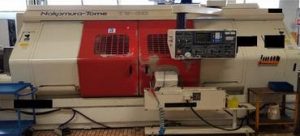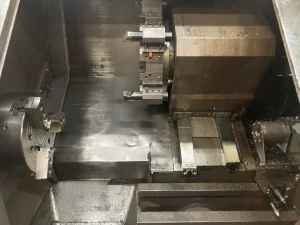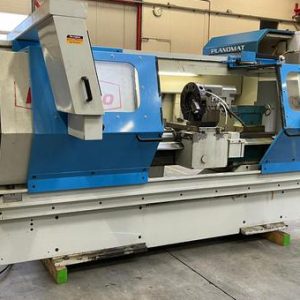
From Factory Floor to Your Workshop: Evaluating a Pre-Owned , Used , Secondhand, Surplus CNC Machines Before Purchase PINACHO MUSTANG 225 CNC Lathe made in Spain
Below is a tailored inspection & evaluation guide for a Pinacho Mustang 225 CNC lathe (Spain-made), with items specific to this model plus general CNC-lathe checks. Use it on site (or remotely via video/photos) before purchase to assess risks, costs, and whether it’s a viable investment.
Basic Specifications / Baseline Info (to verify)
Before or during inspection, collect and confirm these machine parameters so you know what “nominal” is, and where deviations may indicate wear:
| Parameter | Typical / published spec | Source & notes |
|---|---|---|
| Swing over bed | Ø 450 mm | |
| Swing over cross slide / saddle | Ø 260 mm | |
| Turning length between centers | 1,500 mm | |
| Spindle bore | 65 mm | |
| Max spindle speed | ~2,500 to 3,000 rpm (varies by variant) | |
| Spindle motor power | ~8 kW in many listings | |
| Tool turret | 8 stations (VDI style or equivalent) | |
| Tailstock quill / taper | MT-4, quill stroke ~115 mm in some specs | |
| Overall footprint & weight | ~3,400 × 1,800 × 1,900 mm; ~2,700 kg (some variation) | |
| Control type | Fagor (for many listings) – e.g. Fagor 8055 TC |
These specs form your baseline. During inspection, measure and compare to see how much deviation / wear exists.
Inspection & Testing Checklist (Model-Specific + General)
Use this as a guide during an in-person inspection (or request the seller to record video clearly showing these). Mark issues or deviations and estimate cost to correct them.
1. Documentation & History
- Request maintenance logs, repair records, parts replacements, downtime history.
- Ask about previous usage: what kinds of parts were machined, cycle times, duty cycles, coolant type (water soluble, oil, etc.).
- Get serial number, year, variant (sometimes Mustang 225 is similar to Mustang 200 series), configuration (turret type, tooling, options).
- Get copies of original manuals, schematics, electrical diagrams. Pinacho appears to publish or offer “Mustang 200 / 225” manuals.
- Check whether any major components have been replaced (spindle, ballscrews, turret, drives).
If documentation is missing or incomplete, your risk is elevated.
2. Visual / Structural Inspection
- Castings, bed, saddle, base: look for cracks, patches, weld repairs, distortion.
- Bed way surfaces: examine wear lines, scoring, corrosion, pitting.
- Guideway covers / way wipers / seals: check condition, damage, deformation.
- Turret / turret housing: inspect turret face, clamping surfaces, whether turret indexing appears sloppy or worn.
- Tailstock: check quill for straightness, smooth movement, absence of binding, and whether quill locks securely.
- Protective covers, panels, guards, chip shields: missing covers or open panels may indicate neglect or tampering.
- Coolant tank, piping, hoses: look for rust, sludge, leaks, corrosion.
- Chip handling (if any): conveyors, augers, chip pans—inspect condition, backed up debris, wear.
- Electrical cabinet housing: check for cleanliness, proper covers, dust ingress, corrosion, rust, signs of water damage.
Take detailed photos of all key areas for further review.
3. Control, Electronics & Wiring
- Power up the control: check for boot-up errors, warnings, alarms.
- Verify that operator panel, display, buttons, keyboard, MPG handwheels, and any pendants are fully functional.
- Inside electrical cabinet: inspect wiring insulation, connectors, discoloration (which may signal overheating), burned wires, cable routing, cable flex loops / drag chains.
- Inspect servo drives / amplifiers: look for signs of heat damage, broken LEDs or modules, cooling fans working, ventilation.
- Check grounding and shielding quality.
- Inspect control memory backups, software version, CNC parameter backups, availability of spare control boards or software license.
- If possible, load or simulate a simple program to see if the control is responsive / stable.
Problems in wiring or electronics can be costly to repair, especially in older machines.
4. Spindle & Bearings
- Run spindle at low speed, monitor noise, vibration, smoothness.
- Gradually ramp up to higher speeds, listen carefully for growls, squeaks, or vibrations.
- Let the spindle run for several minutes; feel for unusual heating (bearing hotspots).
- Check spindle runout (both taper and face) using a test bar and dial indicator.
- Check for axial / radial play in the spindle (use proper test jigs).
- If possible, measure vibration spectrums or use a vibration sensor.
- Check drawbar / retention system (if applicable) for proper operation and clamping force.
- Also verify the spindle bore (65 mm in many specs) is still within tolerance (i.e. no ovality or wear).
If the spindle bearings are worn (especially the main bearing), repair costs escalate fast.
5. Motion & Axis Systems (X & Z axes, turret indexing)
- Jog each axis (X and Z) through full travel in both directions at moderate speed; note any binding, jerking, stiction, or hesitation.
- Listen for noise: grinding, scraping, or metallic chatter.
- Use a high-precision dial indicator or gauge to measure backlash in each axis (in both directions). Compare to what the machine’s specification or what is acceptable for your work.
- Using a straight edge or granite bar over the bed / saddle, check for deviations in straightness or twist, especially in long traverse.
- Optionally, perform a ball-bar test or another dynamic calibration tool to quantify circularity errors, positional deviation, and combined motion error.
- Test turret indexing under no-load and light load: the turret should index cleanly and repeatably, without slop.
- If there is a live tool or driven tooling (if optional), test that as well.
- If the turret uses a drive or hydraulics to clamp, check clamping force consistency and hydraulics.
Axis wear, backlash, or irregular motion is common in used lathes — you need to see how far it can be corrected or whether parts need replacement.
6. Lubrication, Cooling, Hydraulics, Pneumatics
- Check the lubrication system: is it functional? Are oil flow paths clear? Are the pumps, filters, pressure sensors, and pipes intact?
- Inspect ways lubrication (if automatic) — verify that oil or grease is reaching all necessary points.
- Inspect the coolant system: pump(s), piping, nozzles, filters, hoses. Run coolant pump and check for leaks, flow, pressure, turbulence, and contamination/sludge.
- Inspect any hydraulic or pneumatic systems (if turret clamping or tailstock is hydraulically assisted): check for leaks, cylinder smoothness, pressure stability.
- Check air supply (if needed) and regulators, valves, and filtration.
- Verify chip flushing / coolant flushing nozzles and whether they are properly positioned and functional.
Failures in lubrication or coolant often lead to secondary damage (wear, overheating, corrosion).
7. Test Cuts & Dynamic / Load Testing
- If possible, run a test part (with material similar to what you will use) to exercise the full travel, turret, spindle, feed rates, depth of cut, and tool changes.
- Measure the part for dimensional accuracy, surface finish, repeatability, circularity, straightness, run-out, etc.
- Under motion, command circular interpolation, rapid traverse, and cross-axis motion to see how smoothly the machine behaves under dynamic load.
- Test several tool changes (turret indexing, tool change times) to ensure reliability.
- Let the machine run for an extended period and monitor thermal drift, repeatability over time, and consistency.
This is the “real-world” test — if it can’t hold tolerances under load, much else is academic.
8. Safety & Compliance
- Verify that emergency stop, interlocks, guards, covers, safety shields are present and functional.
- Check door switches, limit switches for axes, overtravel protection.
- Ensure proper electrical safety: grounding, isolation, fuses, breakers, compliance with local codes.
- Inspect signage, labels, and any safety barriers.
Safety risks or non-compliance may require modifications or legal costs.
9. Spare Parts, Tooling & Accessories
- What is included: chucks (3-jaw, 4-jaw), collets, faceplates, steady/rest, tooling holders, cutting tools.
- Are spare parts (gears, belts, sensors, switches, motors) available or included?
- Optional accessories: steady rests, follow rests, bar feeders, collet chucks, live tooling, coolant or chip removal systems.
- Does the seller offer schematic drawings or exploded views for parts ordering?
- Are replacement parts for this model still manufactured or in aftermarket catalogs?
The more included tooling and spares you get, the lower your risk.
10. Installation, Utilities & Logistics
- Check electrical requirements: voltage, phase (3-phase, voltage level, current), whether your shop infrastructure matches or must be upgraded.
- Assess floor and foundation: can your floor support the ~2,700 kg machine plus dynamic loads?
- Route for transport: door widths, ceiling heights, crane or rigging access, clearances.
- Estimate cost for transport, unpacking, reassembly, leveling, anchoring, and commissioning.
- Cooling / air / compressed air infrastructure: verify your shop can support coolant requirements, chips disposal, air supply, drainage.
- Any site modifications or building work needed.
These “hidden costs” can often exceed the price difference between two similar machines.
11. Price Negotiation & Decision Criteria
- From your inspection findings, prepare a “repair / refurbishment estimate” (spindle bearing replacement, ballscrew / guide replacement, calibration, wiring repair, etc.).
- Establish a maximum “all-in” cost you are willing to pay (machine price + repairs + transport + installation) so your margins or capital outlay remain safe.
- Use defects you uncovered as negotiation leverage.
- If the seller refuses access to full inspection or test cuts, or hides critical areas, treat as red flags.
- Consider hiring an independent CNC inspection consultant to accompany you (or virtually observe).
- If repair costs or uncertainties are too high relative to the asking price, walk away.
Red Flags Specific to Pinacho Mustang 225 (and similar vintage CNC lathes)
- Spindle bearing noise or excessive heat at moderate rpm indicates nearing end-of-life.
- Excessive or uneven wear on the bed / ways — especially in long-turning lathes, wear is often nonuniform.
- Turret indexing issues, lost repeatability, worn turret face surfaces.
- Non-responsive or unstable control (Fagor in many units) or missing / corrupted software.
- Wiring harness deterioration (embrittled insulation, rodent damage, repaired sections).
- Coolant system blocked, sludge, leaks, corrosion — old coolant systems often show their neglect.
- Missing or nonfunctional lubrication system or failure to maintain oil flow.
- Large backlash or cumulative positioning error exceeding your tolerance budget even after compensation.
- Hidden repairs (e.g. cracked casting, weld repairs) not disclosed.
- Difficulty sourcing spares for obsolete or discontinued components (especially for control, drive modules, sensors).
- Seller unwilling to permit full motion tests or test cuts.
Example Walkthrough & What to Emphasize
As an example, imagine you go onsite and see:
- Bed ways show polished zones and minor scratching — acceptable wear.
- Spindle run shows slight vibration above 2,000 rpm, and after ~10 minutes, the spindle bearing area feels warm (but not burning).
- Axis motion appears smooth, but you measure ~0.02 mm backlash in Z and ~0.015 mm in X.
- Turret indexing is slightly delayed and occasional chatter is audible on indexing under light load.
- Coolant system has rust and sludge, hoses cracked, pump hums slightly.
- Electrical cabinet is dusty, some wires show discoloration.
- Test cut yields marginal tolerances (perhaps acceptable for some work, but not precision jobs).
Based on that, you’d estimate cost to refurbish the spindle and bearings, service coolant system, clean wiring, turret rebuild, and calibration. If that cost plus transport pushes you too close to the price of a newer machine, you may reject.