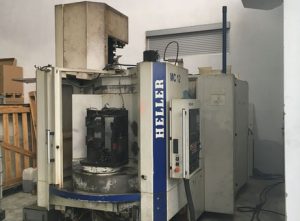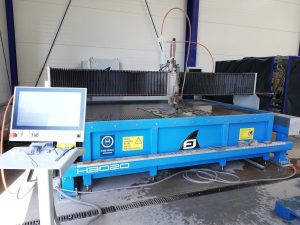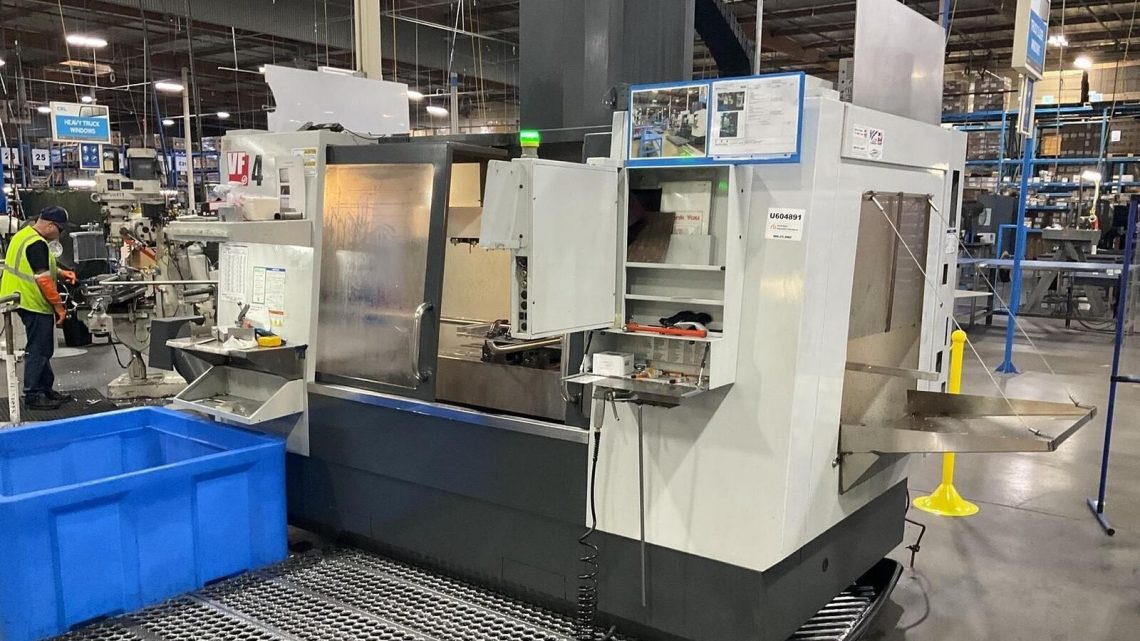
From Factory Floor to Your Workshop: Evaluating a Pre-Owned , Used , Secondhand, Surplus CNC Machines Before Purchase Haas VF-4 CNC Vertical Machining Center made in USA
Below is a structured framework and checklist you can use when evaluating a pre-owned / surplus Haas VF-4 (or similar VMC) before purchase. A VF-4 is a relatively large vertical machining center, so the stakes are high. The goal is to distinguish “what is a good deal you can fix vs. a money pit you should walk away from.”
Why it matters
Buying a used CNC is not just about the upfront cost — you need to factor in:
- Hidden wear (spindle bearings, ballscrews, guides, backlash, etc.)
- Parts availability and support
- Recalibration, alignment, and setup costs
- Transport, rigging, installation, leveling, and utilities
- Downtime, risk, and your ability to repair or replace components
A well-inspected machine can save you years of headaches.
Key Areas to Inspect / Test
Here’s a breakdown of the major systems, what to look for, and rough tolerances or red flags, especially for a Haas VF-4.
| System / Area | What to inspect / test | Tools / methods | Acceptable / warning thresholds | Notes / pitfalls |
|---|---|---|---|---|
| Documentation & history | * Maintenance logs, repair records, part replacements * Serial number, build date, configuration, options * Original manuals, electrical schematics, service bulletins | Review documents, talk with seller, request HFO records | Machines with consistent preventative maintenance and fewer major repairs are far more valuable. Many “cheap” machines fail because of neglect. | Some sellers may exaggerate “hours run.” Distinguish between control-on hours vs spindle-on hours. |
| Visual / walkaround inspection | * Exterior frame, castings, welds, cracks * Paint wear / local polishing on table or slideways * Way covers, guards, chips, rust or pitting * Missing covers, open panels, dangling wires * Cleanliness of the machine * Coolant tank, filtration, piping | Flashlight, mirror, borescope for hard-to-see areas, photos | Any crack, heavy rust or corrosion is a red flag. Slight cosmetic wear is expected. | A dirty or chip-ridden machine often signals that maintenance was neglected. |
| Spindle & bearings | * Run the spindle at various RPMs (low → high) and listen for noise, vibration * Let it run for several minutes, feel temperature (bearing heat) * Check spindle runout (taper and face) with test bar and dial indicator * Axial and radial play measurement | Test bar, indicator, temperature probes, vibration sensor | Runout ideally < a few microns; any noticeable play, growl, or heat is dangerous. | Spindle bearings are expensive to replace. If the spindle has been abused (collisions, over-speed), it’s a serious risk. |
| Axis motion, ballscrews & guides | * Move each axis through full travel both directions; listen for abnormal noise or binding * Check for backlash in each direction using a dial indicator * Use a straightedge or granite bar over guideways to feel deviations * Measure “flatness” or bow over the travel * Inspect ballscrew (nut wear, backlash zones) * Check for lubrication (grease, oil) and signs of starvation | Dial indicators, granite surfaces, feeler gauges, test cuts if possible | Backlash beyond what can be compensated is problematic; binding, noise, or stiff travel is a red flag. | Some backlash or wear can be adjusted or compensated, but extensive wear across the full travel may require component replacement. |
| Control, wiring, drives & electronics | * Power up the control; check for error codes, boot issues * Test all buttons, switches, keypads, display * Open electrical cabinet; inspect wiring, cleanliness, signs of overheating, burned wires * Check DC bus voltages, grounding, connectors * Servo drives, amplifiers, motor connectors * Inspect wiring harnesses (flex cables, drag chains) | Multimeter, infrared (IR) camera or thermometer, visual inspection | Any burnt wiring, unusual smells, or untraceable wiring is a red flag. | Replacing wiring harnesses or servo drives can be expensive. Ensure you can source replacements. |
| Hydraulics, pneumatics, coolant & lubrication systems | * Inspect hydraulic piping, hoses, cylinders for leaks or deterioration * Check coolant tank: look for sludge, rust, contamination * Test pump flow, pressure, filtration * Inspect lubrication pumps, lines, pressure, filters * Inspect air lines, regulators, solenoids, cleanliness | Pressure gauges, flow meters, visual inspection | Leaks, sludge, clogged filters, non-functioning pumps are warning signs. | The lubrication/coolant system is the “lifeblood” of the machine — failures here often lead to secondary damage. |
| Alignment & calibration | * Perform a ball-bar test or laser interferometry to quantify positional accuracy and backlash * Check squareness and orthogonality of axes * Check table flatness * Test a known part or test cut to verify tolerances * Check tool changer alignment (if equipped) * Check axis straightness, pitch error | Ball-bar, laser interferometer, precision gage blocks, test part, square, dial indicator | If the machine cannot meet specs (for your intended work), it’s nearly worthless. | Realignment or retrofit services can be expensive — determine if the seller includes an alignment/rehab. |
| Dynamic tests / stress test | * Run the machine at full rapids across full range; listen/hear for inconsistencies * Command circular interpolation (large diameter) to spot axis errors under motion * Do a “spindle-up and hold” for a while; monitor temperatures * Do several tool changes (if equipped) and see if any errors occur * Run it under load (milling a test piece) if possible | CNC control, cutters, stocks, coolant, instrumentation | Inconsistent motion, vibration, chatter, tool change errors, thermal drift are red flags. | These dynamic tests often reveal issues that static inspections miss. |
| Spare parts, tooling & accessories | * What tooling (collets, holders, fixtures) comes with it? * Are any spare parts (guides, belts, covers, sensors) included? * Check for optional systems: 4th axis, probing, high-pressure coolant, tool setter, pallet system, etc. * Are software backups, license keys, control media included? | Inventory review, photos, lists | The more included extras and spares, the better. Missing parts can cost you dearly to source later. | For a Haas, note whether options (like high-pressure coolant, chip conveyors, 4th axis) are present and working. |
| Utilities, installation & costs | * Confirm electrical requirements (voltage, phases, power draw) and compatibility with your shop * Check foundation, floor capacity, crane / rigging requirements * Transport cost, teardown, reassembly, leveling, calibration * Cooling, chiller, compressed air, drainage * Safety systems, enclosures, guarding, chip removal | Review drawings, specs, ask seller, engineering site visit | If the machine requires major site upgrades, that can blow up your budget. | Always “walk the route” from current location to your shop — tight doors, low ceilings, etc. |
| Price negotiation & “walk-away” criteria | * Calculate an allowance for repairs, calibration, parts in your offer * Have a “not-to-exceed” threshold based on your worst-case scenario * Demand video evidence or live demo before finalizing * If the seller refuses inspection or hides areas — consider that a red flag * Prefer a hiring of a third-party inspector (not tied to seller) | Use your inspection notes and cost estimates | If the cost to bring the machine to full accuracy and reliability exceeds too much of your margin, skip it. | Many “cheap” machines get sold because the current owner knows it has hidden faults. |
Specific Points for Haas VF-4 / VF / VM Series
Because you’re considering a Haas VF-4, here are additional items you should check, based on Haas’s own published documentation:
- Haas’s preventive maintenance checklists and level-based inspections are published; these tell you what the original builder expected to check regularly (e.g. lube system, filters, spindle drawbar, axis lubrication)
- The VF/VM series manual includes maintenance intervals for lubrication, wipers, axis components, etc.
- Make sure any optional systems (probes, tool setters, high-pressure coolant, chip conveyors) are present, functional, and properly integrated.
- On Haas machines, note that tool changer, auto-door, and magazine components are typical failure points if neglected.
- Check that your specific machine’s model variant (e.g. VF-4 / 40-taper, or VF-4SS) matches your tooling strategy and spindle needs.
Red Flags That Suggest Walking Away
Here are warning signals that often mark machines not worth the effort:
- No or incomplete documentation / repair history.
- Spindle with noise, play, runout, or excessive heat.
- Major wear across all axes that goes beyond simple backlash compensation.
- Burnt wiring, damaged electronics, unknown drives or unavailable spares.
- Severe rust, pitting, structural damage, cracks in castings.
- Refusal to allow full dynamic tests, or only partial inspection.
- Hidden costs (transport, foundations, utilities) that exceed your budget margins.
- The seller cannot or will not demonstrate the machine cutting a part to your tolerance.
- Parts for that model are obsolete or extremely difficult to source.
- Machine has been lying idle for many years without preservation — seals dry, lubrication lost, corrosion started.
Suggested Inspection Workflow (On-Site)
Here’s how you can run your inspection in practice:
- Preliminary review: Review documents, ask questions, get serial/model/build info.
- Walkaround / visual: Note all obvious issues, take photographs, talk with operators or maintenance staff.
- Start-up & control test: Power up, check error codes, interface, jog axes, test buttons.
- Spindle run-up & test: Bring spindle to speed, monitor sound and vibration.
- Axis motion tests: Jog full range, listen for issues, measure backlash.
- Alignment & calibration tests: Ball-bar, laser, test part if possible.
- Dynamic motion: Run circles, rapids, tool changes, test cutting.
- Utility systems check: Coolant, lubrication, hydraulics, pneumatics.
- Assess spares, accessories, tooling, optional equipment.
- Cost & repair estimate: Based on all findings, prepare a repair / rework budget.
- Negotiation / decision: Use your findings to either lower the offer or walk away.
Example: What to Watch in a VF-4 Case
- Suppose you notice during spindle run-up, the spindle housing warms quickly and you feel a slight vibration at higher RPMs. That suggests bearing wear and potential replacement cost of thousands of dollars.
- If a long axis (say Y or X) shows binding in mid-travel or variable backlash, that could indicate inconsistent wear on the guideways or ballscrew nut wear — hard to correct uniformly.
- If the machine’s coolant tank is full of sludge, and piping is corroded, that suggests the cooling/lubrication system was neglected, which often cascades into component damage.
- If you check the electrical cabinet and find chip dust, charred wires, missing covers, or overheating marks — it raises questions about the machine’s past electrical abuse or neglect.
- If the seller won’t allow you to cut a precision test coupon for your own spec, or refuses to show full-speed motion across all axes, that’s a red flag.